
90125 - 1983 Atco
A
(Very Good / Good)
Best song: Hearts
So Yes broke up after the Drama tour. Big deal! This band had already survived quadruple-turnover in the keyboard slot, a change of guitarist, a change of drummer and the loss of its lead singer and long-time primary creative force. It had managed to survive the change of critical opinion wrt prog rock and art rock as a whole, and had made a valiant attempt at staking its claim as a force to dominate the 80's as well (a move they arguably could have pulled off had they just been willing to LOWER THE PITCH OF THEIR SONGS so that Horn wouldn't be booed every night and practically have a nervous breakdown, essentially ending his singing career). For this band, breaking up was just another minor detail.
Of course, for many people, Yes ends at this point because of the loss of Steve Howe. After a decade of prog, I guess he had gotten a little sick of it and decided he wanted to try something new. So he grabbed Downes (a SHAME that is - I wish so very very much that he'd been able to stay in Yes), hooked up with ex-ELP drummer Carl Palmer and ex-King Crimson vocalist/bassist John Wetton to form the AOR/pseudo-prog group Asia. I can tell you that I've listened to the first Asia album, and I hated it at first, but now I only hate half of it while kinda liking the other half. But I digress.
Trevor Horn put out another album with Geoff under The Buggles name, but it was obvious that he no longer had much urge to pursue his singing career. Hence, he began focusing more on his producing career, and sure enough he quickly became infamous as one of the best New-Wave producers in the business. So he was set. As for White and Squire, they had a few potential projects to pursue. The most exciting of these was a venture that would have seen them hook up with Robert Plant and Jimmy Page to form an ex-70's stars supergroup of their own (which would've been called XYZ, for "Ex-Yes and Zeppelin."). A few songs began to come together, but the band dissolved before any official release (though some elements of these tracks would come up in later Yes work - in particular, Can You Imagine? from Magnification survived in almost its entirety, and the main riff to "Mind Drive" was also born here).
Squire and White were too famous to stay completely unwanted for long, though. They called up an established South African guitarist by the name of Trevor Rabin to come up and jam with them. Sure enough, something clicked, and they decided to form a band. Obviously, though, this wasn't gonna be a Yes-style band, mainly because Trevor's guitar style was nowhere near the same as Steve's. Although Trevor had received classical training (ironic, considering that fans always regard his playing as "less sophisticated" than Steve's, who actually had no classical training), his playing was much more in the line of "generic heavy metal" than anything else (with the exception of occasional stretches of surprising beauty). It also seemed that Chris was willing to subvert his ego to an unprecedented degree, letting his bass merely provide support while Trevor would dominate the front of the mix. It also goes without saying (so of course I'm, er, saying it - stupid expressions) that White's drumming was simplified greatly as well; complex rhythms were now a thing of the past, replaced with Bonham-style awake-the-dead pounding.
So anyway, the power trio decided they needed a keyboardist, and looked for somebody that wouldn't "get in the way." Hence, in came Tony Kaye. THAT Tony Kaye. Yup, he was still alive, and apparently hadn't gotten over his "I don't like synthesizers" hissy fit that had contributed to his departure from Yes ten years earlier (a lot of the keyboards on this album are Rabin), but he's back, for better or worse.. Again, if only they'd been able to keep Downes ... Actually, it should be noted that for a brief period of time, Tony quit and Eddie Jobson came on board, but nothing came of this, and Tony returned. Sigh.
So the power-trio+keyboardist, with Chris and Trevor as vocalists, was in place, and the band came together under the name Cinema. Trevor Horn was brought in to produce, and the layering of tracks continued in earnest. And then it happened. Chris had apparently more or less made up with Jon, and during a visit Chris played Jon tapes of some of the material Cinema had created. Not only did Jon enjoy the tapes, Chris invited Jon to become the full-time lead vocalist, and Jon gladly jumped at the chance. The songs mostly remained the same, but Jon remade many of the lyrics in his own image, not to mention of course that Chris and Trevor were mostly relegated to a supporting role in singing.
The nature of the dilemma was suddenly clear. All of a sudden, the band contained FOUR ex-Yesmen, FIVE if you counted the producer. The band could have attempted to pretend that they weren't Yes, but the public at large wasn't about to buy it. And speaking of the public buying it, it did make more sense from a commercial perspective to use a name that people were familiar with (especially if it could be justified) than to go by the name Cinema. Hence, Yes was reborn.
Of course, Rabin wasn't too thrilled about this - he knew quite well that the material he had helped to mastermind was alarmingly different from the mid-70's classic tracks, and he suspected that many would hold it against the band (and him) when they would realize these differences. Not to mention that he probably felt frustrated that, had he known in advance that the band would turn out as Yes, he could easily have drawn upon more of his classical training in the approach he took to composition. But what was done was done, and Yes' 90125 hit the market.
Now, here's the thing that you MUST be willing to accept up front - this is nothing like the mid-70's Yes. But that doesn't mean it's BAD - lengthy prog explorations aren't everything, after all. If anything, actually, this incarnation of the band bears a strong resemblance to the original Peter Banks incarnation of the band. I mean, lessee - an emphasis on compact/catchy melodies, solid vocal harmonies (thanks in no small part to Trevor Horn, whose layering of the vocals on the album is often quite genial. And as an aside, even if you hated Jon's voice during the classic albums, it's quite possible that you'll enjoy him in this context. There's a very polished, ringing and clear tone to his voice on this album, seemingly making his voice stronger with age.), good interplay between guitar and bass (albeit with slightly more emphasis on guitar) and boring keyboard work! Yup, seems right. Point is, if you hate this incarnation for violating the spirit of 70's Yes, just think of it as an 80's update of the original 60's Yes. Trust me, you'll feel better.
Of course, this album is slightly less consistent than Yes, which is why it gets a lower grade. A couple of the tracks just aren't quite up to snuff. "City of Love," for instance, is really only good for kitcsh value, most of which comes from Anderson's singing over such a heavy track. Problem is, this heavy track is based around a "riff" that consists of TWO chords played again and again, plus some occasional ultra-generic soloing from Trevor and uninteresting keyboard work. Goodbye one rating point (maybe more). There's also "Hold On," which despite the nice a capella break mid-song, has just a whee bit too much of an air of arena-rock genericism for my taste.
Everything else is good or great, though. Everybody in the whole world has heard the mega-hit "Owner of a Lonely Heart," and while for many people this makes the song the focal point for all of the hatred that is directed towards the Rabin era, these people are nuts. It's catchy as hell, it has Police-style drumming, smooth-as-butter backing vocals from Trevor, you can dance to it, and it has a generic guitar solo in the middle that still manages to be fairly entertaining. Alright! As popular as that one is, though, it's far from the best song of the lot. Heck, it's not even in the top two of side one. "It Can Happen" is a WONDERFUL pop song - it's not every day you're gonna find a song with clear production and an electric sitar and a catchy melody and a chorus that you will want stuck in your head for hours and incredible vocal harmonies. Yeah yeah, I know, it was all over the radio, so I know people want to hate it, blah blah, IT RULES SO THERE.
As does "Changes" - except for the lyrics, which admittedly are a bit cringeworthy ("I look into the mirror, I see no happiness, all the warmth I gave you has turned to emptiness," ehn), I would be hard pressed to find any fault in the track. The harmonies are once again nice, the melody is untrival while still memorable, and the chorus once again rules (oy, I love "One word will bring you round, CHANGES"). And most impressively, the song manages to simultaneously be well-developed AND compact - it grows and expands on the main theme, but not a SINGLE note is out of place, and I stand by that.
Side two (even accounting for the dumb "City of Love") isn't much worse. The side-opener "Cinema" is a phenomenal instrumental that accomplishes a surprising amount in just a little over two minutes - it's so good that Yes actually won a Grammy for it, no small feat given that Yes had gone a few years without massive critical respect at this point. And then there's "Leave It," which I once hated for whatever reason. The lyrics are kinda dippy, but the vocal layering is simply beyond PHENOMENAL. Everyone's voice makes it into the mix (even Horn's! Tell me you don't hear him in "HellO hellO heaven"!), and there's staggered "dooh dooh"'s and Squire towering over all in "I can feel no sense of measure ..." ... The instrumentation is a little cheezy, but we'll just accept that. There's a REASON this album only gets an A ... Anyhoo, there's also the unfortunately overlooked "Our Song" - a gorgeous piece of powerful pop (as opposed to "power pop") that has a slightly obvious main synth riff but still manages to get stuck in my head relentlessly.
Unfortunately, the album kinda crashes into a generic stand-still with "City of Love," but we do NOT end on this glum note. No, the band truly saved the best for last on this album - I know that many, many will disagree with me, but "Hearts" is not only the high point of YesWest, I also consider it one of the ten best songs the band ever did. Nowhere else on the album does the whole "60's-Yes enters the 80's" feel come across this strongly, and the result is pure gold. I know I've been raving about the harmonies all throughout the album, but it is here that they absolutely take the cake - Jon's voice practically *glows* in its beauty, Trevor gives good counterpoint, Chris supports in a way not heard since CTTE, and I haven't even mentioned the incredible interplay during the uplifting chorus. The lightweight hippie of 1970 has seemingly grown only more idealistic, and the lyrics and vocals combine to provide a feel so beautiful in its naivety that it can't help but bring a tear to my eyes.
And I haven't even discussed the playing yet. The general consensus on the playing here is that the first portion is nice, with just a light touch of synths laying the foundation of the piece, and that the ending (with a guitar solo that glistens in every note) is pretty, but that the middle "80's" portion basically wrecks the song. This is one of those cases where I firmly break away from the crowd. Trevor's initial "heaven-and-hell"ish solo is somewhat generic in construction, but it still pulls off the requisite purpose (building the tension, giving a slight foreshadowing of the future) just fine. And then, after some more of the glorious harmonizing, we hit *it*. The "Who would believe you - wise men do" section, with Trevor's guitar playing call-and-response with Jon's angelic voice, with Tony's simplistic keys suddenly exploding with energy and verve and life not even HINTED at on the rest of the album ... this is not only the greatest moment of the album, this is THE DEFINITIVE MOMENT of the Trevor Rabin era of Yes. Twenty seconds or so that sum up everything good about this version of the band, and which make me listen to the song again and again after the album shuts down.
All in all, then, a great great start for this era of the band. There's unquestionably an alarming dose of genericism throughout, and not all of the songs are that hot (else I'd raise the grade), and the band no longer has its blazing musicmanship at its disposal ... but when this album is good, it cooks at an unbelievably high level. Cut out the songs I don't like, and I'd happily give it a D. Take that!!
Laurent MASSE (masse.geocean.u-bordeaux.fr)
Trevor even had strong reservations about using the name. And he was right: this is not a YES album, this was not conceived as a YES album, but is incredibly good in its own right. The controversial name resurrection did not prevent it from being a very big and highly deserved commercial success. Part of this has to do with the very 80's yet very fresh and inventive production. I think it ages very well and was an important landmark for this period. Strange it had to come from a once dead/resurrected band. A lot of things here belong to the Yes canon, namely vocal harmonies and a lot of instrumental intricacies, however you can tell they came at an early stage for what they bring to the music and not as late minute inclusions to justify the name. The songwriting is really on a high, thanks to Trevor who is a talented songwriter in his own right, more down-to-earth than Jon (who probably did not contribute much to that one anyway), and much more productive than the lazy Chris. "Owner Of A Lonely Heart" is barely a song, just a bunch of toilet riffs moulded into a repetitive brainless danceable tune. I always saw this as a thinly disguised attempt to clone the very popular Police sound at the time (Alan's snare even sounds like a sample of Copeland's). I find "City Of Love" a bit too cheesy, "Hearts" a bit too syrupy and sticky in places like a generic 80's ballad, but "Hold On", "Changes", "Cinema", "Leave It" and "Our Song" are very good, Yesmusic or not Yesmusic. My favourite cut is by far "It Can Happen", with incredibly improved verses compared to the Cinema version on Yesyears. And I'm glad you did not even mention the anecdotic "9012Live", because with one third of Fish growlings on it, I would've been rude once again.
Joel Larsson (joel.larsson.privat.utfors.se)
This is pure 80's pop. Why should anyone listen to this dumb???
Sittinger, Brian D (brian.d.sittinger.lmco.com) (7/21/01)
This is going to be a brief commentary, because I :(1) don't own this, and (2)only heard it once in its entirety late at night. In truth, this objectively is not too bad of an album.
I can't recall any true stinkers on this record. "Changes", despite its 'new-like jingle' with the keyboards at the beginning is quite decent. "It Can Happen", although simple, is okay too. "Owner of a Lonely Heart" is way too overplayed on the radio, complete with all the generic 80's trappings: guitar tone, synths. Finally, "Hearts" (I think this is the one?) annoys me due to its vocal arrangement.
Just keep in mind this is an 80's production with all of its trappings. This just is not the same Yes the we all know and love. Otherwise, its just okay. If this is the high point of Yes-West, it will be a long time before checking out Big Generator. 6 out of 10.
Daniel and Corine Bosch (dcbosch.optusnet.com.au) (5/15/02)
Overrated! "Owner" is great, no question, but the album is dragged down by dreary nothing songs like "Hold On". Surprise surprise, the longest song is the best(Hearts)!!!
Robert Knight (Robert.Knight.mori.com) (5/14/03)
After being a fan of 70s Yes since 1978 I've just recently discovered they continued to make albums after they fell off the cliff that was TORMATO. I have started to collect later albums and I now have a much better picture of their whole career. The 90125 thru UNION period was nothing short of a tragedy. Who the hell was Trevor Rabin and how did he achieve such influence?
Of those albums, 90125 has received many good reviews so I gave it a go. The songs and production are just competent, but that's all. The principal emotion it evokes is the disappointment of a chance wasted. This sounds like a Trevor Rabin solo album with guest vocals from Jon A. It also sounds like a product aimed at the US stadium circuit, another Foreigner/Kansas/JohnBonJovi clone, devoid of (most) originality. There are moments - Hearts is passable, Changes works ok, but only really gets there when Jon takes over the lead vocals halfway. And there's the nub of the problem - it doesn't sound like Yes. A band can evolve, but it must keep its essence. Yes' sound has two main essences: Jon's voice and Steve's guitar; without either it is not Yes, it is simply a Producer's wet dream. If Jon had sung every lead vocal on 90125 even the generic Mr Rabin's US-heavy metal guitars could have been overlooked.
Thank God they have recently returned to their roots, and their most successful line-up. I'm seeing them in the Summer and I have high hopes. Now all we have to do is get Jon writing decent lyrics again - "Soft as a Dove" indeed -Yuk!
Vandermeer (bkvander.telus.net) (7/06/03)
In my opinion 90125 caps off a sequence 5 great but very different albums (starting with Relayer). In 90125, Yes gets their first pop masterpiece thanks to Trevor Rabin.
I mostly agree with your rating here. City of Love is certainly the weakest song, with its two chord riff getting tiresome after a while, but the rest is good to great. My favourite is probably the 2 minute Cinema managing to sound so alive in its short time span. I often find myself playing it again when its over-always a sign of a great song. It Can Happen is also great with its catchy chorus, sitar and robotic vocal delivery. Leave It is also great, with Anderson, Squire, Rabin, (and Horn?) showing how well they can sing together. Owner of a Lonely Heart is (obviously) very catchy and perhaps even deserving of its excessive radio play. Hold On, Changes, and Our Song are all pleasing enough. I don't like Hearts as much as you, but it's ok nonetheless.
I give this album an 8 (11) and I'm really glad Trevor Rabin brought his song writing skills to Yes. He had a bit of a let down on the next album, but would flourish after that.
Craig Thomas (Craig.W.Thomas.btinternet.com) (9/09/03)
It's such a hard piece of work to mentally process. In terms of fundamentals, this is not a Yes record, but 4 members of previous Yes incarnations made it, and it went out under the Yes moniker, so it is. It's a permanent paradox.
For me there is little more to say. With the exception of Owner Of... and Hearts, this is a woefully, hilariously inadequate piece of work, it doesn't matter who's making it. It's Yes meets Kagagoogoo with someone waving a chain saw in back. It's not just that it sounds so much of its time - i.e., that it's made out of a mixture of cheap metal and low grade plastic (and you can almost catch the smell of hair gel from this different century) - it's that the music is unadulterated crap and anyone would have to be insane to listen to it, Yes fans or no. It terms of composition, it's shoddily, amateurishly made. No amount of techno-glitz and trickery can disguise that. And in music, composition is everything.
Yet it seems that a lot of Yes fans like it. This can only be explained by the fact that our world is indeed flat and held aloft by a gigantic turtle with the assistance of four huge elephants. And that two out of three people next to you at a Yes concert are complete idiots. Though not you, dear reader, not you.
Craig Thomas
Sammy James
Hey man: I don't even know who you are, but you can help that pretty easily. Anyway, I read the great review that you wrote about Yes's 90125 Surprise! album, and I'm inclined to agree with you on every point that you made therein. I have just a couple of comments.
1. I'm a producer too, like Trevor Horn (though not LIKE Horn, because he is incredible and has been doing it for over 20 years, and I'm lucky if I've been doing this for 20 weeks, so anyway...). I bring it up because from a production standpoint, my world rocks every damned time I listen to this incredible album. I agree with you 100% on your song choices, and yeah -- I know, I know -- a lot of "generic" stuff in there. But that brings me to my second point...
2. Which is that, I believe that the reason why this album has some "generic" moments is that someone had to create all of the motifs and cliches that got used for the better part of the remaining seven years after this album came out. I credit Horn, Rabin, and Anderson for teaming up and giving people enough stuff to copy for a long, long time. I was just explaining to my parents last night how it seems to me as though, sonically and production-wise, you can't get any better than what you've got on this album. Period.
What I'm saying is as follows: You hear lots of stuff that might occasionally cause you to think, "hey -- that's kinda cool." But let's face it -- there is nothing, and I mean NOTHING new out there anymore.
For a few years now, you've heard bands like Dirty Vegas and the ubiquitous Britney Spears/Christina Aguilera wannabees all trying to create that "golden" sound. But hey -- the Back Street Boys were just emulating the kinds of harmonies that Yes clearly already did about 15 years prior. And Britney and Christina, along with Janet and even En Vogue (god rest their souls) all have tried that heavier-than-air kind of sound, with limited results. Rabin did, as you pointed out, create that incredible heavy metal sound, in a way that has been emulated by almost every hair-metal band out there.
I even really LIKE City of Love, if only because it proved that Yes, a seemingly anemic prog rock band from the 70s, could rock harder than anyone!
But enough about the songs, because as I said, you were correct in most of your assertions about their songwriting. I also happen to find that Trevor Horn is just an amazing producer. Think about the direction that he gave to these guys in the studio, and this explains a lot about what happened before and since.
I'm not sure whether HE invented that snare sound, but someone had to do it. And I do recall that Owner of a Lonely Heart was one of the first songs on which I remember hearing that "Shotgun Snare" sound. The only other songs that I can remember from that time were, well..actually, I can't remember any! It wasn't until about 1984, and Def Leppard (I think) and Quiet Riot really began employing that kind of sound. MAYBE Rupert Hine, who might have used it on The Fixx's "Reach the Beach," which might have also come out in about 1982. But anyway...
So, well...that is my brain fart for the weekend. I just like to yap indefinitely, especially about production in music. Let me know if any of this helps to order things in your brain. Meanwhile, I'm going to check out the rest of your articles on this page. Take care.
Sincerely,
Sammy James
Paul Janisch (paul.ohwell.co.za) (5/15/05)
I'm a South African who has been a huge fan of Rabin for years. I still regard Rabbitt (his South African band) as a huge influence on my own music. It's therefore quite easy to dwell on the sentimental and lose sight of the reality.
Whilst Rabin is a brilliant musician I think he sometimes suffers from inconsistency. His solo albums before "Can't look away" are peppered with fantastic songs but these can be dragged down by absolute mediocrity.
To get an idea of what 90125 would have sounded like without Jon Anderson you should listen to Rabin's demo album 90124. The basics are there but it took Anderson to fix a lot of the songs up lyrically to take it up a notch. And on 90125 Rabin seems to be in another space altogether. His guitar playing is incredible, there's elements of jazz, blues, fusion and rock - almost as diverse as Howe.
90125 was the beginning for Rabin - he grew immensely after that. Big Generator was a personal improvement for Rabin and his contributions to Union make that album palatable. And for the first time ever he produced a solo album "Can't look away" that was consistent.
Trfesok.aol.com (12/31/05)
It's ironic, with so many Yes alumni involved, that this sounds almost nothing like the Yes of yore. Everyone follows the lead of the one guy that isn't an alumnus, Rabin. Kaye might be on keys, but you can be sure that Rabin came up with the arrangements. And the rhythm section is totally anonymous. There are still some traces of the old Yes around -- White came up with the oddly syncopated intro to "Changes", and the verses of "Our Song" are trickier than they sound, too. The vocal harmonies are really the most Yessish part of the songs - I throughly enjoy them, especially on the bridge of "Hold On", and "Leave It", I must agree. The B-side of the single (now on the remaster, I think) is a mix without the backing track, and the voices are amazing. For me, the album really runs out of steam towards the end. "City of Love" is not a two chord song -- it's actually a NO CHORD song! (I've seen the sheet music). It's pretty brain dead, but again, the vocals on the chorus pump it up a bit. "Hearts", based on a very simplistic Kaye riff, strikes me a poor man's "And You and I" wannabe -- pretty boring, rather than majestic. On the whole, though, I enjoy the music, but whether it qualifies as Yes (especially without Howe) is questionable.
Pete Anderson (pete.distantearlywarning.info) (12/13/09)
This was actually the first Yes album I heard, back in spring 2007. From there I proceeded to The Yes Album, my first impression of which was a totally different band but with the same (wonderful) vocals.
Anyway, I guess that puts me in a better position to appreciate 90125 than the authors of the negative reader comments here. My view is: it is stylistically very different from, say, Relayer, but that does not imply artistic bankruptcy. Aside from the obnoxious "City of Love", every track is wonderful, and I agree that "Hearts" particularly stands out. My other favourites tend to be "It Can Happen" and the exhilarating instrumental "Cinema".
Also, how is the main synth riff of "Our Song" "obvious"? Try counting 1-2-3-4 through the opening bars and see what happens. ;)
8(12).

Millersville 1984 - Bootleg
C
(Very Good / Great)
Best song: Nah
See, now this is the kind of bootleg that makes bootlegs worth reviewing. This is a recording of the very first show of the Rabin era, and while it's EXTREMELY difficult to locate, it is so very much worth the effort. While the group's shows would eventually stagnate badly (before making a big comeback on the Talk tour), this show shows nothing but rosey promise for the group ahead.
What really stands out in this show is that the band is extremely on edge, extremely anxious in its performance. Unquestionably, resurrecting the group the way they had was a very bold move, and the band had to be uneasy about how their new sound would be received. As a result, everybody is working their asses off to show that this version of Yes could be just as entertaining as the 70's version. For instance, Rabin's playing is more generic than Howe's, sure, but the feel of it is very much more "I'm adding modern stylistics to the older works" than "look at me, I'm a rock star!" Hence, while later versions of "Yours Is No Disgrace" would be made virtually unlistenable, here Rabin's Van-Halenesque shredding stands out and adds a seriously interesting dimension to the sound. But the same can be said for the band as a whole; they're trying to keep respect for the past while advancing into the unknown all at once, and they do all they can to keep everything sounding novel and interesting and energetic.
The setlist also makes me smile - the band performs 90125 in its entirety, and everything is helped by the live vibe and accompanying energy. Leave It might be slightly sloppier, due to the lack of exacting studio precision in the vocal harmonies, but that's forgivable. "Cinema" is a GREAT way to start the show, and all of the other tracks from the album come across as well or better than before (except for "City of Love," which still hasn't been graced with the hilariously "tough" vocals that would benefit the Talk-tour rendition). Even "Hold On" suddenly becomes interesting, generically crowd-pleasing it may be.
The other interesting aspect is that the band uses Tony Kaye's return as an excuse to resurrect all four big epics from The Yes Album. The aforementioned "YIND" goes off well, "ISAGP" is as great as usual, "Starship Trooper" is an utter BLAST (especially the wank-a-licious approach to Würm), and even "Perpetual Change" shows up! The latter is noteworthy especially, as the band soon decided that it wasn't meeting their expectations (sheez, what did they want exactly? This version RULES) and therefore dropped it, so you need to bum an mp3 of this rendition off me or whatever. It's more geared towards RAWK than virtuosity, but in this context it works amazingly well.
The only place the show sags a bit is in one unfortunate holdover from the older days - the solo spots. But within the context of the show, they sound ok - after all, the point of them was to give each band member a brief spotlight and introduction, and they each sound alright. So within context, they're nice breathers from the rest of the material (even if Squire does go a little overboard, entertaining as "Whitefish" may be).
Overall, then, this is just exquisite. Unfortunately, this bootleg is EXCEPTIONALLY hard to find, so I have in fact just wasted your time. Unless, of course, you ask nicely for mp3's from me ...
David C. Hails (dhails.ecologicalrestorationinc.com) (5/15/05)
I was in front row at YES concert at Millersville, 1984. Great show. I recall they were at least an hour late starting and had some technical difficulty early on, but awesome concert, worth the wait.
Matthew Boles (ozarkmatt.sbcglobal.net) (08/28/08)
While doing an image search for Geddy Lee for a Fark photoshop contest (don't ask). I am curious about "Millersville 1984 - Bootleg." I saw that tour in Hartford Connecticut, it was broadcast as a Westwood One radio show, but I have lost the tape long long ago.
The one thing that really sticks out about that show was the concert T-shirt. That was one of the first tours I remember that had a corporate sponsor. Sparkomatic Radios, cheap aftermarket car radios. Perfect for the mid 80's. (Side note - the first tour I remember seeing with a corporate ad was Triumph's 'Never Surrender' tour in '83 - a page in the tour book had a full page ad that had nothing but the Nike swoosh.)
Sparkomatic had their logo on the T-shirt, and the next morning when I came down the stairs for school (remember? You HAD to wear the T-shirt to school the next morning after a concert. It was required) my dad just ripped me a new one, making fun of me for spending money for a T-shirt that had "an AD" on it.
Of course now, a logo on a T-shirt is be nothing. But then? My dad laughed - I paid money to advertise a radio company.
Bill and Katrina Zellman (lewisnclark94.hotmail.com) (08/28/08)
Just surfing around and your bootleg reviews caught my eye. I was a student at Millersville at the time and remember the show. I would love to get my hands on a copy of the recording. The campus radio station ran a simulcast but the DJ ran his mouth during the entire show. As years passed, I lost the cassette recording along with my ticket. Quick story: I stayed up all night with a good friend of mine outside of the "SMAC" (I think that's the nick-name of the student center) to score tickets not knowing that it was general admission. We still laugh about that night and how we bought the first six tickets to that awesome show. I did wind up at the front row until another friend of mine fainted at the beginning of the first encore.
Ryan Schleifer (rschleif1.yahoo.com) (12/13/15)
Hey fellas,
This formally "hard to locate" bootleg is now just a click away on youtube. Here's the link: https://m.youtube.com/watch?v=9VdXvLCq2gs
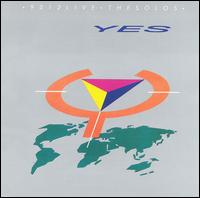
9012live - The Solos - 1984 Atlantic
4
(Bad / Mediocre)
Best song: Changes
An incoherent, useless mess. The solos work just fine within the show itself, but what a BORE when taken on their own. Tony Kaye's piece is a worthless 2-minute rendition of "Tocatta And Fugue" (and some other random wanking), Trevor Rabin's piece is pleasant but rambling, and "Soon" sounds utterly stupid in this context. Only the Squire/White showcases, the first a two-minute by-the-book rendition of "Amazing Grace" and the latter a medley of "The Fish," "Sound Chaser" and "Tempus Fugit" (with Anderson singing "Yes yes" in the right places) are at all interesting, but they're not exactly the most musically substantial thing I've ever heard.
The only saving grace of the album is that it bothers to put on a pair of actual songs from the tour, both performed adequately. "Hold On" is slightly weaker here than in the Millersville gig, but "Changes" is a bit more polished, so whatever. The album is still practically useless.
Trfesok.aol.com (12/31/05)
This "mini-album" came about as a result of a really dumb marketing move by Atlantic Records. Released at the same time was the 9012Live video. It contained excerpts from the Edmonton show, but NOT the solos. The album contains the versions of "Hold On" and "Changes" from the video, but no other actual songs!! What was the point of all that? I filled out my tape with a couple of live B-sides, "It Can Happen" and an edited "City of Love" (that one also from the video), but the CD itself only was released in Japan, and is definitely NOT worth the import price. It would be nice if Rhino/Atlantic would release instead an archive release of the complete concert, but fat chance of that!
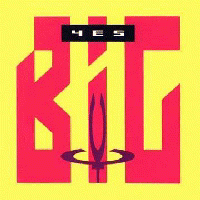
Big Generator - 1987 Atco
7
(Mediocre / Good)
Best song: The Rhythm Of Love
If you're looking for a single figure or fact to summarize everything wrong with this album, look no further than above. 90125 was by FAR Yes' best-selling album ever, naturally buoyed by the world-wide smash success of the #1 hit "Owner of a Lonely Heart." It showed a successful reinvention of the band, one that could both be mainstream and clever all at once. With another well-timed album to keep them in the public eye, the music world would be theirs (and everybody knew it) .... so why in the HELL would it take FOUR YEARS to follow up on such a huge success? Was the band just stupid or what?
Unfortunately, it's not that simple. Such a long layoff could only mean one thing - SERIOUS confusion among the ranks of the band and those associated with it (which at least partially shows itself in the liner notes, where we see just how many places the band used in recording - one should also note that some of the material on the album was recorded as early as 1984, which should say something). On the one hand: the success of "Owner" had brought with it the unfortunate expectation of future hit singles, and Trevor really had no choice but to somewhat comply with management's requests. On the other hand - while Jon had been perfectly happy to come sing the poppier stuff when the band was Cinema, this time around found the band going into the studio as Yes. Not Cinema, Yes. Jon had at least somewhat regained his desire for "artistic integrity" over the past decade or so, and while he'd been gracious enough to not demand a complete overhaul of the Rabin numbers of 90125, he was not about to yield all artistic control this time around. Add in the fact that neither were as formidable in their song-creation as before - Rabin's playing and singing had only gotten more generic, to say nothing about his songwriting, while Anderson's "artistry" had started a journey towards new-age shlock - and add in that both Squire and White had basically given up any pretense of uniqueness in their playing and approach (you would NEVER guess that this was the rhythm section of "Gates" or even "Machine Messiah"), and you have MAJOR problems.
What's amazing, then, is that the album turns out as well as it does. For all the complaining so far, only one of the eight songs is really truly bad. Then again, the band managed to go for all-out crapulence on that one song. This of course is the title track, which is everything a bad mid-80's corporate-driven "Owner"-redux should be. The verse melody is more or less ok, though not particularly inventive, and I almost enjoy the brief bridge that comes up here and there, but the rest ... wow. The rhythm guitar work (I refuse to call anything in there a riff - random "tough" sounding chords do NOT constitute a riff) is astoundingly stupid, the synth horns that pop up will drop your jaw with how out of place they seem, the chorus is enough to singlehandedly drop the rating of any album substantially, and the obligatory guitar solo doesn't come close to matching the one in "Owner."
Now the rest of the material can't help BUT be substantially better than that piece of garbage, but that doesn't mean we're looking at genius here. "Almost Like Love" is an improvement over "BG," sure, as there's an actual melodic groove going on thanks to White's generic pounding drums and Kaye's synths in the beginning, with Jon "preaching" some lyrics before the band goes back into the groove in the chorus. On the other hand, though, the song is as generic as generic can be - the lyrics are stupidly cliche, and basically the whole thing has the same corporate-feel that occupies "BG" (not to mention the AWFUL guitar solos).
Three of the others find a way to bug me significantly as well, though to lesser degrees. "Love Will Find a Way" is pretty, and more or less deserved to be a hit single, but eGADS the late-80's genericism here just oozes out. That said, I'm pretty impressed with the bridge, predictable as it may be and as dumb the lyrics may be ("I eat at Chez Nous" is the favorite to point out), so I'll save it total condemnation. Even if it's TOTALLY by-the-numbers. As for the other two songs which bug me - "Final Eyes" probably SHOULD be pretty, but if it takes me six or seven listens for anything from a song to register for me, I'm gonna start shifting blame for that from myself to the song. That said, there are some nice elements, especially in the contrast between Rabin's sung parts and a really lovely "If ever I needed someone ..." part from Anderson. And finally, Anderson gets to close out the album with "Holy Lamb (Song for Harmonic Convergence)," which has a decent, albeit rambling melody but sounds way too much like a stereotypical track from one of his solo albums (with some Rabin-by-numbers electric backing).. Grr.
Fortunately, the other three songs help things substantially - an EP of just those three tracks (and hey, it'd be 20 minutes or so, not bad) could probably squeeze out a 9 or even an A from me. The album gets off to a solid start thanks to "The Rhythm of Love" - the opening harmonies over a synth layering give a good vibe to the beginning of the album, and the poppy guitar-riff works terrifically in its simplicity. Meanwhile, Anderson sings an effective melody that more-or-less mirrors the main riff, the backing harmonies harken back to Hearts in their effectiveness, Rabin gets in a decent guitar solo, and even KAYE has a couple of energetic moments. Great!
After we follow this beauty with the horror of the title track, we come across the strange 7-minute "Shoot High, Aim Low." A few things really jumped out at me after a few listens, and really make the track worth it. First of all - this is one of the most effective uses of *space* that the band would ever pull off. The overall sound and feel of the track is HUGE, yet this is pulled off by a surprisingly minimalistic arrangement - the synths are very low-key, Squire is (as usual) subdued, Rabin only uses a few effective solos here and there, and only a slightly monotonous drum track deep in the background sticks around throughout. This minimalism in the instrumental track, however, only serves to augment the quality of the vocals on the track. The vocals in the chorus are utterly MAJESTIC, and during his part of the verses, Anderson belts out his vocals with a passion not found in a long long time.
The third interesting aspect comes from the lyrics. On first glance, they seem incredibly stupid, but further examination shows that that is only a half-truth. Pay attention seperately to the parts that Jon sings and the parts that Trevor sings, and you will realize that they are singing two DIFFERENT songs. Jon is singing an anti-war diatribe while Trevor uses his by-now ULTRA-generic vocals to sing something about a simple pleasure of life, sitting in a car on a beach with a girl. These two topics are united only by a common chorus for the first portion of the song, suggesting in some way (I guess) that both the actively passionate and the passively unaware share a common point in the outcome of universal affairs. This is also partially reinforced when Anderson unexpectedly belts out Rabin's line of "Someone shouted "OPEN THE DOOR!" LOOKOUT!", suggesting that the horrors of war have managed after all to reach the blissfully ignorant Rabin. Of course, maybe this is one of those cases of hallucinating that which isn't there, but whatever.
Finally, coming right before "Holy Lamb," we have the 8-minute "I'm Running." The opening bass riff probably isn't as intelligently crafted as some would like to think (one person on alt.music.yes said something to the effect that he's randomly plucked keys in a similar rhythm and come up with something cooler), but it still provides a neat Latin feel not commonly found on Yes albums to this point. The song gradually becomes darker, with marimbas and then subtle electric guitar replacing the opening latin jam, and Anderson gets a neat little vocal memory before the band soars into the "I'm Running" chorus. Anderson continues to get his chance to rant over some surprisingly nice piano and overall fresh-sounding instrumentation (weirdly humorous too - Rabin's guitar QUACKS at about the 2:50 mark), varying the melody here and there in such a way as to make the general feel more anthemic and epic. Eventually, the song builds from this into a vocal-harmony extravaganza, with Rabin given a chance to briefly go nuts on guitar, and after a while there can be no doubt that Anderson NAILED this when coming up with the main ideas.
Unfortunately, that's basically the exception rather than the rule. Needless to say, this album (and the whole situation, for that matter) got Anderson frustrated, and things got shaken up in the Yes world once more.
Laurent MASSE (masse.geocean.u-bordeaux.fr)
Seen from France in the middle of the 80's and after the success of 90125, Yes were part of what we called "American Rock FM" at the time, along with BonJovi, Van Halen, etc... Needless to say this did not convey a very good image, and is the likely reason why BG had good reviews in the french musical press at the time, because obviously they were much more ambitious musically. Hearing the incredibly catchy "Rhythm Of Love" on the radio and reading some of these reviews prompted me to buy the album at the time. It didn't convert me, but I found it quite enjoyable, apart from the horrible "Big Generator" and "Love Will Find A Way" which were (and still are) absolute american cliches to european ears. But honestly, I think the songwriting on this album is very good, even if not as convincing as on the previous one. "Almost Like Love", "Final Eyes" and "Holy Lamb" are anecdotic but no less than pleasant, while "Shoot High Aim Low" and "I'm Running" are really high points. This material is generally badly served by an awful production, not aging well at all, something like the worst of the 80's. The main problem with this album is that, on one hand Jon was there in the conception stage, wanted to come back to the 70s Yes canon and Trevor felt the pressure of the name as well, and on the other hand they had to capitalise on the success of 90125. The result is a difficult compromise approach and a totally schizophrenic album, as none option is fully acted upon. I really believe "Love Will Find A Way" and "I'm Running" do not belong on the same album.
Daniel and Corine Bosch (dcbosch.optusnet.com.au) (5/29/02)
Not as directionless (or as woeful) as Union, but not far off. This record bears no resemblance to Yes as I know or love them. That is not to say that there is not some good - indeed very good - music on this album, just don't go calling it Yes! And no, I am not a Rabin-hater, see my review of Talk which I feel is one of their finest. "Love Will Find A Way" and "Rhythm Of Love" are really good songs but compare them with anything from the 70s Yes or, indeed, anything off "The Ladder" or "Magnification" and you'll see what I mean.
Vandermeer (bkvander.telus.net) (8/10/03)
Definitely below average by Yes standards, but still an ok album. My biggest problem is that no song really stands out as being a Yes classic.
Having said that, no song is really that bad either. Even the title song, which seems to be commonly loathed, isn't too bad-just a pale imitation of Owner. My favourite is probably Love Will Find a Way. Rabin's guitar sound is really crisp on this track. The only other two songs that I really enjoy are Almost Like Love and I'm Running. I really get a kick out of Anderson's vocals on the former--I find it reminiscent of Circus of Heaven which I also liked. The latter also has a nice groove to it that I really enjoy. The rest is kind of mediocre. Rhythm of Love and Shoot High Aim Low seem to be most people's favourites, but I just find them ok. Same with Final Eyes and Holy Lamb.
I give Big Generator a 6 (9). It's probably the most mediocre album in their catalogue. I sort of feel about it like you felt about Rush's Hold Your Fire (although I obviously like BGmore than you liked HYF). None of the songs are bad, but presented all back to back on one album-I just don't get as much out of listening to it as most other albums. I suppose it's even more disappointing when you realize it took them four years to get it out.
Eric Benac (ebenac.nmu.edu) (1/17/05)
actually, i'd disagree and say that this album is as good as 90125. there is some creative orchestral arrangements, and vocal intros. and these songs, while mostly being pop songs, still have quite good melodies and interesting riffs. and shoot high aim low is one of the best songs trevor contributed to the group. not a high point, not a low point. simply a continuation of ideas and styles from 90125. so basically, an 8.
and i'd give talk an 8 too, even if it's better. it somehow seems wrong to give any of these albums a 9.
Trfesok.aol.com (12/31/05)
You hit the nail on the head about the length of time it took between studio albums this time around. The initial sessions in Italy were spent with Trevor Horn trying to reconcile the warring factions of Anderson, Rabin and Squire. Somehow, Horn got the blame for all of this and got fired (according to Kaye, he "wasn't the right producer" for them -- but no one would have been at that point). This resulted in the band, basically, scrapping what they had done and starting from scratch in L.A. with Rabin in charge (although they had to keep Horn listed in the credits in order to avoid lawsuits from him).
For all this turmoil, the album isn't all that bad. I don't dislike it quite as much as you do. Not a major departure from 90125, of course, except, that they seem to be more willing to work on more extended pieces. I also like "Shoot High, Aim Low" a lot, too. "Love Will Find a Way" shows the Beatles/Byrds influence in Yes resurfacing after a long absence. (It actually wasn't originally intended for Yes, but for Stevie Nicks (!), which might explain that) "Holy Lamb" has Jon trying to do a "Soon" for the 80's, but sounds rather out of place here. The title track is indeed the weakest song, showing Rabin's propensity for generic hard rock at its worst. Overall, though, it's not an uninteresting album, but, again, it still looked like a Rabin-centered sound was not totally compatible with Yes.
Pete Anderson (pete.distantearlywarning.info) (12/13/09)
Not for the first time, the second successive album by a single Yes line-up is a big (no pun intended) disappointment after the first (Tormato anyone?). Even if only the title track and maybe "Almost Like Love" are clearly bad songs, Big Generator just isn't as memorable or exciting as 90125. The production is weak and has no punch to it, a far cry from the vibrant colours of its predecessor, though that might just be because the album hasn't been remastered as of late 2009. "Rhythm of Love" indeed stands out here, though I think "Love Will Find a Way" is the album's finest moment.
Otherwise, though, I agree with the 6(9). If 90126 is what you're looking for, The Ladder is a much better bet if you ask me. However, it does feel weird giving 90125 an 8(12) and then slagging off BG, so I just might raise the grade to a low-end 7(10) if the album ever gets remastered.
"Pete Anderson" (pete.distantearlywarning.info) (01/13/10)
Further to my last: whaddaya know. There is in fact a recent remastered edition of the album, available as a (rather expensive) Japanese import. Now this is what I call a good remastering job: the sound has a real kick to it, making the "danceable" elements of the good songs stand out that much more. 7(10) it is.
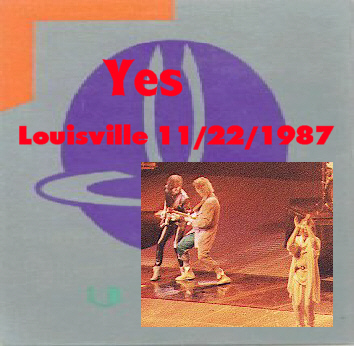
Louisville '87 - Bootleg
6
(Mediocre)
Best song: Mediocrity abounds
Ugh. UGH!! Regardless of all the nice things I have to say about this Yes lineup in my Endless Dream review, this bootleg is mediocre to the point of driving me nuts. This is a recording from the Big Generator tour, with seven of the eight songs of that album showing up here ("Final Eyes" apparently didn't make the cut). Needless to say, this does not make me jump up and down with glee. "I'm Running" is done pretty well, and Jon at least has passion in his voice when singing "Holy Lamb," but that still doesn't make it a very good song. Throw in that the only 90125 cuts found here are "Hold On" (which sounds like a ridiculous crowd pleaser in this context), and "Owner of a Lonely Heart," and you pretty much have a display of the bad sides of YesWest with few of the good.
Even the classics sound mediocre here. "Yours is No Disgrace" is made unbearable with Trevor's generic guitar parts, "Heart of the Sunrise" is extremely sloppy, and "Würm" (coming out of "And You and I") is, for the first time in the history of mankind, completely BORING. You do realize what an accomplishment that is, right? They took possibly the greatest "let's jam over this" chord sequence of all time and made the jam BORING. It doesn't help that it goes for nine minutes, either.
The saddest thing on the album, though, is Jon. Not that he sounds bad; his voice may have actually been at its peak here - higher, more angelic and more emotional than ever. But the only times that Jon sounds happy to be on stage are when he's singing the older stuff (as well as "I'm Running" and "Holy Lamb"). You can just tell that he's not putting his all into these modern songs, unlike on the Endless Dream album seven years later.
Overall, this is an interesting recording only from a historical perspective. It's interesting to hear what Yes concerts had denigrated into by that point, and helps the listener understand what precipitated the next move in Yes history ...
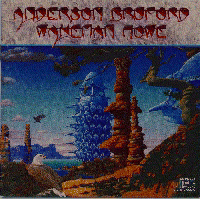
Anderson Bruford Wakeman Howe - 1989 Arista
8
(Good / Mediocre)
Best song: Birthright
This entry in my page requires a bit of explaining, as technically it is not a Yes album. You see, when the Cinema gang decided to fish the Yes moniker out of the dumpster back in '83, they figured that nobody would care. The logic behind this was that since Anderson and Squire had officially founded the group, the name was theirs to use as they pleased. Alas, this was not so. You see, the former members of Yes, who were quite numerous by now, felt that they had as much say in whether the Yes name could be revived or not as did the current members. And, for some reason or another, they felt the name should stay dead; why, I do not know for sure. Maybe there was some provision that kept them from getting their fair share of royalties in the current setup, or maybe they were just jerks. Either way, the issue of the name "Yes" began to bubble up in the early 80's, culminating in a late 80's lawsuit related to this album.
Fast forward to 1988. Anderson decided he'd pretty much had it with this incarnation of Yes, and he decided to leave the group and let it sully its reputation without him. Rumors circulated about the fate of the band, with some accounts saying the band dissolved while others said the band considered Billy Sherwood and even ex-Supertramp singer Roger Hodgson as a potential replacement. But no matter - our story now focuses on the fate of Jon Anderson.
I can only speculate, of course, but I'd imagine that Anderson badly wanted to stick it to his former Cinemates. Meanwhile, there was a bunch of disgruntled ex-Yessers, some of whom were regarded by fans as the "true" Yes. The course of action was now clear - Anderson would surround himself with as many elements of "classic" Yes as he could to drive home the point that Cinema had no business calling itself Yes. Hence, he wrote some songs himself and brought in good ole Steve Howe, Bill Bruford and Rick Wakeman to arrange his vision.
Now, the thing is that while this may (as the album makes sure to point out) be the group that brought us Close to the Edge, this album does not truly fulfil the desires many fans had for a "rebirth" of 70's Yes. Honestly, though, that is a fallacious desire in the first place - this quartet may have been 80% of the greatest Yes lineup, but the fact remained that each one of them had changed substantially since the early 70's. Put another way, assuming this group would produce CTTE II would be a lot like meeting your old friends at your 20th high school reunion and expecting your group to go partying until 5am like in the old days. People change over time, and that's a fact.
Indeed, Steve's playing didn't change THAT much (though it had certainly received an infusion of AOR during his time in Asia), but the other three had changed substantially. Anderson had begun to establish an alternate persona as a New-age solo artist, albeit with some of his former ambition. His songwriting and lyrical style had changed quite a bit from the 70's - his lyrics were less mystic and cryptic (though still not exactly straightforward) and more blatant in their attitude of hippie idealism, while musically his focus was now soft and flowing acoustic balladry (interspersed with elements of, let's face it, AOR-laced prog). Wakeman of course had established his own prolific solo career, replete with synthesizer patches that often dwarved his Yes tones in cheeziness. Finally, Bruford had undergone an almost complete revolution, mostly courtesy of his involvement with the last two incarnations of King Crimson. In particular, he had become utterly enamored with electronic percussion and creating tricky, "ethnic" polyrhythms with them. In other words, this isn't the Bruford of Siberian Khatru - this is the Bruford of, er, "Sleepless." One should also note that the band brought in Bruford's old KC-mate (and world-renowned session bassist) Tony Levin, but unfortunately he doesn't get to make much of a substantial mark on the material.
What's fascinating, then, is that despite this TOTAL lack of artistic "unity" (Anderson basically wrote the songs himself and left the others to try and make their now-disparate styles work in cohesive arrangements), this album turns out remarkably well. So well, in fact, that if weren't for a pair of utter suckjobs, I'd spend this review gushing over what a wonderful mix of (some) traditional Yes values with the updated approaches of the band this album represents. Instead, I end up assessing this album as good, not great, but definitely good.
Unfortunately, the two suckjobs are pretty much abominable. "Quartet" starts out reasonably pretty, but along with some useless female background vocals (useless because Anderson still sounds so good), it's basically annhilated by the corniness of section two, "She Gives Me Love." As if Anderson felt they somehow had to prove they were the real Yes, he decides to incorporate the names of various 70's Yes songs into the lyrics whether they actually belong or not. It's corny beyond words, and destroys the song for me. As for "Teakbois," well, it might be reasonably catchy, but Wakeman's synths basically annhilate what is Yes making a vague attempt at a piece with Jamaican rhythms. Gehn.
But elsewhere, everything works surprisingly well. The songwriting (besides the two previously mentioned tracks) is surprisingly effective (Anderson had some good songs up his sleeve after all), and the arrangements work out much better than they should in theory. They're mostly dominated by Wakeman's synths, but that's ok - while his tone choices are very arguably cheezier than anything on Tormato, he puts so much energy and verve into his playing that I can EASILY forgive any lapses in taste in sound-quality. Seriously, one could legitimately make the argument that Wakeman's playing peak with Yes came HERE, and while I wouldn't really agree, I'd definitely see the merit of such a claim. As for Steve and Bill, well, they "pick their spots" - in the moments when they're given a chance to strut their stuff without being covered by Rick, they pull out some INCREDIBLY entertaining parts, while the rest of the time they just kinda exist in the background. But again, that's ok, since Rick is just king here.
As for the songs themselves (except for, again, the two wastes mentioned earlier), they can basically be divided into three parts; pretty acoustic/piano-driven ballads a la "Time and a Word," epic pop-songs-made-into-prog pieces, and bombastic anthems. The first and third categories are represented impeccably - from the first, "The Meeting" and "Let's Pretend" each have cleverly constructed hooks that help pound Anderson's endless optimism into your head that much further.
The third also more than pulls its weight, even making sure to contribute the best track of the album, the incredibly powerful "Birthright." In this, Anderson travels back to the mid-50's, protesting nuclear testing by the British government in a remote area called Woomera. Without contacting the aboriginal people first. Doh. The lyrics work fabulously, not just for this specific context, but rather as a reminder to the listener that the suffering of one group of people is the suffering of humanity as a whole ("we are them and they are we"), and that having political power gives one no universal right to the ill-treatment or negligence towards "lesser" people. But lyrics aside, the music is benefited by a "primitive" rhythm from Bruford, some subtle acoustic from Howe (with an occasional interjection of a growling riff in the chorus), and most of all by an utterly majestic Wakeman-led onslaught during the last two minutes. Ye gawrsh, it's good. As for the other, "Fist of Fire," it's not quite as good, but it's still at least a minor highlight of the album. Anderson's vocal melody and lyrics are aggressive in a goofy, elvish sort of way, but what distinguishes the album most is the seemingly endless bursts of infinite aggressive energy coming from Wakeman's hands. Indeed, his first synth "explosion" in the song may be the most powerful highlight of the entire album.
Now, the second category can throw people a bit. Most people at least somewhat enjoy "Brother of Mine," if only because for coming so close to adult-contemporary in its feel, it still manages to have several enjoyable melody lines thrown in. In particular, the line, "Nothing can come between us, you're a brother of mine" pops into my head all the time. Yes, I do think the song is needlessly stretched out, but the overall effect is such that I can definitely tolerate it more than something like, say, "Driving the Last Spike."
As for the other two, I agree with critics that these tracks are needlessly complex and "progressive," in that they take relatively normal pop songs and sandwich them with instrumental whatever. But that doesn't mean I can't enjoy them. The opening piano tinklings in "Themes" are a beautiful way to start the album, the alternation between Wakeman and Howe in "Soul Warrior" (part iii of "Themes") is enthralling, and dang it I enjoy the middle section (even if the "I don't believe in demons, I don't believe in devils" line bugs me, if only because I can't help but think of it as a stupid filking of John Lennon's declamation in God) if only because of the drumming. Yes, the Bill Bruford of Absent Lovers fame comes alive in that section, and that's enough to pull me in. Likewise, "Order of the Universe" is kinda overblown and cheezy, with everybody going for a BIG BOMBASTIC 80'S sound, but man I like the drumming. Polyrhythmic and varied in electronic tone, with powerful *BAAAM*'s knocking you off-kilter when you aren't exactly expecting it. Bless you Bill Bruford.
And there's your album - not a comeback to the Yes of the 70's, but rather an unexpectedly enjoyable integration of the 80's should've-been-Yes members. And, unfortunately, one that couldn't exist for an extended period of time, good as the album and their live shows were.
Norbert Becker (n.k.becker.worldnet.att.net)
On your otherwise well-written, concise review of ABWH I noticed
an
error. After BG, Yes ceased to exist (until Union). They did not continue
to tour as a 4 (3-1/2 counting Tony) piece, although were tensions in the
group less they might have.
(author's note): Correction has been made.
Laurent MASSE (masse.geocean.u-bordeaux.fr)
I really doubt this was a real group effort. I've always seen it as "Classic Yes updated for the 80's through the eyes of Jon Anderson". Indeed Jon initiated the project with almost all of the songs in mind. Rick's input was apparently important, although I really have problems with his sticky greasy 80's synths (the way he totally destroys "Teakbois", now that's what I call synth-vomit!). But I always thought Steve and Bill only got to overdub the backing tracks. Anyway, the songwriting is on a high, except for the childish melodies of "Teakbois" and the ridiculously cliche mediterranean sounding "Quartet". But "Brother Of Mine", "Birthright", "The Meeting" and the b-side "Vultures In The City" are very good, while "Themes", "Fist Of Fire", "Order Of The Universe" and "Let's Pretend" are a step lower but never falling on the boring side. I remember reading a Bruford interview in which he stated that a window opened for this group somewhere in the middle of "Birthright", but that the business diktat of the time did not allow them to act upon it. Anyway, his electronic drums may not be as inventive as on the 80s King Crimson trilogy, but his onslaughts in "Second Attention" and "Order Of The Universe" really kill me everytime. How could White (as much as I like him) come up with such wicked rhythmic punctuations? Oh, and I almost forgot the high point for me: a Squireless album! Last point: although you did not mention it, "An Evening Of Yes Music Plus" is one of the most satisfying live albums to date. Highlights are the funny acoustic "Time And A Word" medley, an incredibly improved, powerful and emotional "Birthright", and the best version of "Close To The Edge" ever. I truly believe all the other Brufordless recordings of that "tune" suck.
Nick Karn (mjareviews.yahoo.com)
It's crap that Chris Squire wouldn't let the other four members of the classic lineup involved in this album use the Yes name. I mean, Floyd continued on using their name without Roger Waters, didn't they? That's A LOT more drastic of a change than this. Strange.
This album certainly isn't any less Yes-sounding than, say, Drama, but I don't really think it can be called too progressive either. Sure, "Themes" gives off that false impression as two out of three of its' sections are instrumental, but some of this stuff musically seems a lot more in the vein of an extended Genesis' epic from their late pop period ala Invisible Touch (especially "Brother Of Mine", my favorite on the album - it's nice). "Quartet" and "Order Of The Universe" just combine four short pop songs in each one into 9 minute epics (the former in a quite corny and dull fashion).
It's kinda hard to figure my overall rating here, because the best stuff is only pretty good (though in the case of "The Meeting" quite pretty if not too memorable), but other than parts of "Quartet" and most of "Teakbois", there isn't much overly lame here. A really low 6, probably.
"Sittinger, Brian D" (brian.d.sittinger.lmco.com) (8/02/01)
Well, you took just about everything I had to say out of my mouth. This album does not seem to be truly progressive at all. Even the "multisectioned" songs lack the substance to deserve those breakdowns. However, the music is mostly fine, although it is very clear that this album is deeply rooted in the 1980's. "Order of the Universe" and "Brother of Mine", though not up to the classic standards of Yes, still are quite good. All the players here have shown they have not lost anything yet, depite this being during the 1980's. But, where is Steve Howe and Bill Bruford half of the time? I'd still prefer to listen to this over 90125 any day. Finally, so what if Chris Squire was not on here anyway? Tony Levin was low in the mix!! Low 7 out of 10.
TheRubberCow.aol.com (4/19/02)
Well, I picked this album up used for $2 (on cd!), and I've only listened to it once, but you seemed to think the exact same thing I did. The title-quoting in "She Gives Me Love" is embarressingly stupid, and "Teakbois" is cheezy (I don't remember there really being bad synths, but some Jamaican guy shouting out "Teakbois!".....reminded me of an early 90's Kool-Aid commercial). But I do like what I heard this first time, and I have a feeling the album will visit my player relatively often.
Daniel and Corine Bosch (dcbosch.optusnet.com.au) (5/29/02)
The lost Yes album! Forget the name, this is more Yes than 90125, Big Generator or Union could ever be. Extended tracks, silly lyrics, Wakeman in your face - very cool! OK, "Teakbois" doesn't work, the history quoting in "She Gives Me Love" is annoying (not to mention obvious, basically saying "we really are Yes"!) but most of the reast of the album is great. Hard to pick a favourite - no, too hard!!
Vandermeer (bkvander.telus.net) (8/10/03)
This is the only Yes album that I like less now, after multiple listens, than I did when I heard it the first time. I really liked everything on this album when I first heard it, but I don't enjoy it as much anymore, and I'm not exactly sure why. I think it's mostly because the two long productions, Brother of Mine and Order of the Universe seem too long and overblown. They both have good moments of beauty especially BoM but I just don't really enjoy them all the way through. Too bad.
I will call you out for saying that Quartet and Teakbois are "utter suckjobs". Quartet is my favourite on the album with the four pieces of music blending together perfectly to make an enjoyable 9 minute song. The only real complaint about Quartet you and others seem to have is the song quoting. I don't see what the big deal is-Anderson was just making some humorous references to Yes' past. The Beatles did the same thing in Glass Onion and I didn't see any complaints about that. As for Teakbois, I enjoy the simple lyrics and feel of the song and also consider it a highlight of the album. Also very good are the opening Themes with its lovely piano at the beginning, and The Meeting with Anderson coming up with another memorable short melody. The rest of the album I can take or leave. Lots of people seem to like Birthright, but it always passes me by as being overlong and boring. Fist of Fire and Let's Pretend are also not too memorable.
I give this one a 6 (9). I feel a little guilty for not going higher, since some music is just great and nothing is horrible, but I just find it one of the hardest Yes albums to listen to from beginning to end.
Tom Burrichter (tburrichter.austin.rr.com) (4/07/04)
One thing I have noticed is that this album seems to have aged well. When it came out, the friend who turned me on to Yes back in the mid 80's ripped it apart with a long list of jabs. I was on the fence about it (comparing it to what these 4 had done in the past), but this is a really cool album and I only wish there could have been a couple more.
Tom Burrichter
Trfesok.aol.com (12/31/05)
Actually, the reason that this bunch couldn't call themselves Yes was that Squire, being the only guy who had been in all incarnations of the group, had legal control of the name. The lawsuit arose around the the billing of this tour as "An Evening of Yes Music, Plus", which Squire, surprisingly, lost.
Although this is really more Jon's A Momentary Lack of Reason than an album by another version of Yes. As with the "Pink Floyd" album, a creative force in the old group, with the help of some former members and session men, creates a solo album disguised as a group effort. While the best Yes albums had group members taking whatever raw material the guys brought in and built it up together in the studio, this time Jon took what few contributions the others made (Bruford contributed a chunk of "Birthright," for instance, and the "Long Lost Brother of Mine" section was a GTR leftover from Howe) and reshaped it according to his vision. Howe didn't even go along with the rest of the band to Montserrat for the initial sessions -- he actually overdubbed his parts later in London! It helped to have Chris Kimsey along (who had produced the two best Marillion albums with Fish, Misplaced Childhood and Clutching at Straws) to craft a pseudo-prog album. I enjoy it, but it's clear after a few listens that somewhat overdone production disguised some relatively simple music, by Yes standards, anyway. The only outright disaster is the idiotic "Teakbois," a really stupid attempt to be "ethnic." The rest of the songs are at least catchy and accessible, and the guys do get to shine once in a while. The most annoying thing about the album is that Jon did not take advantage of Tony Levin's presence -- he is basically inaudible in the mix. Still, this material really came to life on stage. However, as you know, Jon's trying to repeat this approach only could lead to disaster.
Ross Dryer (dryerross.yahoo.com) (09/13/12)
Good evening. Just a few notes (i.e., this is going to be a loooooong comment)...
Whilst I was reading your and Starostin's review of this album, I have to admit, I was intrigued. I predicted that I would absolutely loooooove the album, like most of the other Yes (and yeah, YesWest) albums. The first time I saw it at Vintage Stock, I was tempted to get it...but I didn't. However, the next time, I bought the sucker. And I started to listen to it, and... I did not like it much at all on first listen. It was very difficult to sit through, and even more difficult to play Mario Kart to (which I was attempting to do at the time). The ballads didn't strike me at all, and neither did the anthems; and the "epics", ESPECIALLY "Order of the Universe" bored me to death. Also, the synth tones Wakeman was using throughout the album were really obnoxious and ruined a whole bunch of tracks.
HOWEVER, on subsequent listens, I have decided that I was what you would call "an idiot". This album's freaking amazing for an 80s one, and I am so glad to own it.
"Themes" was one of the songs that struck me the least on the album- it just didn't seem like the proper way to open an album, aside from "Sound" (gotta love the piano tinklings on top of the swirling panning synth noise), because "Second Attention" had what sounded like a really stupid, nearly nonexistent vocal melody (and the filking of "God" is fairly obvious), and "Soul Warrior" just seemed absolutely pointless (and a lot wimpier than its title implies). However, I've decided that any flaws of the vocal melody (which I can perfectly sing along to now; it just takes some time, because it's "unorthodox") are completely made up for by the ultra-happy tinkly piano and the syncopated drumming. And "Soul Warrior"? Still seems kinda pointless, but is now ENTERTAINING, at least. Also, why is this track supposed to be one of the "proggy epics"? It's not even SIX MINUTES LONG!
"Fist of Fire" was another one- and it's still not my favorite, but the vocal melody is irresistable, and Rick is FANTASTIC on that one. 'Splodin' with energy!
"Brother of Mine" I thought was okay. I actually feel as though it could have made an INCREDIBLE album opener, and there are simply so many good melodies in "The Big Dream" and "Nothing Can Come Between Us" (not sure where the difference is)(such as "Sooooo-oo- oooo, giving all the love you have..." and "Nothing can come between us, you're a broooother of mine" and "Took me by surprise, it opened up my eyes, I can't believe we're ready to runanother, runanother, runanother"), and "Long Lost Brother of Mine"? More catchy clapalong ditties! Yay! Don't know why the track's ten minutes long, though.
"Birthright" is an absolute masterpiece. I think that's the general consensus, and it is right- even though I have absolutely nothing to do with the subject matter, I can still get the feel for the track, and yes, the lyrics are fantastic. Also, I've really got to sing along to, "This road is never lonely! To England they are tied!" and "This place, this place ain't big enough for stars and stripes". And a question- is the piece of history the song is referring to the same piece of history as "The Rabbit-Proof Fence"? Connections! And Wakeman's awesome again.
"The Meeting"...ah, that one's wonderbeautiful, to steal a made-up word from Starostin here. Man, I've got to learn to play and sing this in church sometime. It's totally memorable, it just takes a little while; once it gets to your soul, though, it'll stay.
Skipping the two "pretty much abominable" tracks for now, I'll start raving about "Order of the Universe". It's probably still my least favorite track on here, but it's certainly a lot better than I originally thought. I mean, it's got a memorable "theme" (which is played around with for like three minutes at the beginning), plus, the "Rock Gives Courage" bit's hilarious as they try to "rock" at that tempo. Also, it's got that "THE OOOOOOR-DER OOOOOOF THE UUUUUUNIVERSE!!!" bit that I love to sing along to, and there's a part in "It's So Hard to Grow" that goes, "Sick feeling, sick reasoning, sick challenge you la la la la, you can't imagine it, how hard it is to grow, you can't imagine it, YOU CAN'T IMAGINE THE OOOOOR-..." which is awesome, and the drumming in "The Universe" is simply fantastiwastic, to steal another made-up word from Starostin there.
"Let's Pretend" is just one of the best tracks on the album, probably up there with "Birthright", and while all of you critics (you, Starostin) say it reminds of "Time and a Word", I think it reminds me more of an acoustic version of "To Be Over". Yep.
Now back to those other two. "Teakbois" is objectively a smash disaster, and on first listen, it gave me two distinct impressions at once. It gave me the "OMG WHAT THE HECK IS THIS DONKEY KONG CRAP WHY ARE THE SYNTHS SO OBNOXIOUS WHY IS THIS SONG SO LONG", but it also gave me the "OMG WHAT THE HECK THIS IS SO D*** CATCHY AND HILARIOUS". I've drifted more and more to the second of those since. Really- the combination of hideous synths with Latin rhythms is so embarrassingly bad that it cracks me up, and like I said, the song is so d*** catchy. I mean it! The vocal melody in the first part of it is catchy as HECK, but the next part is even catchier! "(Bobby Dread and the kooooool run-nin'...)" I find myself singing all the time. So glad they incorporated that part into the live acoustic medley! Oh, and there's also the "This summer you couldn't get it!". I could see someone hating this, but I really really love it.
AS FOR "QUARTET". I think what you did is you let the lyrics of section two- that's right, only ONE out of FOUR sections- really get to your head and completely make your mind go into "HATE HATE HATE" mode. Really, what he's doing here is having a little nostalgic fun! Even though the lyrics of that section make negative sense, it's really cute, and it's not like it's unmelodic. Plus, there're the other sections. "I Wanna Learn"? How is that not gorgeous and totally catchy? How's it only "reasonably pretty"? Oh, right, because the lyrics of the NEXT section make references to past songs. "Who Was the First"? How is that not SO CUTE? Even though the lyrics are kinda dumb in this section also ("Baby I'm-a love you, I'm-a want you..." WTF? A Bread reference?), the melody is so attractive (and I LOVE the way "I Wanna Learn" is reincorporated) that I can forgive it of everything. But of course, it's abominable because the lyrics of the PREVIOUS section make references to past songs.
And, of course, my bet for best song on the entire album is "I'm Alive". If you haven't heard this because you've skipped the entire track every time, I suggest you go back and listen to it NOW. I swear, this is catchier than any other melodies on the album, and most of the melodies in the entire Yes catalog (I said it! I said it!). This song's gorgeous tinkly piano riff (How can't you like this if you like "Sound"? Oh, right, because the lyrics to "She Gives Me Love" make references to past songs.), along with the amazing chord sequence (So simple, so elegant...), the verses, and ESPECIALLY that chorus (BEST CHORUS EVER) really make for a freaking amazing song. However, if you don't want to listen to "She Gives Me Love" again to get to it, you can go to YouTube and search up the single version, which is just as good. It might sound a little too "generic 80s-ish", as it's arranged as a bombastic anthem, but it's not any worse. I wouldn't recommend actually watching the video, though (cringe cringe cringe). I'll give you the link (http://www.youtube.com/watch?v=jVkJRgzbyk0).
I'm not saying "Quartet" is flawless, as they probably didn't need to weave the four songs into one track (this is obvious because even though the transition between "She Gives Me Love" and "Who Was the First" is barely noticeable, as they're basically in the same groove, the other transitions don't exist at all), plus the arrangements are a bit of an issue, especially in that "She"/"Who" part. But the entire thing simply OOZES with youthful optimism (AND MELODY), which I can always enjoy. It's just so happy and pretty and sweet and cute!
Also, have you heard the bonus track/"Brother of Mine" single b-side "Vultures in the City"? It's another bombastic anthem up there, with a daaaark mood turning into a cathartic happy one. It might not be as good as "Birthright", but I at least think it's better than "Fist of Fire".
So rewrite your review, PLEASE. I'd give this at least a B (production issues, Rick's synth tones, 80s sound, but it certainly gets more than a "good, bordering on mediocre" rating), and since you said that "...If weren't for a pair of utter suckjobs, I'd spend this review gushing over what a wonderful mix of (some) traditional Yes values with the updated approaches of the band this album represents. Instead, I end up assessing this album as good, not great, but definitely good", and since I've disproved both tracks' suckiness, please, PLEASE bump up the rating.
An Evening Of Yes Music Plus - 1994 Caroline
A
(Very Good / Good)
Best song: The solo spots, especially Anderson's
An official release of a typical ABWH concert in 1989, roughly split between good-but-by-the-book renditions of Yes and ABWH numbers and beautiful-and-clever 'solo spots' and rearrangments of songs. Ironically enough, it was the presence of the latter that kept me from buying the album for so long - I could never get myself to buy a live album that had so much 'solo wanking' occupying disc 1 - but of course, they turn out to be the best part. First of all - you have GOT to hear the "Time and a Word"/"Owner of a Lonely Heart"/"Teakbois" medley at some point in your life. The way Anderson's voice and Howe's (or Anderson's? You tell me) acoustic guitar move through the three songs and make them flow seamlessly into each other, even placing the lyrics to one in the melody of another, is a royal treat to listen to, and makes the album worth while by itself.
The other spots are certainly not bad themselves, not by any means. Wakeman's pieces are entertaining as hell (remember what I said earlier about solo Wakeman being absolutely thrilling in small quantities), and one of them is even an instrumental version of "Madrigal!" Meanwhile, Howe's runthroughs of "The Clap" and "Mood for a Day" are slightly routine, but before and between them, he messes with some other pieces to alleviate any semblance of boredom. And finally, Bruford's spot, coming out of an acoustic "Long Distance Runaround," is an actually entertaining solo on his electronic drums, where he bashes around so furiously that it seems (if you've ever listened to Absent Lovers, that is) like the band's going to suddenly break into Indiscipline at any given moment. That's a big compliment, by the way.
After that, the band launches into a great version of "Birthright," with Rick's keyboards taking on an even more entertainingly epic character than before, and this is one of the few instances on the album where the "live energy vibe" pops out and shows its head. Same goes for "And You and I," which returns to the structure of the original. And then, although it was originally at the very end of the show, CD 1 closes with a wonderful "Starship Trooper" that boasts plenty of twists and turns from previous versions.
But on CD 2, aside from the fabulous "Close to the Edge" performance (the only official live recording of Bruford playing the song, btw), which has Bruford's awesome percussion brought even higher in the mix than in the studio version, thanks to the electronic drums, the vibe of "were doing something different" disappears and the vibe "we need obligatory live versions of these songs" comes in. None of the ABWH songs on this disc are bad, and "Roundabout" is "Roundabout," but then, none of the ABWH songs on here really surpass their studio counterparts, and I've heard so many versions of "Roundabout" in my life that it's hard to feel a lot of attachment to more than a couple of them. And as for "Heart of the Sunrise," well, Jeff Berlin does his best (Tony Levin was unable to play this show, so Berlin filled in), and he doesn't actually flub any notes, but he's just playing notes as opposed to messing with the rhythms slightly and throwing in random stacattos and legattos like Squire does. As a result, the rest of the band is mixed much higher than normal, and quite honestly, "Heart of the Sunrise" sounds friggin' weird with the bass as the lowest instrument in the mix.
So all in all, this is a good album. If it weren't for the fact that it has neither "The Meeting" nor "Let's Pretend," I'd say to ignore ABWH and just get this, but alas, those are good songs, so I can't say that. But as much as I'd like to give this a higher grade, I just can't. Sorry.
PS: There was eventually a re-release of the album that moved "Starship Trooper" to the end of CD 2, where it happened in the show, and ends CD 1 with a rousing "I've Seen All Good People" (which actually sounds more inventive than I can remember any other live version I can remember).
"Riley, Matt" (matt_riley.saleslink.com) (5/31/03)
The acoustic guitar that accompanied Jon's solo medley in the beginning of the show was played by one of the 2 sidemen that played on the tour (1 keyboardist, 1 guitarist), either Milton McDonald or Julian Cobeck I believe.
Trfesok.aol.com (12/31/04)
I had front row seats to a show on this tour, so I'm a bit biased, but out of the four lineups of Yes that I've seen, this was the best. Even without Squire. On the album, Jeff Berlin fills in adequately. But, visually, the show was probably lacking a bit without Tony Levin, who was quite a performer.
The solo bits were indeed a bit surprising, with guitarist Milt McDonald and Julian Colbeck on keyboards accompanying Anderson on the opening medley -- which lead to a bit of confusion until Howe and Wakeman came out later! The song lineup accurately reflects the show, except Anderson and Wakeman also played "The Meeting" at the show I saw. (Jon said that the song was actually "about us all getting back together," even though only the two of them played it!). The material from the ABWH studio album actually sounds better to me here, more stripped down and energetic and less contrived. "Close to the Edge" and "Starship Trooper" are superb performances. Yessongs may have the edge over this in terms of raw energy, but for solid, highly professional musicianship and excellent live sound quality, this is the place to go for live Yes.
Bob
Michael Charlton (mj.charlton.gmail.com) (08/13/14)
I actually saw the opening night of the UK tour at Whitley Bay Ice Rink and had heard that Tony Levin was floored with hepatitis at the time.... Really worried me, as Levin was one of the main reasons I wanted to see it.
Anyway, come the night of the concert, I get there for doors opening, run to the front and set myself up near the keyboard rig.... At that point I realise there is a Chapman Stick there near the bass rig and the famous white silhouette bass with Levin's profile is there to.... That means Tony Levin is playing!
By jingo he was amazing.... He owned everything he played and even though he's a "session player", he's pretty much the most recognisable one out the for his playing style.
I've never forgotten that gig and it cemented my opinion of Tony Levin as one of the greatest players ever of his chosen instrument.
Yesyears - 1991 Atco
8
(Good / Mediocre)
Best song: Oh bite me...
I really don't like reviewing boxsets like this. This is a classic example of a "schizophrenic" boxset - on the one hand, it's packed with songs that fans already have on regular studio albums (which sorta makes it a compilation, I guess), which can in theory make it alright for newcomers. On the other hand, it has several tracks that can't be found elsewhere, making much of it interesting for band historians but only marginally relevant for the inexperienced fan. This very conflict makes coming up with an accurate rating for the set as a whole utterly impossible, and the 8 above may just as well be a 6 or a C.
First of all - as a compilation, I would not even consider recommending this boxset. Not just for reasons of spite, mind you, but rather the fact that the two disc Yesstory, released a year later, fills the multi-disc compilation void for the band rather nicely. It leaves out any whiff of Drama, but considering that it manages to fit on "Close to the Edge" AND "Ritual" and three epics from TYA, it's a pretty decent buy. Plus, it has the two rarities that are REALLY worth everybody's time and money (but that's for later). Plus, it doesn't have such a whackily distorted allocation of tracks as on here - FIVE tracks from Time and a Word but only two from the debut??? Wow ...
So that leaves the unreleased stuff (and quite frankly, my advice is to somehow compile yourself a two-CD "rarities" collection from this collection and then sell the rest). It disappoints me heavily to say this, but the unreleased material, particularly in the last couple of discs, almost uniformly stinks. There are three Rabin-era live cuts, which wouldn't be so bad except for the fact that they're from the BG tour. "Changes" is done decently enough, but "Heart of the Sunrise" and "And You And I" ... words fail me. "Heart of the Sunrise" is marred just by being sloppy, while "AYAI" is utterly massacred thanks to unnecessarily cheezily generic synths, GENERIC AS HELL "heavenly" guitar soloing and a pounding drum beat that utterly does not belong. A jaw-dropping failure this is, and I can only be grateful that the reinvention on the Talk tour came across so much better.
The other outtakes from around this time don't do much to impress either. Some of them come from the Rabin years; one of them, "Love Conquers All," is boringly generic, but it's still an interesting historical footnote (it was written with an outside collaborator and doesn't feature Jon's vocals). On the other hand, we get a glimpse at the pre-Anderson Cinema, and if what we have here is any indication, it might not have been that great a success without Anderson coming on board. "Make it Easy" has a neat intro (which would make it into many concerts as the prelude to "Owner"), but the actual song can go to hell as far as I'm concerned (well, sort of - the verses suck mightily, but the chorus grew on me plenty). One also gets an early version of "It Can Happen," with Chris on lead vocals, that lacks the electric sitar and halfway decent lyrics that would make the later version so captivating. The cool chorus is already in place, though, so that makes it somewhat bearable.
Now what comes on disc three, the ending days of the "glory days," is what really disappoints the hell out of me. First of all, I am utterly perplexed that the band didn't see fit to include studio versions of "Go Through This" and "We Can Fly From Here," outtakes from the Drama sessions that made it into their live set. And yet, the band included "Run With the Fox," an alright "Christmas" single that wasn't even released under the banner of Yes - it was a Squire/White independent collaboration after the band's breakup.
But never mind that - why are there so many outtakes from the TORMATO sessions????!!! I enjoy the band's live cover of "I'm Down" from around this time, sure, but the studio stuff is just time taken from my life I wish I had back. "Money" is funny in its own right, with the BBC broadcast voice in the background, and it would have actually been a highlight on Tormato, but that's not exactly saying much. The band includes a nice instrumental piece from the GFTO sessions ("Montreaux's Theme"), that's nice and atmospheric with some subtle yet still trademark Howe soloing, but they bookend it with the two-part "Vevey," which has no thematic development whatsoever and sounds like an outtake from a Wakeman solo album (though it could have worked well as the midsection of another piece, I'll give it that). And, er, aren't ballads like "Abilene" supposed to actually be MEMORABLE??
On the plus side - aside from the dispensable single version of "Soon" and Squire's two-minute rendition of "Amazing Grace," the rest is quite enjoyable. The main attractions are (a) a four minute single version of the band's ten-minute cover of Paul Simon's "America" (one can actually tell this is a bit of a hack job, but it's still funny), (b) a studio version of the band's HILARIOUS cover of "Something's Coming" (only available otherwise on the BBC Sessions, at least before Yes was remastered and reissued) and (c) cleaned-up, well-produced renditions of "Then" and "Everydays" from those same BBC Sessions. If the sound quality of that collection gave you a headache, then this is your best bet to catch the early version of the band in its live glory.
Gah, and that's it. What a bloated behemoth this is (though I guess some would argue that that matches up with the character of the band, blah blah blah).
Trfesok.aol.com (12/02/07)
This thing has gone out of print (replaced with another boxset with a different set of rarities), and it's probably just as well. I agree, for a hardcore fan, it was pretty much a disappointment as far as rarities were concerned. Most of the studio rarities have now been added as bonus tracks to the remastered albums, with the exception of "Love Conquers All". By, the way, this is not "the only officially available track from the post-Anderson post-BG time period" -- it was actually recorded at the same time as the YesWest tracks on Union, but never made it to the stage where Anderson overdubbed vocals. Rabin's voice sounds too strained here -- the version on the Squire/Sherwood album Conspiracy sounds better, with Billy Sherwood's lead vocal fitting more comfortably in the song's key. The Cinema tracks are a letdown, too -- the recording quality makes it clear that these are demos. "Make it Easy" sounds like typical 80's rock, and "It Can Happen" proves that Anderson's vocal and lyrical quirks (Squire's verse lyrics are quite trite) were needed to make 90125 work as Yes album.
As for the live stuff, I would have preferred another BBC cut than "Everydays", but "Then" definitely proves that the orchestra was quite unnecessary on the second album. "I'm Down" is not from the Tormato tour -- it has Moraz on keyboards. Fun, and lightweight, especially considering that the band was performing its heaviest material during this period. Anderson's voice is surprisingly gruff, here, for him. As for the last three songs, looks like I didn't miss much. "Changes" feels like a ripoff, since an almost identical version appears on 9012Live. As for the classic songs -- I agree that "generic" is the word. In particular. I remember "And You and I" being a big highlight on the 90125 tour, but here, it sound like a Yes cover band fronted by Anderson.
The booklet is nicely packaged, but you'd never know there were any conflicts within the group from the lovey-dovey essay. Overall though, it's not now worth paying collector prices for this set just to get the booklet and a few lost tracks of less than stellar quality.
Union - 1991 Arista
3
(Bad)
Best song: Masquerade
Absolutely awful, that's what this one is. The thing is, though, while the band should certainly receive a good portion of the blame for allowing themselves to be pushed around and snookered into this, the degree to which this album sucks is really not their fault. I'm not saying that this album would have been a masterpiece otherwise, but I'm quite sure it would've been much better than what we got.
Let me explain. ABWH was deemed sufficiently successful to warrant a sequel, and so the quartet went into the studio to try and hack out some new material. Now, supposedly, the band actually did have quality material at its ready - the demos for this second ABWH album are often found in the collections of Yes-collectors (though not in mine, alas), and supposedly they're not half-bad (if you more or less liked ABWH, that is). But for some reason, almost none of the songs from this demo made it onto the album ...
But I digress. As the band assembled its songs, it realized that they had one problem - none of the songs were going to in any way function as potential radio-friendly hits. Given that even ABWH had had "Brother of Mine" as a minor hit, this was not something that Yes/whatever was really used to in recent years, and they panicked. Well, YesWest and Trevor Rabin were currently out of work, so ABWH accurately deduced that Rabin would be willing to write them something catchy to help them out (yeah, ABWH had kinda screwed Rabin out of work, but I'm somehow doubting that sales from Rabin's solo album were putting food on his table). So he sent three demos to ABWH's record company, Arista, and said to pick one. Well, Arista liked them all - a fact that is innoccuous on its own but set off a catastrophic chain of events that led to, well, this album.
See, the record executives noticed that there were currently two "factions" of the same band, and instead of seeing this in terms of the artistic separation that it really was, they only saw this as potential Yes-related profits getting sucked down the drain. So they took the course of action that seemed most logical to them, since songs from YesWest were going to be on the ABWH album anyway - combine the two factions into one 8-man Yes. Not that all eight members play on any one of the tracks, of course - Anderson sings on the YesWest tracks, and Squire contributes backing vocals to some of the ABWH tracks, but that's as much "unity" as one can find here.
But that in itself is not responsible for the utter disaster that is this album. On the one hand, the four YesWest tracks - as good or as bad as they may be - at least represent the honest product of YesWest. Not so with ABWH, and for that we can thank company-appointed producer Jonathan Elias. To say that he singehandedly butchered this album would be the understatement of the millenium - it is OBVIOUS that he hadn't the slightest idea of what any Yes album sounded like (barring maybe 90125 and BG, though even that's doubtful), and his cluelessness messed things up to a degree that could only be matched by Dilbert's boss. If you examine the liner notes, you will notice that (except for the concluding "Take The Water To The Mountain," and the Levin/Bruford collaboration "Evensong"), Elias gets writing credits for all the ABWH tracks. By all accounts, this was not some act of gratitude on the part of the band members. On the contrary, Elias took complete liberty to take the ideas submitted by the band and rework and "modernize" them into oblivion. Within a very short period of time, all creative freedom within the band had been extinguished - Steve and Bill would come in when Jonathan told them to, play what he wanted them to, and leave disgruntled.
And even worse, if Jonathan wasn't satisfied with what he heard from the players, he freely brought in session musicians - his friends, and in some cases himself - to replace the parts. Most of the guitar parts are supposedly played by Steve (though only a scant few bear the stylistic markings indicating they were conceived by him), except for on "Dangerous" (starring some talentless wanker named Jimmy Haun), but Bill Bruford is supplemented by studio drummers (BILL FREAKING BRUFORD REPLACED BY STUDIO DRUMMERS), and Rick ... Jonathan must have REALLY hated the "non-commerical" sounds of Rick, because there are - brace yourself - ELEVEN SESSION KEYBOARDISTS on this album. There's a reason that Rick Wakeman has freely referred to this album as Onion - he says he cannot hear ANY of his parts on the album, and I believe him.
(It should be noted, though, that Elias' version of the story is that (a) Howe didn't show much interest in playing anything interesting and (b) Wakeman had no interest in playing anything that wasn't on his newfangled synths. He basically said that, if there weren't session musicians, the music wouldn't have gotten made, and there's probably truth to that.)
So what do we get out of all this carnage? Some decency in a sea of corporate-driven BS. The highlight of the album ultimately turns out to be a pleasant acoustic instrumental chipped in by Steve, entitled "Masquerade." It hardly stands up to "Clap" or "Mood for a Day," and actually sounds a bit like John Denver in bits, but it's still an incredible breath of fresh air from the rest of the album. On a related note, the aforementioned Bruford/Levin collaboration "Evensong" is unfortunately brief, but still shows a semblance of actual music, which differentiates it from most of the rest of the album.
Elsewhere, the only complete song that ends up pleasing me is, naturally, a Rabin number. "Lift Me Up" is generic, of course, but so help me it's actually catchy and uplifting and makes me want to keep it singing it after it's done. Just a good ole' fashioned pop-single (with some stupid obligatory heaviness that doesn't actually mar the song after all) that would've been a highlight on 90125. But to be fair, there are bits and pieces of other songs that I can almost enjoy. The first part of "Without Hope You Cannot Start The Day" (before it becomes stupidly generic after a minute-and-a-half) is pretty, and the closing "Take the Water to the Mountain" is cute and harmless (it would've been filler on any other Yes album, but it seems ok here). And ... er, ok, I like the introduction to "Miracle of Life," and the Squire/Billy Sherwood collaboration ("The More We Live - Let Go") manages to have a surprising amount of power in its overly mellow, slightly directionless delivery. And .... ..... ok, the opening "I Would Have Waited Forever" has its moments, even though the mid-section really seems like an inferior rewrite of "Order of the Universe."
But the negatives ... oy. OY. This album contains the three worst songs in the Yes catalogue, and several others are jockeying for the other positions in the list. "Angkor Wat" is brain-sucking, melodyless MUSH that accomplishes nothing but making you long for the sweet release of death, but instead it brings further pain with some woman reciting Cambodian poetry at the end. But even that seems like a masterpiece compared to what follows, the beyond abominable "Dangerous (Look in the Light of blah blah blah)." The one good thing I can say about it is that it features the most distinctively Levin-esque bass of his tenure with ABWH, but it's still hardly one of his best bass performances. Going so far as to feature a generic hip-hop beat in the middle, it's a sort of generic heavy-metal piece that has nothing to do with Yes and basically encapsulates every bad aspect of early 90's corporate songwriting.
Oh, and the third bad song is a generic reggae piece, the Rabin-penned "Saving My Heart." Yes would try reggae again later in their career to better effect, but for now this is just a head-smashing disaster. And before I go, let me remind you that "Shock to the System" is a LAME generic hard-rock tune, and if Steve wrote that riff I'll eat my keyboard. The others aren't even worth mentioning.
So basically, this is an encapsulation of everything that can possibly go wrong when record executives become overly involved in the music side of things. I almost considered giving the album a 4, but the fact is that this album just sucks out your will to live. In other words, I may put this CD in my player to hear "Lift Me Up" and "Masquerade" (and maybe "The More We Live") again, but there is NO WAY IN HELL that I will ever listen to this straight through again. What a shame.
Laurent MASSE (masse.geocean.u-bordeaux.fr)
"Masquerade" should have been the title as it is an accurate description of the content. Not as lame as "Open Your Eyes", but very close. Both albums have a lot of things in common: underinspired, overproduced contractual obligations to support a "back to classics" tour. All those who participated were not interested at all and let the management decide how to finish it because they were contractually locked. Bruford's interviews are particularly telling. During the sessions, he was told when to come, what to play, and did not have the choice. He knew before the tour he would leave as soon as possible. I suspect Steve felt the same. And that ridiculous story in the booklet! The material is indeed incredibly lame. The opening chorus to "I Would Have Waited Forever" is decent, but the song quickly drowns in a swamp of lame melodies on pointless greasy arrangements which are the norm all along. "Shock To The System", Without Hope", "Miracle Of Life", "Silent Talking", "Dangerous", "Holding On", "Take The Water" and "Give And Take" give you the impression they just rearranged the same lame song as many times as needed to fill an album. Actually, "Shock To The System" reminds me of Scorpions more than anything else! In the middle of this, the ridiculous "Angkor Wat" even manages to sound like an interesting diversion! The other songs? Even the ones which sound decent and acceptable ("Lift Me Up", "Saving My Heart", "The More We Live") are not particularly uplifting or convincing. The best part of the album is by far the small interludes "Masquerade" and "Evensong". If you liked the latter, it appears in a much longer and satisfying form under the title "Jewels" on Levin's 1995 solo album "World Diary".
Robert Grazer (xeernoflax.jack-the-ripper.com)
Oh boy. This is not the worst album ever made. It is probably Yes's worst though. A few points to consider.
1. This is not Yes. Yeah It's got the members, the cover and the name, but it doesn't sound a thing like them. I mean "Shock to the System" is done by the same band that did "Starship Trooper?" I don't think so.
2. It's OK for a band to make an album that isn't their normal style...sometimes. I mean, I can think of several metal bands that released non-metal albums just for the fun of it and get bashed by close-minded fans when the music on the rather experimental releases is not really all that bad.
3. This album isn't THAT bad. Yeah no song on here could even fream of holding a candle to a song even half as good as "The Ancient," but it is passable, espescially compared to other 1991 "classics" like Nirvana's Nevermind.
BEST TRACK: "Masquerade" is a nice guitar instrumental that is the only track on this album that has a hint of the old stuff in it. I still prefer "Mood for a Day" and "The Clap" anyday.
RATING: My Scale: *** John McFerrin's Scale: 6(9)
Terry Shea (sheaterry.earthlink.net)
As bad as this album is by Yes standards, it's still probably better than almost anything else that came out in the 80's or 90's. I think it starts off allright, but the album pretty much dies after Lift Me Up. I don't care for any of the other Yeswest tunes on Union and Howe and Wakeman played very little if at all on this album. The record company wanted it done immediately and used session musicians when Howe and Wakeman were'nt available.
Philip Maddox (slurmsmckenzie.hotmail.com)
Ah, Union, everybody's least favorite Yes album, including mine. More Yes members, more songs, and yet less actual Yes than on any other Yes album. I don't think it's quite as bad as a 2, though - if we ignore the politcal BS that plagued the album, the studio musicians, and the totally completely misleading packaging and hype, what we're left with is... a boring AOR album with a couple of good tunes on it.
I actually like 2 songs here a lot - "Lift Me Up" and "Miracle Of Life" are both great songs - very pretty and uplifting. The chorus to the former is breathtaking - unbelievably pretty. Worth buying this album for a dollar if you see it for those 2 songs alone. Steve's guitar solo is nice, too. It would be filler anywhere else, but here it blows most of the competition clean out of the water. A couple of the other songs aren't too bad, either - "I Would Have Waited Forever" and "Without Hope You Cannot Start The Day" aren't all that good, but they're at least decent, and I get the desire to hear them every now and then.
Most of the rest absolutely sucks, though, especially the vomit-inducing pseudo-reggae adult contemporary of "Saving My Heart". "Angkor Wat" might be even worse, though - no melody at all, just aimless boring pretentiousness. It's painfully obvious that no one was interested - there's a lot of studio musicians, and the parts that ARE played by the actual Yes don't sound any different (I can't even tell the difference!). Where's Bruford's tricky drumming? Where's Squires booming bass? Where's the good music? This could have been a nifty little EP, but at 65 minutes, it's about 45 minutes too long. I'd give it a VERY, VERY low 4. I'd give it a 3, but I'm boosting it a bit for the fact that most of this album is listenable, if not exactly good. I'm glad that YesWest was able to pull an album as strong as Talk out of this mess.
"Poschmann, Steve" (Steve.Poschmann.fmr.com) (11/25/01)
Thanks for you interesting web site with Yes album reviews. Just some background on my Yes experience before I comment on your review of Union. Back around 1980 when I was 15, I bought the Yessongs record because I liked the cover, having never heard anything from it. I grew to love the album. (By the way I never noticed the muddy production...but as a rule I don't care for live albums very much due to the production value that live albums typically lack.) (Also, the drum solo, by Bruford, to me shows why he is considered the best Yes drummer.) I also bought Drama soon after because it was in the cut-out bin and I appreciated the "new wave" take on Yes (influenced by Downes and Horn). Later, I liked the 90215 radio tracks for reasons different than why I liked their earlier stuff, but I never owned any of the YesWest albums (until Union). Just wanted to let you know where I'm coming from.
Now, regarding Union. First, I kind of liked many of the songs on the album. Maybe it was because I bought it used on a whim and had very low expectations. I feel that two of the YesWest contributions -- 'Lift Me Up' and 'Saving My Heart' -- have nice melodies and are comparable to the better songs from 90215 or Big Generator...and I thought a couple of the ABWH lineup's songs were very good at best. Apparently, I'm in a minority. That's fine...I can deal with that. Its not a big deal.
Here are some questions that arose to me in listening to the cd recently and reading the liner notes: (some you touched on)
- Sometimes, I could not tell who played what instruments at what times. There so are MANY session musicians listed! I could tell Rabin and Howe's guitars usually, but how much did Wakeman actually play on the album?
- Why isn't Levin considered a member of the band? I guess they were pushing for the ABWH + YesWest theme, but Levin's name deserved to be in there as much as the others. Other short-lived memberships have been listed as members earlier and subsequent albums.
- Why do the liner notes make such a big deal about Chris Squire's vocals being added to the ABWH tracks of Union? I didn't realize Squire had such distinctive vocals. Wouldn't it have been more appropriate to have added Rabin's vocals to the ABWH tracks? His backing vocals contrast Anderson's in a nice way...and he is known to be a decent backing vocalist, no? And it doesn't even say "backing vocals" of Squires were added. It says "vocals". Is Squire a lead vocalist at all? Very confusing.
Daniel and Corine Bosch (dcbosch.optusnet.com.au) (5/15/02)
How horrid! To call this disorganised, overproduced, under-written mismatch "Union" - they should be sued for false advertising!! I can't think of one major redeeming feature of this album, even so the worst thing Yes may record is better than many bands' brightest moments
bsitting.mail.math.ucsb.edu (8/20/02)
Aargh! Where do I start? Well, when I was still at SCU, for some reason a friend gave this to me for free (Supposedly, she had an extra copy). I listened to a small portion of it. That was over a year ago. Finally, I brought it out again yesterday night, vowing to listen to it all. Needless to say, after I had enough with some of the songs (esp., the second half), I skipped on into the next ones.
Why? First, the songs themselves are not inherently the worst things I've heard in my life. BUT, after "Lift Me Up" or so, the songs just numb the living daylights out of me! It has to be the genericism. I can't explain it any other way. "I Could Have Waited Forever" is the 'catchiest' out of the bunch, but even this one rambles a bit unnecessarily (repetition/solo breaks). And, of course, "Masquerade" is the most pleasant song present. I can hardly remember how the others go... . This album can get no more than 4 out of 10 from me.
Vandermeer (bkvander.telus.net) (8/10/03)
Ok, here's where I'm going to have to disagree with just about everyone. I love Union! Since you and almost everyone else take great pleasure in dumping crap all over the album, it's time someone comes out to defend it.
The person most responsible for my love of the album would be Trevor Rabin. The three songs he contributed are all fantastic, definitely the best he had written for Yes up to that point, and the three best on the album. My favourite is Miracle of Life with its killer intro and boisterous, catchy chorus always putting a smile on my face. The oft maligned Saving My Heart has an infectious opening riff and beautiful sing-a-long chorus-I don't know why you and so many others hate it. And of course Lift Me Up is one song even the Union bashers seem to like. It's also full of energy and catchy hooks. The last YesWest contribution The More We Live is ok, but is one of the weaker tracks on the album.
As for the ABWH stuff, well there is some good stuff and some unmemorable tracks. Angkor Wat might be my least favourite Yes song, going over five minutes with no discernable melody. Without Hope You Cannot Start the Day is also kind of blah-I can never really remember anything about it. The others are ok to good. Masquerade is a nice interlude from Howe, but certainly less memorable than his other solo Yes pieces. I Would Have Waited Forever has a nice groove and is probably the best of the ABWH tracks here. Shock to the System rocks pretty good and has a nice middle interlude. Silent Talking is kind of boring to start but has a nice melodic finish. Holding On is enjoyable as well, although certainly no classic. Finally Dangerous, Evensong, and Take the Water are all short and fun, even if they don't stick with you afterwards. The weakness in some of the ABWH stuff brings down the album a bit, but the Rabin stuff is so good, I can't help but give it an overall 8 (11).
Believe it or not, after I read some of the scathing reviews you and some others wrote about Union, I actually tried to hate it! Since this was the first new Yes album I heard after getting into them, I thought maybe I was slightly biased towards it. After all, everyone loathed it so much, I figured there must be something wrong with me for liking it. But I've listened to it repeatedly and I still love it! I know all the back history about the production woes and the forced union of the two factions, but that just makes me think how much better this album might have been. It doesn't take away from how good it is.
Trfesok.aol.com (12/31/05)
As with all things, there are two sides of the story of this debacle. According to Elias, by this point Howe and Wakeman were so burned out that it was like pulling teeth to get them to write or play anything useable. Which is why his name appears so much in the credits -- he and Anderson had to take whatever scraps they could get and turn them into songs. To make matters worse, Howe's parts were so bland that that Arista demanded that they be redone. That's when Anderson and Elias absconded with the tapes to California to begin the work with session men. According to Jimmy Haun, (excluding the pretty "Masquerade"), Howe plays for a grand total of less than 5 minutes on the album when you add it all up -- he replaced everything else. Finally, Arista told him that he had to somehow sound like Howe and Rabin at the same time, which explains the hard rock horror of "Shock to the System" (even Rabin hated playing that one live) and another "Owner of a Lonely Heart" clone, "Dangerous."
While the ABWH album was a reasonable facsimile of a Yes album, "their" stuff here sounds like a pale shadow of Yes. It's like (and effectively is, I guess) an album played by a band of ghosts -- no power or oomph at all. The songwriting is either really dull ("Take the Water to the Mountain," "Angkor Wat," "Without Hope..") or melodically disorganized ("I Would Have Waited Forever," "Dangerous"). The catchiest and most coherent of the "ABWH" tunes, a simple rocker called "Give and Take," was actually relegated to the B-side of "Lift Me Up." This stuff actually sounds worse the more times that you play it (especially "Shock to the System" -- that is just a really stupid song).
It's amazing that the YesWest stuff sounds so much better. The multipart "Miracle of Life" actually sounds more like classic Yes than the ABWH mess, and the complex intro and outro to "Lift Me Up" is a very Yessish touch bracketing a nice folk-rock tune. Although simple, "The More We Live" also captures the meditative feel of some of early Yes. Although Rabin later regretted letting Anderson talk him into including "Saving My Heart," it's at least not as dumb as "Teakbois." However, it's telling that none of the songs (nor "Love Conquers All," retained from these sessions by Atlantic as part of the deal getting YesWest out of its contract and on to Arista) sound like each other in the least. This indicates YesWest was as confused and directionless as ABWH, if more competent. It's a good thing the tour happened, or Yes probably would have not survived this jumbled fiasco.
Close To VIII Progressors - Bootleg
9
(Good)
Best song: Awaken
Wow, what a horrible bootleg name ... Union may have been an abominable album, but the ensuing tour was surprisingly successful. This recording of the final show of the US leg of the tour doesn't completely demonstrate this fact, but it still contains enough firey performances to give at least some creedence to this suggestion. The recording can't help but be hampered by the fact that it's in support of such weak material ("Lift Me Up" is good, but including both "Shock to the System" AND "Saving My Heart" doesn't make me smile), which in turn caused much of the rest to take on the nature of a "greatest hits" tour (augmented by a lot of solos), but it's still a decent listen.
That it's decent, though, doesn't necessarily make it a cohesive listen. The biggest issue throughout, as you might imagine, is the way Howe and Rabin often make the concert into a sort of territorial pissing match. No track better illustrates this, in my opinion, than the opening "Yours is No Disgrace," where the mid-song 'jam' section reminds me of two little kids fighting each other for a fire truck on Christmas day (like my brother and I once upon a time, hehe). Howe does his thing, throwing in a nice jazzy solo with prog leanings (as he is wont to do), but when he finishes his part and you expect the midsection jam to end, it starts again with Rabin doing HIS thing! Of course, I simply do not care for what Rabin does here - he plays fast and loud and all that, but I really CANNOT tell what would make this better than some average hair-metal guitarist's speedwankery. The overall effect might have been nice if I saw it live, but here it just seems kinda silly.
Anyway, speaking of solos, it's my opinion that they really take too much time out of the concert with these solos. BOTH guitarists get to have their solo spots, and while "Clap" is still as great as ever, Solly's Beard still rambles like nothing else, and it would have been nice to stick in another song here. Also, both Squire and Wakeman get lengthy solo spots, and they really don't do anything here that they hadn't shown in years past. I DO find it a nice touch that Anderson sings the lyrics over Chris' rendition of "Amazing Grace," but other than that, ehn. This said, though, I will give the band credit - they could have given Tony solo time, and that would have made the peformance that much more tedious, but they didn't, so whatever.
Not all the solos, though, make things worse. The band takes the opportunity to do "Rhythm of Love" and "Owner of a Lonely Heart," and both are made into fine renditions courtesy of GREAT Wakeman solos at the end. Seriously, it might surprise you at first that Wakeman would have such fun playing YesWest material, but for all his pomp and pretense, Rick has always demonstrated a preference for playing more energetic and upbeat and rawkin' material, so the surprise is tempered at least somewhat. Oh sure, his keyboard tone is kinda cheezy, but it's a fun kind of cheese, and the energy level is enough to make things extremely engaging.
The utter pinnacle of the show, though, comes when the band comes together, puts its collective egos away, and pulls off a stunning 8-man rendition of "Awaken." Rabin mostly uses his guitar for atmospheric effect, not as a competitor of Steve, Tony provides low-key ballast for Rick's parts (though with some of the solos handed to him), and Bill and Alan give a subtle boost in the activity of the percussion without making the piece turn cacophonous. Indeed, Bill's electronic drums give the piece an interesting mood and extra dose of intensity, and while he might not really make a sizable impact in the rest of the concert, he certainly does here.
Otherwise, though, the concert is pretty much what you'd expect. I would say, though, that it highly disappoints me to hear Bill do so little overall - perhaps he'd cared at the beginning of the tour, but it was obvious by this time that he just wanted his paycheck so he could afford to do jazz. Oh well. 'Tis pretty enjoyable anyway.
Trfesok.aol.com (04/29/08)
I actually don't have this particular bootleg, but I do have excerpts from the tour. Parts of the second show at Wembley in London were broadcast on a US radio special, while songs from two German shows show up on a pretty good bootleg called Around the World in 80 Dates. From what I've been told, the show was very exciting to actually see, but seems to lose something in translation to audio only. It sounds like the full eight man lineup doesn't appear on all the "group" numbers, such as "Changes" or "And You and I", even if they do. The solos are pretty much a waste of time, except I do think that Rabin (?) adding those countryish electric licks to Rick's ..Six Wives.. solo is amusing. The "Owner.." and "Rhythm of Love", I agree, are also highlights, thanks to Rick, even if his choice of synth tones on his solos is disturbingly Tormato-esque. Also in agreement about "Awaken". I'm not a huge fan of the song, but this version is definitely the best sounding and performed of the versions that I have. Still, it seems to me that the tour could have been better. Guess I'll have to hunt down a DVD to make sure.
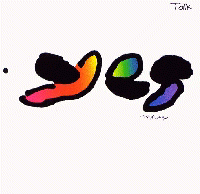
Talk - 1994 Victory
9
(Good)
Best song: The Calling
After the complete and utter disaster of Union, it's understandable that the band took a couple of years off to try and regain some semblance of direction in its sound. Bill Bruford took his paycheck and bolted, never to return, while Steve Howe (supposedly) was becoming enough of an irritant to other band members that he was paid to go away and leave Yes alone. Rabin and Wakeman actually became good friends on the Union tour (it's obvious that Wakeman enjoyed playing YesWest material, as evidenced by recordings from that tour), and there were rumors of both Rabin and Wakeman working together on the next Yes album. But alas, it was not to be. A new record label, Victory, had recently opened for business under the ownership of an associate of Yes, and offered Yes a recording contract on certain grounds. These grounds were (a) that they use the 90125 lineup (so no Wakeman) and that (b) Trevor Rabin produce. It might not have been the direction fans wanted, but it was a direction, and that was good enough for the band.
Now, as a result of this condition, many fans automatically dismiss this album as a Rabin solo-project with only marginal input from Anderson. I fell into this trap once, but actual historical fact shows something substantially different. Fact is, with Rabin in control, he was free from any outside pressures to produce Owner-like hit singles, and this meant he could freely collaborate with Anderson without looking over his shoulder for the disapproval of record executives. The result, then, is that Anderson has FAR more input on this album than on any other YesWest record, and the focused vision of Jon and Trevor produced results that proved that Union was merely an unfortunate fluke. For the first time, Rabin was free to try and help create a Yes album, and in many ways he succeeded. The songwriting is very strong, the instrumental parts are powerful without sounding stupidly generic (like on much of BG), there's a good dose of atmospherics, and the harmonies are nice.
So why only a 9? Well, for a couple of reasons. The first is the production. It's very good from a technical standpoint, but the problem is it's too good. The sound has obviously been processed again and again to remove any blemishes, and the result is that the final product is sterile like nothing else in the Yes catalogue. It's squeaky clean and completely anti-septic, but at the price of sucking the very life out of the songs at times. It's no wonder then, that when placed in a live environment (see the Endless Dream review below), these songs suddenly kick like few other things can, whereas here I'm somewhat left scratching my head.
The other problem is that there are a couple of cheeseball moments so severe that I can't help but lower the rating out of good conscience. One of these happens in the otherwise gorgeous "I Am Waiting," where the swaying anthemically beautiful melody is interrupted by a stupid hard-rock break with Trevor's generic screams making me ashamed to play an otherwise wonderful track in front of my friends. The other of these happens in "Endless Dream," during a section that honestly sounds like the guitars are belching and vomiting (even though it's just Trevor processing his guitar sound into oblivion. Bleh). A shame, since the piece is pretty damn much perfect otherwise.
But other than those the problems, the songs are pretty much fine. "The Calling" is an incredible anthemic opening, a jaw-droppingly ecstatic way to resume your Yes listening-experience after suffering through Onion. There's a neat wall-of-sound effect to the vocal harmonies, while Anderson serenades us with some of his usual metaphysical jibberish/goodness over a terrific vocal melody, and the instrumental parts are just fun to listen to. Tony Kaye gets a wonderfully energetic Hammond Organ solo in the middle (a side note: Trevor is credited with all the keyboard parts on this album except for Hammond Organ, which may seem egomaniacal at first but is actually an admission of how it'd been all along in YesWest. Where's Geoff Downes when you need him?), Trevor messes with a weird chord sequence that's incredibly engaging, and in the end it all fades out with a plaintive "In the beginning is the future ..." Wow.
Nothing else on the album ends up as start-to-finish entertaining as the opener, but that doesn't mean that parts of other songs don't exceed much of that one. "I Am Waiting" has some incredibly pretty, emotion-seeped guitar work from Trevor, and the actual song successfully weaves together enough solid balladeering ideas to make three good songs. Again, chop out the "It happened in the water" break in the middle, and you have a pretty much flawless track. In the pop vein, we have the terrific single (actually written originally by Trevor with Roger Hodgson, during the ABWH era) "Walls," with a chorus that will drive many "traditional" Yes fans up the wall but that makes the well-done-pop-lover in me smile with glee. And I'm not about to deny the goodness of the verse melody, even if it is sung exclusively by Trevor.
A few others don't grab me quite as much, but they're still good in the end. "Where Will You Be" doesn't really jump out at me in this version, as it seems to just kinda simmer at a sleepy level, but as a live version shows, it's a neat atmospheric piece after all. And besides, the lyrics are cute in their spirituality, a pondering of where current friends will be when you and they are reincarnated elsewhere. Elsewhere, "State of Play" is a little too "dancey" in places for me, but the main verse melody and the middle eight are just incredible in their catchiness and beauty - the only thing that ends up seriously bugging me is the excessive "sterilization" of Jon's voice when he sings "It's just a state of play" right before a generic hard riff in the middle of the track. And of course, there's "Real Love," the piece that suffers the most from the mellow production. It has a nice riff, a good melody, and I don't even mind the extended ending anymore, but the intensity is sucked out of it as if by a vacuum cleaner thanks to the production. This would especially become GREAT in live performance, with the percussion becoming deep and booming and giving it a drive the piece so desperately needs.
Closing things out, we have YesWest's stab at a Yes epic, entitled "Endless Dream." Jon and Trevor cowrote it, as with the rest of the material, and it should be no surprise that both expressed great love for the piece. It is somewhat derivative from a strictly prog perspective, but nobody here is claiming it exceeds Gates or anything like that. The opening is a powerful blast back to progressive days past, with thunderous drumming from Alan and powerful playing from Trevor, while the rest of the piece (except for the stupid guitar sounds in the "Tin Jesus" part) alternates between ethereal ambience and pretty vocal melodies graced with gorgeous harmonies. It is said by Anderson that the vocal harmonies literally brought him to tears while singing, and knowing Jon, I can believe it, because they really are so very very pretty (especially when it seems the voices are just melting around me during the climactic "We call this surrender slowly towards the north AND THIS ENDLESS DREEEEEAM"). And hey, the overall construction is very clever - there are thematic reprisals at just the right time, with effective alternations in intensity and beauty, and a wonderful coda that fades things out. Not to mention that Trevor pulls out some more of his pretty guitar work (a la in the end of "Hearts" or in the best parts of "I Am Waiting"), which makes the sound that much fuller and more powerful. The piece has its flaws, sure, and I was only able to really appreciate the magnificence of this version after sampling a live version, but it still deserves its place among the modern classics of the band.
Unfortunately, the album sold horridly, mainly because Victory forgot to, you know, PUBLICIZE the album at all. Victory ended up going bankrupt fairly quickly, and unfortunately this has resulted in the album currently being out of print. Too bad - for all the (unwarranted) abuse Trevor has gotten from hardcore fans (and Steve Howe) for this album, it's really quite good.
Kristie Biro (kbmsu10.hotmail.com)
You know, it is quite funny to me that you would have such a bad review for this album. I mean...it may sound weird to you, but this is the 2nd Yes album that I heard....and honestly, this is the album that turned me on to Yes. It is true that it is a bit different from there other records...but which two are alike? Isn't that the beauty of music?!? I think Trevor Rabin did a great job on this album...I mean, not everything can be put into it. Sure Chris Squire is a GREAT bass player and I am sure he had a lot of high points in the studio, but you can only incorporate so much of it onto the actual record. The first time I heard this album I fell in love with it. The strange thing is that I was only 17 the time....a year ago. I am now 18, and Talk is still high up there on my list of Yes Albums. I am still a premie to the music....but I know what I and others like. Tales is one of my favorite albums....the music is just spectacular, but I wouldn't short change any of there albums. Especially Talk. Listen to it, and to the words. It is a Beautiful masterpiece. The lyrics and the music together combine to make an extravigant record. Hopefully you can learn to widen your thought of the music and learn to enjoy and see the beauty in the Talk Album.
Crows311.aol.com
My dad is a huge yes fan, i mean the biggest. So I have grown up listening to yes my entire life seems like. I feel that talk is one of their best albums. Your right, it did not get the billin it should have. but endless dream, i can see how you can have mixed emotions about it, but i just love the effects they mixed on keyboard blended with piano, i feel it brings the song together. It is quite lengthybut that is expected with any yes album or song. They are not known for the one hit wonder radio songs. Your site is one hell of a good one attributed to an awesome band. but these are my feelings on the album regardless. thanks for a great site.
Laurent MASSE (masse.geocean.u-bordeaux.fr)
I absolutely love that one, from beginning to end. Ranks up next to CTTE as my second favourite. Trevor has been unjustly and rudely bashed for being responsible of it, while in fact he had the cleverness of taking entire direction of the proceedings, instead of going on with the disastrous and directionless compromise approach of the last ten years. And he put a lot of love and care in this album. Unfortunately, after the Union tease and debacle, this was not the Yes the fans wanted to hear at the time. Add to this the collapse of the unsupporting label, and you have it: the album sank without trace. No wonder Trevor left. At least he did it on an artistic high. This album is much more coherent and consistent than anything else in their recorded output. The songwriting is top notch, the production is the best in a long time (still some sequels of the 80s, but not annoying at all to these ears). All albums since "Drama" were overproduced, but NOT THAT ONE! This may be "Yes through the eyes of Trevor Rabin", but he probably was the only one with a clear vision of where to go at the time. "The Calling, "Real Love", "State Of Play" and "Endless Dream" really grabbed me on first listen. "I Am Waiting" moves me to tears, this is the simple yet haunting melody every aspiring songwriter is dreaming of. "Walls" may not be Yes, but such a catchy and effortless pop tune amazes me. "Where Will You Be?" may sound duller, but actually has a consistent atmosphere and really works in certain conditions (summer afternoon car drive through the Bordeaux vineyards for instance). I don't hear any longueurs in there, and actually a lot of the songs were edited (the complete "Calling" on the promo CDS is over 8 mn, and not boring at all). And Squire demonstrations are kept to a minimum, a sure sign of good taste from the producer. Their last non nostalgy-driven effort to date.
Terry Shea (sheaterry.earthlink.net)
First of all, this is not a Yes album despite what the credits say. This is an overly egotistical Trevor Rabin solo album that he "graciously" allowed the other yes members to play on in small bits and pieces. I thought the Union tour was fantastic(even if the album sucked) and I couldn't wait until the next album came out featuring all 8 members. The day Talk was released I immediately went out to buy it. When I saw the album cover I was very disappointed that Roger Dean had not done the artwork, but it was done by someone named Peter Max, who was apparently not more than 3 years old at the time. It's nothing but ink scribbles and blotches! Absolutely horrendous. I then turned the C. D. over and was again disappointed that Howe, Wakeman and Bruford were not on it. But I had heard "The Calling" being played on the radio for a couple weeks and I really loved that song, so I figured How bad can the album be? Well let! ! me tell you how bad it is... As bad as Peter Max's "artwork" is on the album cover, the musical content is worse! Steve Howe said it didn't sound like a Yes album to him and I couldn't agree more. Other than "The Calling" there is absolutely no reason to listen to this album. A few of the songs sound like The Momma's and The Poppas or Peter, Paul and Mary with Jon Anderson singing. "I Am Waiting" is well, everytime I hear it I'm waiting for it to end. Long and boring. Same with "Endless Dream". Nothing but endless drivel! Trevor only allowed Tony Kaye to play Hammond on this album. Trevor played all the other keyboard parts(which consists of almost entirely piano). Chris Squire is a rumor on this album. I mean he's on the credits, but where does he play anything? Trevor wrote all the songs despite sharing credits Jon Anderson on most of them( I don't think the other me! ! mbers wanted to take writing credits for any of this drivel). Trevor produced the album entirely on his computer. Trevor wrecked the band with this album and then left the band shortly after the tour. Good Riddance!
Auto2112 (auto2112.blueyonder.co.uk) (4/23/02)
This is my fave Yes album of them all. How does that happen when the general consensus is that it is the worst album they ever did? I can't understand that either but with Yes, i never really worried about who played what or how they played (Except for Wakeman who i could praise forever). For me, Yes were successful when they could write a song where at the end of it I would sit there in sheer awe and lap up the aftermath of great feelings that would come over me. The only Yes songs that ever did that to me were:
1. Starship Trooper
2. Leave it
3. Homeworld
4. Fist of Fire
5. Real Love
6. Turn of the Century (My fave Yes song)
7. Close to the Edge
8. The More We Live (Let Go)
9. Rick Wakeman's solo on 'An Evening with Yes +',
10. Where Will You Be?
There's probably others, but they were the main ones that I could remember, and as you no doubt can tell, i am definitely more of a fan of their later stuff than their early stuff. For me, their early albums were just too vague and their songs generally overlong without being interesting. Which is why songs like Where Will You Be floored me the first time I ever heard them. Yes' Talk as an album is one of my faves ever. The feeling I get after listening to it is one of immense satisfaction. The problem I see is that people who hate this album are the ones who want concept and nothing else. Me? I love my concepts, The Wall is sheer class as is The Division Bell and 2112. But even so, you can't have concepts forever without getting bored, so an album of catchy songs will do me just fine. I point you to Yes Talk, Hold Your Fire, ABWH, Dark Side of the Moon...
Oh and on a final note. You can't buy this album anymore? Well there's me fucked cos i've been looking for this for the past 6 months and wondered why i couldn't find the ruddy thing anywhere. Why does fate deal me such a cruel blow??? :)
(author's note): Never fear, Talk lovers! Spitfire has reissued the album as a "collector's edition," with expanded liner notes and the extended version of The Calling as a bonus.
Daniel and Corine Bosch (dcbosch.optusnet.com.au) (5/15/02)
A lost classic this. This is where old and new Yes met, and a great meeting it is! Also, it rocks harder than anything else in the Yes catalogue. I can't see how people can deride this album or call it a Rabin solo album, it is certainly more Yes than 90125, Big Generator (ech!) or Union (eecchh!!) and three songs, "The Calling", "Real Love" and "Endless Dream" are absolutely brilliant.
bsitting.mail.math.ucsb.edu (10/29/02)
Not as bad as I thought it would be. Granted, I'm still not the biggest aficcionado of the Rabin era, but they album is quite solid! In some ways i like this more than 90125.
I can only think of one song here that really gets on my nerves: "Real Love". The background music really nags at me in the beginning, though things do get better in later verses. The production is admittedly a bit slick, but that doesn't bother me too much (though some of these songs sound way fuller in concert...). The main consistent 'flaw' of these songs are that they are a little too long for what they contain.
Enough critiques! The opening song might be my favorite on here, though the riff sounds like it could be off a Mellincamp song (forgive me!). There's quite a bit of energy in this song, and Rabin plays some great solos, with varying guitar tones; not generic at all! I like most of "I'm Waiting" though it's a bit long, and has that annoying rap verse, but the main guitar theme is really sweet. "Endless Dream" is a pretty good epic, more or less justifying its length, though the 'synth vomit' section (actually done with the guitar!) is grating. Overall: 7(10.5). Not bad, considering my thoughts of this era!
Vandermeer (bkvander.telus.net) (8/10/03)
Here's where Trevor Rabin hit his song writing peak that he had been approaching after his great contributions to Union. Every song on here is either really good or fantastic. After many repeated listens, I just keep liking it more and more and now consider it my favourite Yes album, and thus give it a 10 (15).
The album couldn't open any better with The Calling. The guitar riff, beautiful vocal harmonies, and middle solos make for just a perfect track. It would be easily my favourite on the album were it not for what comes next. I Am Waiting is just absolutely gorgeous throughout, with its simple guitar line and short verse passages. The boisterous vocals near the end (beginning with "Can you hear me, I am yours" and ending with just Anderson's "My world is you) is simply one of my favourite moments in all of Yes. Real Love is probably the weakest track on the album but is still good with its underlying bass rhythm. State of Play and Walls are just great pop numbers that I can't help but love. Where Will You Be used to bore me a bit, but now the simple melody has grown on me. Finally we get the epic Endless Dream which I can't praise enough. Throughout its 15+ minutes I'm just enchanted by its simple beauty (that seems to be my feeling about a most of Talk-simple but beautiful). The vocal deliveries by Anderson here are probably his most emotional with Yes. I believe the reports he was moved to tears in singing this song. Overall an absolutely perfect album. I have to scratch my brain to find any complaints-maybe Real Love and Where Will You Be are slightly overlong but that's a minor quibble.
I think that Rabin and Anderson (probably the two most prolific song writers in all of Yes' members) must have really put their heads together to come up with this one. It's only too bad that it sold so poorly, and made Rabin and Kaye quit the band. As far as I'm concerned they left on the highest of artistic quality. I think they've only made one really good studio album (The Ladder) in five attempts since Rabin's departure.
trfesok.aol.com (08/13/10)
Well, I don’t know if I’d agree with Dan about the rest of the album, but “The Calling” is the YesWest track that sounds most like a truly classic Yessong. All the ingredients are there – classic harmonies, Anderson’s cosmic peace-and-love lyrics, a really good Hammond solo (the only place that I think Tony is actually audible, although he was supposedly very active behind the scenes as Rabin’s assistant). I remember getting very excited when first hearing it on the radio several times, and had high hopes for the rest of the album.
Unfortunately, nothing else really compares, although the album has really grown on me over the years. This is the logical culmination of the evolution of the Rabin version of the band. Excluding the anomaly of Union, you can hear the development of the sound quite clearly. I don’t agree with detractors that say that this is a disguised Rabin solo album. From what little I’ve heard of Rabin’s solo stuff, it sounds very 80’s generic to me, which this clearly does not. However, most of it doesn’t sound like classic Yes, either. I think it can be most accurately described as an Anderson-Rabin duo album. The other members don’t make much an impression. As before with YesWest, White does a lot of loud pounding which anybody could do; Squire sounds anonymous, as well (Rabin played some of the bass, too); and Tony, as stated before, is practically non-existent here.
I have to agree with you about the cold production. There’s a reason for this -- Rabin linked 16 Macs together and recorded straight to hard drives. This totally digital approach was bound to remove any warmth from the sound. Also, you make a good point about the annoying use of distortion effects, particularly on the “Endless Dream” suite.
However, despite all of this, I don’t think that there’s a bad song here, even if it’s atypical for Yes. Rabin does some clever things with his hard rock guitar (“State of Play”) and 90’s variants of the band’s spaciness (the New Age-ish “Where Will You Be”, with some very pretty vocals). “Endless Dream” drags a bit at the end, but Rabin’s piano rolls on the intro would give Wakeman a run for his money. I have mixed feelings about “Walls”. “Love Will Find a Way” at least had those massed harmonies which brought in into Yessong territory. On the other hand, “Walls” sounds like a Rabin solo single with Yes singing backup, which isn’t the same, and Rabin’s lead vocal isn’t his best. But, it is very catchy, and they did need something that could have been a hit. On the whole, though, the album is a strong addition for the band, easily the best (if least commercial) from YesWest.
Your review of the bootleg makes me wish that I had seen the tour. They appeared only THREE BLOCKS from where I was living at the time, and I had NO IDEA. Which just shows you how poorly they were promoted at the time. No wonder the album bombed, despite some airplay and its overall quality.
Endless Dream - Bootleg
D
(Great / Very Good)
Best song: Hard to say
A fantastic bootleg from the Talk tour, and a perfect capstone to the legacy of 'YesWest'. I mean, I always knew that this was a pretty good pop band, but I never would have expected to be this blown away by this incarnation of Yes.
The song selection is terrific, drawing primarily from Talk (6 songs) and 90125 (5 songs), with just a drop of BG (1 song) and some 'classics'. Now, I had only recently warmed to Talk, and I was still somewhat suspicious of the album's quality - now, though, I realize that the actual songs were fantastic, and that it was just the 'sound' that I disliked. I mean, for instance, did you know that "Where Will You Be" is actually a really good song? I sure as hell didn't! Meanwhile, the opening "I Am Waiting" is more gorgeous than ever, the shortened version of "The Calling" is just wonderful, "Real Love" sounds great, and "Walls" sounds like a far more confident number than previously.
And doggone it, "Endless Dream," which closes things out, is FANTASTIC. The 'synth vomit' noises are still annoying, but even those don't bother me much anymore because Trevor's singing part sounds emphatic and powerful! And where the piece once seemed much too long to me in its original 15-minute length (though not really anymore), this 18-minute version is FAR too short for me! It's absolutely beautiful, and by the time they hit the "Talk, talk" chunk, I can feel tears welling up and a giant smile crossing my face, in a way that only that "Close to the Edge" and "Revealing Science of God" had previously been able.
Another great feature of the album is the singing. Not so much the backing vocals, which from time to time sound kinda ehn, but Anderson is phenomenal here. You won't believe it until you hear it, but Anderson sounds fantastic when singing in a 'normal' manner, regularly scratching up his throat and just sounding like he'd rather do nothing else in the world but sing these 'poppy' songs. In particular, "City of Love" and ESPECIALLY "Rhythm of Love" go off like dynamite here (I absolutely adore the way Anderson sings the lyric, "Climbing up your ladder I keep faallling DOWWN.")
Other 'pop' highlights include a solid rendition of "Changes," with extended 'wanking' from Trevor, a good runthrough of "Hearts," a terrific "Cinema," and of course the obligatory "Owner of a Lonely Heart." For a 'true' Yes fan, this would be a nightmare come true, but doggone it, I love these songs. We even get a rarity, an instrumental snippet of a number entitled "Make it Easy." And, of course, no Yes show can be complete without a few classics. "Heart of the Sunrise" is great as usual (the failure shown on the YesYears boxset is just a memory), "Roundabout" seriously rocks (I'm not happy with the elmination of the arpeggios, but hey, the guitar tone is big and fat like one would hear from Keith Richards, so I'm happy), and "I've Seen All Good People" will never cease to be wonderful. Most interesting, however, is the reworking that "And You and I" receives, with the opening acoustic parts replaced with some Rabin (I originally thought Kaye but I was wrong) piano tinklings. It's nice, and provides a solid alternative rendition of a great piece.
Bootleg or no, this album is a necessity for anybody who feels that they are a fan of the Rabin era. For the love of everything, please get it. Maybe the grade is a little inflated based on performance, maybe it isn't, but for revelatory impact it's absolutely deserved.
Vikki Lockhart (Jacaranda.fieldsofluvandindecision.fsnet.co.uk)
Sorry, not meaning to nitpick but...your 'Talk' bootleg review...the piano at the start of And You And I is actually played by Trevor Rabin. See? There is nothing the guy can't do.
Cole (bozman123.yahoo.com) (7/23/02)
this is a great bootleg. the audio quality is better than a fair portion of official live albums I've heard (though the sound gets staticky in a couple places), and the band kicks ass. my only problem... whoever edited this thing should have his hands cut off. first, they switch the song order around for no real reason -- if you're presenting material from one concert, it should go in the actual order played at said concert. the real problem is that the edits are horrible. sometimes it's just stage banter missing, but the entire first half of "The Calling" is cut out, as is the ending to "Rhythm of Love". otherwise it's good.
bsitting.mail.math.ucsb.edu (10/29/02)
What a concert! I actually enjoyed most of this songs here. Most of the songs performed from "Talk" are actally a bit better, like "I'm Waiting" and "The Calling" (way shorter; yeah!). I recognize only one track of "Big Generator" ("Rhythm of Love"), and it sounded fine (truthfully, I haven't heard this song in MANY years!). For the Howe lovers out there, the tracks from this era are still performed very well, though with a few minor differences. Finally, they performed the tracks I prefer from 90125: "Owner of a Lonely Heart" (I guess...), "Changes" (even better live!), and "Cinema". ("Hearts" still doesn't do anything for me.) Though this is not my favorite incarnation of the band, this is still undeniably a great concert: 9(12).
Keys To Ascension - 1996 CMC International
A
(Very Good / Good)
Best song: America
After the complete commercial failure of Talk, prompting Rabin and Kaye to announce their resignations from the band, the other three were left to assess the carnage. Not only were they failing to sell any records, but they were also drawing crowds in alarmingly small and ever decreasing numbers. More than anything else, they wanted to know what they could do to get their fans back. And the obvious answer finally hit them like a ton of bricks; start playing the old stuff with the old lineup again! And so, first things first, the guys went out and grabbed Steve Howe, who was on extended leave from Asia, and Rick Wakeman, who didn't really have anything better to do. Next, they let it be known that they were going to be holding a three day festival in early March, 1996, in San Luis Obispo, California, in which fans would have the opportunity to hear the classic Yes lineup playing the songs which made them classic in the first place.
As you might imagine, the festival was an unqualified success. Playing the same, lengthy set all three nights, so that all who wished to hear them would have equal opportunity to hear the same songs, they razzled and dazzled fans with the astounding revelation that more than 15 years after the band broke up, they could still play this stuff (well, at least to a point - supposedly the actual performances were a bit worse than they come across here). Keys To Ascension is a partial document of those concerts (the rest of the set-list would be released a year later on Keys To Ascension 2), and boy oh boy is it a good buy. Of course, it's significantly doctored, but mostly enjoyable nonetheless. "Siberian Khatru" and "Starship Trooper" are both fabulous, courtesy of incredibly crafted codas in each. "Roundabout" is typically good, and it's hard for a Yes die-hard to not enjoy the track selection in 2-5. Indeed, including "The Revealing Science of God," "America," "Onward" and "Awaken" (all on live albums for the first time) was very nice of the band.
Not EVERYTHING is great, though, and that's even disregarding the studio work the band decided to attach (more on that in a bit). It's not entirely obvious upon first listen, but the band had lost something through the years, and that is the Steve of old. Don't get me wrong, the Steve of the present was still very good, even great at times. After all, it is Steve's parts at the end of "SK" that make this version such a classic, and the licks he throws in throughout "America" were easily enough to win me over to the extent of calling it the highlight of this package (and that says something, considering I was reluctant at first to even listen to this track on the grounds it was a cover). And his duel with Wakeman during the "Würm" coda is nothing short of astounding. But, alas, "Awaken" suffers a bit. He's hitting the right notes and keeping up fine, but ... I dunno, it sounds to me like he's just grazing the notes and not hitting them with any real force. I mean, as much as I love "Awaken," it was the blistering guitar solos that ultimately made me love the original so much, and the oomph that went with the speed was crucial to that. And they just aren't here.
Ah yes, and there's the studio tracks. Both the ten-minute "Be The One" and especially the twenty-minute "That, That Is" were greeted with open arms by the Yes fandom - after all, the Classic Yes lineup was now back together, writing progressive compositions! All is well, right? Nope. The melodies are virtually naught, Anderson's vocals are 'clumsy' for lack of a better term, and aside from some really nice acoustic work by Howe during the first five minutes of "TTI," there's no fascinating playing. And with all of those conditions, how can I really enjoy these songs? Especially when the lyrics to "TTI" sound like, as my brother pointed out, Elvis singing "In the ghetttooooooooo"? "Be The One" COULD have been made into a decent 4-minute pop song, but no dice. Likewise, "TTI," with some MASSIVE improvement in arrangements and energy level, could have been made into something pretty impressive, but as is, it's got a long way to go.
Regardless of all that, though, I give the album an A. Because most of the live tracks rule, because they brought out some 'rarities', and because of the historical importance.
Laurent MASSE (masse.geocean.u-bordeaux.fr)
I discovered them and fell in love with them with this album, so I may not be objective. I really like "That, That Is", "Be The One" is a step lower but pleasant. All the live tracks are really good compared to the studio originals, and with "Revealing Science" we get a glimpse of what TFTO could have been had it matured a bit and gone beyond the crappy demo stage. But I hate "America". For european ears, this is 10 mn of american rock'n'roll cliches. Definitely too much for me. An "american crowd pleaser", really. But isn't this what it was designed for?
Daniel and Corine Bosch (dcbosch.optusnet.com.au) (5/15/02)
These are cool albums, I don't know why you bag the studio tracks. They are great, especially "That, That Is". It doesn't seem 19 mins long because it flows so well. The live stuff is great too.
bsitting.mail.math.ucsb.edu (8/20/02)
First of all, it's nice to see the "Tales/Going for the One" lineup together again for this album (not to mention the summer tour this year!). 3/4 of this album, the SLO live stuff, is very well-performed. The only thing of concern is that Howe's guitarwork, while still great, often lacks the bite it had in the past. As for the songs themselves, it is wonderful to see "America" here. In some respects, one doesn't have to obtain "Yesterdays", which includes the studio version of this song (otherwise, it's a sampler of their first two albums, plus "Dear Father"). The other major highlights include "The Revealing Science of God", my favorite "Tales" track, a revised "Onward", complete with an acoustic intro. from Howe, which makes this version a keeper, and "Starship Trooper", with an engaging duel between Howe and Wakeman at the end of the song. As for the studio tracks, they're okay, not great. If they were edited a bit, that would definitely help their effcetiveness. They definitely do have their moments, though. A solid 8 out of 10.
Vandermeer (bkvander.telus.net) (8/10/03)
I don't actually own either KTA or KTA2-I just have the compilation album Keystudio that contains the 7 studio tracks from the two albums. I liked the album when I first heard it, but now I find it difficult to listen to all the way through on one sitting. Almost every song is too long, meandering pointlessly before ending.
There is some good stuff here. That That Is is probably my favourite. The opening guitar noodling from Howe is quite lovely and I find myself enjoying most of the rest of the song as well (although it could have been about 5 minutes shorter). Children of Light has a good chorus, but the rest I could do without. Bring Me to the Power is catchy but a bit repetitive. Mind Drive has some definite lovely portions, especially the repeating quiet refrain, but there's a lot of filler in its 18 minutes. Footprints and Be The One both start out ok, but should both end much sooner than they do-neither has anything new to offer after about the 4 minute mark. Finally Sign Language is nice while it's on, but it's not very memorable.
Overall I can only give Keystudio a 5 (8). The huge empty spaces between the good parts, make sitting through this album very difficult sometimes (I feel the same way about TFTO). Maybe the effect is better when the studio tracks are mixed with the live tracks like on the original albums, but put all together like this just doesn't work very well for me.
Trfesok.aol.com (12/09/04)
The usual M.O. for the (now defunct?) CMC label was to sign a "has-been" band and allow them to release a new studio album in exchange for a "live greatest hits" album later. That Yes was able to muck around a little bit with that and come up with this interesting track assortment was pretty cool. "Onward" is the standout here -- the acoustic arrangement is gorgeous. This version is the one track that rivals the original. "The Revealing Science of God" is more accessible in this version, but not more interesting. I suppose "Roundabout" and "Starship Trooper" were there to keep CMC happy, but no complaints. I actually enjoy the studio tracks more than you do, even if they aren't quite up to Yes standards. Oddly enough, the remind me more of the ABWH album than Yes. It's as if the guys weren't quite used to being Yes again yet - - the tracks do sound a trifle uncomfortable and slight, if not overblown like ABWH. Still, it was nice to have them back at this point.
Keys To Ascension 2 - 1997 Purple Pyramid
9
(Good)
Best song: Time And A Word (not Mind Drive)
Just what the title says. Disc one is the remaining tracks from San Luis Obispo, and even if some of them are kinda redundant (all but "Turn of the Century" appeared on either Yessongs or Yesshows), all of the performances are, for the most part, terrific. Well, ok, "Close to the Edge" isn't that impressive this time around - the intro has been slowed down considerably, and it is on this song that my sadness about Howe reaches its fullness. No more guitar firestorms, no more spark of improvisation; just a very ho-hum runthrough of a track that was never supposed to be ho-hum. On the plus side, though, Anderson belts a LOT of force into his vocals here, so that's reason enough to give it a whirl. And really, the rest is quite good as well. "Turn of the Century" is positively gorgeous here, with some nice melodic twists in Howe's guitar bridge into the return of the vocals at the end. The biggest treat, though, is the lovely rendition of "Time and a Word" that we get here. Who would've thought their good ole hippie anthem could have received such a beautiful reworking, filled with lovely piano tinklings from Mr. Wakeman?
So yeah, the live stuff is good. This time around, though, only half of this album is live. The gang decided to lay down some more studio tracks, and this time they take up an entire CD. And some of them are quite, quite good. "Footprints" is a fabulous pop number, and even if it definitely doesn't deserve its 9 minute length, the gospelish feel in the verses brings an entertaining vibe rarely found on any Yes song. "Bring Me to the Power" also catches my ear, and although the vocals are, like on KTA, a bit sloppy, the "cover me up and bring me to the power" line gets stuck in my head all the time (though the song, like most of the material from these sessions, is abominably stretched out). And closing things out, the short instrumental "Sign Language" is quite pretty in its own way.
Not all is peaches and cream, though. Many fans adore the 19-minute "Mind Drive," even to the extent of declaring it their finest song ever. I do not, and I consider this adoration of the song to be self-deception of an alarming degree. I mean, I can't think of another way to describe the notion of, "Yes was the greatest prog rock group ever, and they're doing a 19-minute song with incomprehensible lyrics, and it's with the classic lineup, so it must rule!" I'll tell you, though, I've probably listened to the song 20 times, and I still can't like it all the way through. I do like it more than I used to (the first six minutes or so are actually incredible) but there's practically no build or development in the main theme, which in turn just keeps repeating itself ad nauseum. And the instrumental diddling at the end, well, this is one of the very few instances where I consider complaints of self-indulgence on the part of the band to be justified. Ironically, I actually enjoy the ending instrumental parts if I listen to them by themselves, apart from the rest of the song - in the context of the whole, though, they seems incredibly tacked on.
Oh, and what about "Children of Light?" Guh, don't get me started on that one. Yes' attempt at a rap song, and it falls completely flat... wait, ok. It's not really a rap attempt (though I believe it was introduced as such when played, though I may be mixed up), but the vocals are leaning a bit too much towards "spoken with pitch changes" as opposed to "singing" for my tastes, and the instrumentation isn't much more inspiring than everything else here. The ending portion is alright, though, as it makes a valiant stab at recreating the "And You and I" vibe.
All negatives aside, though, this album is no less essential than its predecessor, and who knows, you might really get a kick out of the studio tracks (which is probably most likely if you're a big fan of mid-80's Power Windows era Rush), and want to give this a higher grade. More power to you. Myself, I knock it a couple of points for the slight redundancy in the live tracks and for the weaknesses in the studio. But that's ok. A 9 is still pretty high, considering.
PS - the studio tracks of KTA and KTA2 were bundled together in 2001 on an album called Keystudio. It contains the tracks as presented before, except for a LAME synth-wash introduction to "Children of Light" that, for whatever reason, Wakeman said was brilliant. That album would probably get a 7 from me, for what it's worth.
RhondaMertes.aol.com
Good call on this one but MIND DRIVE is GREAT!!! But just like many YES albums I discovered MIND DRIVE about a year after I had It. I was too stuck on the live tunes. But one day I had the head-phones and all was quiet, (I think it was late at night)and I had some candles burning and this song Just took me away to some where other than where I was. I listened to it every day for months afterward until I was spent. I hope to hear it live sometime.
Laurent MASSE (masse.geocean.u-bordeaux.fr)
Well, even if it bears the same title as its predecessor, the focus here is clearly on studio work. I'm glad they kept "Turn Of The Century" and "Time And A Word" for that one, otherwise it would have been totally redundant on the live front. As for the studio tracks, they've lost their most efficient songwriter, and it shows. The form is much more complex than on Talk, "Mind Drive" almost works, but real hooks are a little missing, especially to sustain attention through the looooooong "Foot Prints" and "Bring Me To The Power". This is musical void under grand-looking disguise. "Lifeline" and "Sign Language" pretty sum it up: very effective atmospherics but filler nonetheless. I remember reading an Andy Partridge interview at that time (by far my favourite songwriter) where he said he was not interested in current music because it was mostly sung grooves instead of songs. I thought it applied pretty well to that album. "Children Of Light" is nothing but almost rapped vocals over a repetitive musical background. It may be good but I don't get this stuff.
OTCSTAFF (OTCSTAFF.student.yeovil-college.ac.uk)
Good grief, you're right. I do like Mind Drive. And I am a fan of Power Windows. That's uncanny.
bsitting.mail.math.ucsb.edu (8/20/02)
This is going to be similar to the previous comment of mine for "Keys 1", except that there are more studio tracks. The concert tracks ar all quite good. Now, with "Turn of the Century", I can paste together an entire "Going for the One" live! As for the studio tracks, I'll be very brief: With the exception of "Children of Light" (I detest rap!), the other tracks (esp. "Mind Drive") could have benefitted from editing. They are alright otherwise! It seemed that some of those instrumental passages were "tacked on" in those songs. To bad they weren't integrated better... . A high 7 / low 8 out of 10.
NOTE: For those who can't stand "live" Yes (eh?), one can now get all the "Keys" tracks on "Keystudio" (!), complete with a previously unreleased intro. to one of those songs, courtesy of Rick Wakeman. Oh boy, oh boy...
Trfesok.aol.com (12/09/04)
Nice enough, again, on the live stuff, although I don't find the track selection quite as interesting this time around. I enjoy the studio stuff more here. Nice acoustic work on "Mind Drive" by Steve, great vocals on "Footprints." I don't find "Children of Light" particularly "rappish," fortunately. Just some typically oddly rhythmed vocals from Anderson. "Sign Language" is a very pretty instrumental. Still, I still here a sort of ABWH-type "incompleteness" in the studio work, as if they didn't want to totally cut loose. Maybe they were too old at this point. Oh well.
Mark Nieuweboer (ismaninb.teacher.com) (02/13/10)
Like I wrote in the introduction the live performances are completely superfluous. KtA (both of them) are only remarkable because of Mind Drive. Finally! Yes has mastered form. Sure, the separate themes are not special in themselves - the metallic riff is monotonous for instance. But know what? All of its 20 minutes are put in a recognizable structure, which is essentially symmetrical. Well done guys, even if it took you more than 20 years to get at the point Uriah Heep already was in 1970 (that band suffered from other flaws). Anderson sounds as good as on Going for the One. Howe's play has become a bit uninspired, but technically it's flawless (when not). The five parts transfer into each other fluently. The metallic part plays a great game with time signature. So in several ways Mind Drive is the perfect Yes composition. That does not necessarily mean that it's my favourite, but it does mean that it's a great song. The rest of the studio tracks are forgettable for everybody but the rabid fans.
Open Your Eyes - 1997 Beyond
9
(Good)
Best song: Open Your Eyes
No album in the Yes discography is riddled with as much controversy as this one. About 80% of fans decry this as the ultimate disaster, an appalling collection of crap that makes Union sound good. On the other hand, the remaining 20% gush over the utter freshness and pure enjoyability that this CD is able to produce almost start to finish. As you can tell from the above grade, I fall into the latter category, but it's worth explaining the background of the album so one can understand why people tend to hate it so much.
After the SLO concerts, and the recording of new "progressive" material by the classic lineup, the logical followup was to get out on tour as soon as possible. Problem was (as I was enlightened below), Rick Wakeman ended up with yet another falling out with the band. On the one hand, some of his synth parts had been wiped from the final mix of KTA2. On the other hand, although I think the studio material on that recording is of mixed quality at best, Rick apparently was very excited about it and wanted it released as its own album instead of as a tacked-on addition to a live album. And on the third hand (what, don't you have three hands? Freak.), there were a bunch of management issues that ended up not favoring Rick, and given that he had health problems and solo projects to pursue, he wasn't about to sacrifice himself to the cause of Yes.
Well, after all was said and done, their old management deal ended up collapsing completely. With no management deal, they couldn't tour, and if they couldn't tour, Yes would be pretty much finanically screwed. So they scrounged around and eventually landed a deal with Beyond. There was just one catch - Beyond wasn't about to let them tour on the laurels of the KTA and KTA2 tracks, since they were on a competing label. This meant that they had to get out an album fast, ready or not. Unfortunately, the band wasn't exactly prepared for this eventuality, and they didn't have group-composed material at the ready.
Enter good ole Billy Sherwood, who had been associating with the band for a while and even produced the Keys sessions (and frankly, he did a good job of making all the instruments sound powerful and seperate from each other, even if that did ultimately expose the weaknesses of Howe's and Wakeman's parts that much more). He and Squire had been involved in a side-project together for a while, and had a good chunk of material ready for the next album of The Chris Squire Experiment. Well, Yes didn't really have any choice, so they welcomed Billy into the band officially and got to work recording and reworking his songs.
Now THIS is the fact that ultimately pisses everybody off about the album. It is unfortunate, but the band did not have adequate time to rework and remake the compositions into "Yes" songs. Of course, some of the band realized that if you have lemons, you should make lemonade, and tried their best with the material in good faith, but Steve Howe was the exception. Yes, I know that he didn't have the chance to ruminate over the songs for six months to come up with the "perfect" guitar parts, but there is little excuse for the (I'd say purposeful) laziness and genericism that saturates his playing on the album. He simply didn't care and just sat around pouting at the fact that the album wasn't "Yes material."
Indeed, that is true, but I am not about to fall into the "if it isn't true Yes, it sucks" camp. People hate the album on the grounds that Billy Sherwood wrote most of the material, and all I can say to that is that Billy Sherwood, at this point in time, had at least some level of genius. What I hear is a bunch of clever, catchy pop tunes that successfully capture the vibe of classic Yes while sticking in my head for hours afterwards. I'm not in love with all of them: "Man in the Moon" is impossibly cheezy and terrible, "Somehow Someday" seems like the band is afraid of tripping over itself (which is odd, because while it's slightly untrivial, it's not that complex), and the opening "New State of Mind" does lumber a bit stupidly for a bit too long. But the rest? Rich vocal harmonies (generic and wall-of-sound style, but enjoyable nonetheless), bits of sitar and steel guitar here and there, and catchy-as-HELL choruses. The lyrics could annoy somebody with their bluntness and "mundanity" in their optimism and pleas for universal love, but quite frankly, that's only if you're a cynical jerk.
Indeed, when I look at the tracklisting, I see song after song of lovely poppy catchiness. The title track is the best of these, with a neat "stagger" effect in the vocal harmonies/interplay, but that's hardly the only decent song on here. "From the Balcony" is kinda mundane (but still pretty), and "Fortune Seller" is also kinda dumb (but containing a blazing organ solo from Igor Khoroshev), but the rest (I insist) is golden. "Universal Garden" has an utterly PERFECT chorus to accompany the beautiful verse melody, the reggae ballad "No Way We Can Lose" is about a zillion times catchier than "Saving My Heart," even if it has some really ridiculous "people should just get along" lyrics, and the oft-despised (WHY??!!! WHY????!!!) "Wonderlove" is sheer optimstic poppy goodness. The simple guitar line at the beginning is incredibly pretty, the song is incredibly catchy, and it shifts into an uptempo secondary section at just the right times.
Likewise, both "Love Shine" and "The Solution" are despised beyond words by many Yes fans, but I don't see why they should be. I utterly adore the simple piano line at the beginning of "Love Shine," which really does a good job of "simulating" a draping of sunshine over the ears of the listener, and while the lyrics are kinda cheezy, the melody is sheer poppy goodness that jumps into my head ALL THE FREAKING TIME. And finally, "The Solution" successfully fuses sections that shouldn't necessarily gel, and the guitars in the chorus (CATCHY AS HELL) are VERY satisfying in their thickness. Yeah, I know Sherwood's parts are somewhat "sloppy" blah blah blah I guess it helps to be a Yes fan who understands the power and edginess that a little "sloppiness" can give in the right doses and situations.
Again, I know that many Yes fans will disagree with me. I know that the "blow" from this album was made that much worse by the fact that it came out two weeks after the 70's "prog-revival" of Keys 2, raising everybody's expectations for a return to hardcore prog, but I just don't see how somebody coming to this album without the associated baggage would hate this. Add in that it flows like smooth butter, and you have a perfectly enjoyable 50-minute (if you cut out "Man in the Moon") dose of Squire/Sherwood tunes performed by Yes. So freaking there.
PS: I used to give this a slightly higher grade but I decided that the grade I gave it only really applies to the version I listen to, which excludes "Man in the Moon" from the flow. If I want to be honest in my assessment of the album, I can't just pretend that it doesn't exist. I've dropped the album a point to a 9.
Laurent MASSE (masse.geocean.u-bordeaux.fr)
I really have to disagree here, as the story behind this album is somewhat different. The actual reason Rick left was that the appalling management deal at the time was fast collapsing, and the tour was forever postponed, which upset him given he had a lot of other side projects in the works, and he quickly lost interest. Apparently, he was encouraged by a strange lack of diplomatic efforts from any of the four others to keep him in the fold. And why did Billy Sherwood get recruited? Well, I think you miss one episode in the saga. When they got a last minute new management deal for a fall tour, this included a whole album of new material to match, and, as they were short on ideas and saw another "Union" disaster coming their way, they contacted Trevor Rabin to quickly put something together. Of course, Trevor declined, and this only resulted in upsetting Steve who was not keen to contribute anything new. In fact, this is the reason why he plays generic overdubs over a material he's not interested in at all, just to justify his name on the back cover. So, as a last resort, they contacted Billy. His role was apparently just to contribute decent-looking material, which unfortunately he didn't have that much. They really didn't need him in the lineup as a player, which has proved right since he's been fired now that they can finally play "Gates" and "Ritual" again. Now onto the song content. I really do not understand you when you say this is good, because there is something more to this album than just taste divergences. After repeated listenings, a majority of the "Union" songs managed to slowly get into my head, but absolutely none of this batch. Honestly, I've tried very hard to find a hook in this mess, and when you finally manage to find something looking like a melody, it quickly stumbles miserably upon pitiful pointless arrangements."Open Your Eyes" and "Man In The Moon" are the only actual songs in here, but they are management-suggested late minute Squire/Sherwood collaborations reworked to rescue what sounded like an awful disaster. Apart from a very short moment in the chorus of "Wonderlove", there's an awful lack of ideas and a reliance on automatic inspirationless writing and playing, painfully showing despite all their efforts to hide it behind production tricks and supposedly classic vocal harmonies. How can you compare the random automatic cliche vocal work here with the RESEARCH on TYA, Fragile and CTTE? These harmonies don't do anything for me, except showing how deep they fell this time. "New State Of Mind" is a decent 10 second idea stretched into a 4mn+ mess, "Universal Garden", "Fortune Seller", "Love Shine" and "The Solution" go absolutely nowhere with their totally artificial vocal melodies (I really cannot whistle any of them three years later), "Somehow...Someday" sounds like a lame remix of "City Of Love", and "No Way We Can Lose" and "From The Balcony" are incredibly dull songs, respectively trying to recapture the atmospheres of "Saving My Heart" and "Leaves Of Green" but miserably failing. Lyrics aside, I don't see how anyone can complain about "Circus Of Heaven" after hearing "From The Balcony". The fact these were the only two songs ever played live says a lot about what they thought of this album. Behind the official statements, it's plainly obvious this was just a contractual obligation and that they were inclined to forget about it as soon as possible. What escapes me is how the fans fell in this trap. I definitely doubt their intelligence since then. Give BG and OYE to any non YES-biased set of ears, and you'll quickly realize the first is the only one CONTAINING MUSIC. The only good point in this album was it made me realize "Union" was not that bad. Just when you think they've reached the bottom, they prove you wrong.
(author's note): I'm not letting this one go unanswered. The only other album that I've seen get this lambasted by fans of a group is From Genesis to Revelation, and I unabashedly love that one too. Perhaps the instrumental melodies on both of these albums are simple, yes. But the vocal melodies and vocal choruses and the way they're sung are terrific! You honestly tell me that all you bashers of this album never taught yourself humming the melody to Love Shine or Wonderlove or Open Your Eyes or The Solution and so on (or, since I can use the exact same line of thinking for FGTR, Fireside Song, In the Wilderness, One Day, In Hiding, Am I Very Wrong, and so on?)? And for that matter, No Way We Can Lose, to my ears, is MILES above the Saving my Heart disaster.
Vikki Lockhart (Jacaranda.fieldsofluvandindecision.fsnet.co.uk)
Actually I have to disagree...i find Billy Sherwood's harmonies physically painful to listen to, and the mix here is awful...everything has this way to trebley sound, IMHO. And there is NO EXCUSE WHATSOEVER for 'Man In The Moon'.
TheRubberCow.aol.com (1/08/02)
wow. I really like this album a lot too, but one of the biggest reasons is Howe's stuff! I don't think he sounds lost at all! If anything, he sound like he has even more of an assured direction, producing sounds that are obviously electronic yet not overly processed, sounding polished and refined, and like they belong to a new world that they just created (i.e. the slide sound over top of the other guitars in the intro to the title track). That example is also very notable for just being one o' the coolest intros I've heard in a long time, and it is mixed perfectly.
I, on the other hand don't have a problem with "Man In the Moon", but hate "No Way We Can Lose." Just sounds like a cheap reggae jam that would be on a kids special.
Daniel and Corine Bosch (dcbosch.optusnet.com.au) (5/15/02)
I actually don't fall into either category you mention - I like the album but it is not one of their best. That is to say it is no "Union" (thank God!) but it is no "Tales" either. Best song? ard to say but "Man in the Moon" is definitely the worst!
Vandermeer (bkvander.telus.net) (8/10/03)
A very disappointing effort. This was the first "new" Yes album I heard after rediscovering them last year, and it almost made me not bother with the rest of the new stuff. Not one song really grabs me.
The best of the mediocre bunch is probably the title song. It at least has a catchy chorus that sticks in my head afterwards. From the Balcony is a nice acoustic piece that harkens back to the lovely Leaves of Green section from TFTO. Also tolerable are Universal Garden (nice chorus), Fortune Seller, and Somehow Someday which have decent parts to them. The rest is below average to bad. Man in the Moon and The Solution are both in my bottom 5 least favourite Yes songs. New State of Mind goes on too long with its monotonous rhythm. Wonderlove and Love Shine are just boring and unmemorable. Finally, No Way We Can Lose is ok, but I'm on the opposite side of you-I find Saving My Heart about a hundred times catchier. The 18 minutes of ambient noise at the end is also kind of ridiculous filler. I give this album a 4 (7).
It really shows that they just took Billy Sherwood's songs and rushed them on an album so they could tour, and that Billy Sherwood can't hold a candle to Trevor Rabin when it comes to song writing (take any song off Talk and put it on this album and it would shine like a beacon in the night). Oh well-there has to be one Yes album that is my least favourite. And this album is still better than probably almost anything else that was released in 1997.
Will Hare (element.sprint.ca) (10/11/04)
I can't believe you enjoy this album as much as you do and I almost (but not quite) suspect you do so for the sheer audacity of liking this album and inspiring dialogue on the matter, but given the amount of time and thought you have put into your reviews, I doubt you'd resort to such tactics and I must take you for your word.
I admit that your enthusiasm will prompt me to give this album another chance... or should I say another chance. Time after time I have tried with this album until I finally learned (with some relief - Surely Yes couldn't make such a forgettable work) that it was a hastily thrown together effort to meet contractual obligations - Anderson has stated that he had very little to do with the lyrical content of this effort, Squire beating him to the punch.
Aside from the title track I disliked this album so much that I didn't buy The Ladder. The decline in their original output since Talk left me increasingly frustrated and this album was the final kick in the teeth. Fortunately I gave The Ladder it's chance and then there is the magnificent Magnification which has since helped to clean the taste of this effort from my palette.
Oh, I did like that long section at the end of Open Your Eyes with the waves sweeping in and the run-through of all the choruses from the album which do have those nice "wall-of-sound" vocals you refer to, but I'm sure they weren't counting on this "hidden" track as the album's selling point.
Great, great site, by the way, but I had to respond to such a positive review of an album that will require me to mine new veins of generosity within myself in order to appreciate to any degree at all.
Trfesok.aol.com (12/09/04)
It grows on me the more times I listen to it. Although it's not that often. About half of it is still pretty unmemorable. A big problem for me is the lack of a strong keyboard presence. And Steve's guitar is far less prominent than Billy's. So, it seems a lot less Yessish than most of the band's albums. Still, the only song that is totally abominable is the silly "Man in the Moon" -- nothing can save the song from Squire's ridiculous lyrics. Still, "No Way You Can Lose" and "New State of Mind" have rather catchy melodies. I would describe the former as more of a reggae-influnced, as opposed to an actual reggae song. An important distinction, since it doesn't sound as forced as something like "Teakbois." "From the Balcony," while played rather perfunctorily, is a pretty song. "Fortune Seller" has some very clever vocal harmonies. I would agree that the title song is the best here, by a long shot.
The problem here, overall, is that the Squire/Sherwood songwriting is just not compatible with the Yes approach. The group songwriting credit is an attempt to mask this problem, but it's clear that the band is a bit uncomfortable with the material. When the Squire/Sherwood album Conspiracy finally came out, the original versions of "Open Your Eyes" and "Man in the Moon" (as well as "Love Conquers All" and "The More You Live") were included. They sound better in that context than they do here. Even if "Man in the Moon" is still stupid there.
"matt faris" (7headedchicken.gmail.com) (02/13/2011)
If you like Billy Sherwood's songwriting, you should give a listen to some of the stuff he did for Jim Ladd. Very much in the same vein as *Open Your Eyes*, lyrically and musically.
The Ladder - 1999 Beyond
A
(Very Good / Good)
Best song: Homeworld
Since 80% of all Yes fans are dweebs and hate OYE, the ensuing tour found the band (by the end, at least) only playing two songs from it and essentially committing themselves to the greatest hits circuit. Well, Yes (wonderfully stubborn guys they are) weren't ready to permanently enter that state yet, and they came together determined to make the next album less of a rush job than was OYE. Indeed, as much as I like the album, the fact remains that the band itself (especially Steve) and the majority of the fanbase didn't, and they had to try and make an album that would fix those problems. So the guys kept Sherwood, made Igor Khoroshev the official keyboardist (making the band a six-piece for the first time), and went into the studio with an actual plan.
Unfortunately, to the dismay of many fans, this was not to make Keys 3. Rather, Squire still believed that the band could, with sufficiently careful construction and songwriting (as well as the marketing blitz that would have helped out Talk so very very much), regain the mainstream popularity they had achieved in the early 80's with 90125. And, to be fair, the band realized that they hadn't really given his poppier vision a fair shake with OYE (of course, they also really hadn't had a chance to do so, but anyway), so they gave it another shot. Hence, the band enlisted the services of producer Bruce Fairbairn (of Aerosmith and Bon Jovi fame) and went off to construct a mainstream pop album.
Wait, don't groan! This is a pop album, but don't think Yes really sold out here. See, you have to remember - this is an album where every band member gave equivalent input to the creative processes, and you can't really think Steve Howe was about to surrender his more progressive visions completely. Add in that Billy Sherwood was still showing good instincts in fusing the traditional Yes sound with more modern stylistics, and what you end up with can only be described as "progressive adult-pop." There are three slower ballads that might seem ready-made for adult-contemporary radio (one of them I actually heard quite frequently in the backroom of Meijer during my part-time shifts there), but they turn out to be much better developed than one would expect. "It Will Be A Good Day" at first seems to be Jon Anderson solo-style schmaltz, but it has an utterly magical downward guitar line that acts as good ballast for the vocal melody (not to mention that the lyrics end up making the song seeming to me like, no kidding, a poppy version of the great hymn "How Great Thou Art"). Likewise, "If Only You Knew," cheezy as it may be, has a MUCH more sophisticated arrangement than you'd ever find on a Phil Collins ballad, and "To Be Alive," goofy lyrics and all, has that GORGEOUS "And You And I"-style guitar line after Anderson belts "let it shake you!". In other words, these are all overly mellow pop, but they each have at least something to redeem them.
Where the album truly cooks, though, is in the up-tempo numbers. The opening "Homeworld" is sheer and utter genius, a sort of "dance-prog" (you can't dance to it, but in another era, I insist that the guitar line could have made for part of a good dance pop song) number that starts with Relayer-style ambience and guitar sounds and eventually shows a perfect merger of Sherwood's bouncy and complex rhythm line and Howe's more traditional proggish solos. Squire's bass establishes itself as the major force of the album from almost the very beginning, helping create a solid foundation upon which Anderson sings lyrics tangentially related to the story behind the computer game of the same name for which this served as the "theme song." The piece develops marvelously without losing sight of the initial themes, integrating tasteful Khoroshev solos into the framework of the piece almost seamlessly. Gah, I'll tell you what - I may enjoy the OYE pieces, but there's no question that the band kinda fell ass-backwards into the quality that made up that album. Here, on the other hand, is nothing but compositional and arrangement genius that makes my jaw drop through the "shut-down" of the piece highlighted by ambient sounds over Squire's repeated monotonous bassline. Of course, the acoustic bridge REALLY makes me cringe, as its banality stands in complete contrast to the genius we just witnessed, but the ballad-ish coda makes up for it enough so that I still feel obligated to name this as the best song of the album.
And the other stuff is good too! "Lightning Strikes" seemed kinda dumb at first, with lyrics of cosmic goodness that can be taken COMPLETELY the wrong way if you're not closely paying attention, but it quickly revealed itself to me as a perfectly enjoyable acoustic-driven Latin-rhythmed (!) pop song with killer basslines. Sherwood's guitar lines are again "simplistic," but they work perfectly within the context of the song, and that's all I need. Likewise, "Face to Face" is a techno-tinged (!!!!!) late-period Yes pop masterpiece, combining a killer riff with more powerful basslines with a melody that will leave you singing "we began at the first real spring, that the promise will come when the promise is made" long after the album is ended.
And please don't forget "Finally," the first song on the album to really grab me when I first listened to this album on liquid audio oh so long ago. A pop song apparently based on an old unused Howe-written riff, it really does a good job of sounding like a Rabin-era song without using the generic heavy tones that often plagued the man's work. Howe surprisingly comes alive in the song (a rarity on the album - more on that later) as his guitar tone is complemented well by Sherwood's grungier rhythm work, the basslines are absolutely KILLER, and Jon puts an aggression into his vocals that we honestly haven't heard since the Yesshows version of "The Gates of Delirium." The coda seems tacked on, to be perfectly honest with you, but it does provide an opportunity for some traditional "atmospheric" work from Howe.
The last three tracks don't really disappoint either. "The Messenger" is a Reggae-tinged (but not actual Reggae) tribute to Bob Marley, and besides the AWESOME bass-riff that drives forward the song, it also features brief opportunities for everybody to solo, one at a time, near the end before dissolving in an uncertain-feeling acoustic coda. It's a beautiful stab on the part of Yes to seriously try something different, and it's a shame more fans don't appreciate it.
Finally, we have an "epic" in "New Languages" and the concluding "Nine Voices." The latter is pretty but somewhat unnecessary, if only because it point-blank steals from the atmosphere (and vocal doo-doo's) of "Your Move" without really adding anything substantial. As for "New Languages," it strikes one a bit as prog-which-shouldn't-have-been, as the most enjoyable attribute of it is the poppy chorus (which of course doesn't happen until four and a half minutes into the song). The opening is alright if you can get past the fact it has a bit of an annoying Boston feel to it, and some of the atmospheric noodling near the end is nice, but it all has a bit of a feel of pointlessness to it. Regardless, though, it's worthy of a couple of listens.
Still, for all the many good things I now find I can say about the album, I do have my complaints. Complaint number one is the drumming: I don't expect complex rhythms in songs like this, but the drumming throughout just seems so predictable as to be nearly maddening. Just a predictable *thump thump thump* that make Alan sound like he's not trying or (even worse) isn't capable of better.
Number two is Steve: some passages, like in "Homeworld" or "Finally," are just wonderful, and the more subtle atmospheric parts are still fine, but the Steve of old really sounds like he's gone. His playing on acoustic may actually be better than ever, but his electric guitar playing often lacks spark and life to an unreasonable degree. His solo when Jon says "Come on, Steve!" in "Face to Face" is kinda sad, and while I want to believe it's because he didn't have his heart in the song, I almost fear that he couldn't think of anything better.
Complaint number three is the production and mix. It isn't sterile to a fault like on Talk, but rather (at least, to my untrained ears) mellowed so heavily as to make the sound seem very plastic and lifeless in places. I know that that's probably what Bruce had in mind in order to make this album appeal to the commoner, removing the edge from the sound, but for somebody who cut his Yes teeth on Eddie Offord's production brilliance, it's tough to take for an entire hour. The backing vocals are subdued and even muffled to an annoying degree, which doesn't help with the initial impression that The Ladder is a Jon Anderson solo-album, and everything just seems to be squeezed together into a non-separated jumble. This can work in the right cases (see: Exile on Main Street) but it just doesn't here.
All that aside, though, this is probably the best that one could expect from Yes making an album of this nature. It of couse sold miserably and didn't get any critical notice, which disappointed Anderson's dreams of winning an unexpected late-period Grammy a la Santana, but artistically it's dang ok. Put another way, The Ladder, at this point, was the best of the ABWH-vein albums that Yes had been putting out during the 90's, and that at least says something.
Peter Agnew (peter.agnew.xtra.co.nz)
John!
Loved your reviews of Yes, thought they were great. And the links you provided to those two other sites were interesting too. But...Yes, only a TWO star group, ahead of GENESIS??!? I sure wrote a note about that one! (puke)
Your comments on The Ladder were very interesting. Jon is certainly "up" in the mix, isn't he? He's still in relatively good voice, though, so I can tolerate those mixing decisions. "If Only You Knew" sounds like it belongs on a Celine Dion album, but never mind.
Well John, gotta go. Good luck with your site OK?
RhondaMertes.aol.com
Hi, My name is Martyr and I'm LDS too. I cant beleive there is another LDS member who likes YES. However I don't wholly agree with your comment on the LADDER album. This album has been a great family album for us. I like It , my wife likes it, and our ten year old son loves it; especially HOMEWORLD. It has been a great bridge builder for us. I'm an old time yes fanatic. (1974 YESSONGS my second album I ever bought. I was thirteen.) Taking into contex that Bruce Fairburn was the producer for this album , the Ladder is a great pop album. I can't beleave that it was'nt nominated right along with Satanas album. The Ladder covers the whole range of modern rocks catagories; Prog-Rock, Easy listening, and strait up rock, it has everything. The album isn't a tfto but niether is Relayer and vise-a-versa. The uniqueness of Yes is that you never know what your going to get when they do an album. But each album has to be taken and judged on its own. Making comparrisons to other albums is futile. As an LDS member the Ladder has so much subject matter that can be applied to the spiritual nature of the Church that I find it comforting. For example : If you've ever been inactive for awhile and need a little inspiration, the song "It Will Be A Good Day" is perfect, at least in my opinion.
Laurent MASSE (masse.geocean.u-bordeaux.fr)
Side by side, "Open Your Eyes" and "The Ladder" show one thing: an interesting Yes album has to be a matured group effort, not a late-minute artificial studio construction. It takes melodic inspiration and a songwriting backbone, not just cliche vocal harmonies superimposed on automatic writing. Face it, these really belong to 71-72 and will never be improved upon. To me, this album is the redemption. I had the biggest of fears after the OYE disaster, but from the first minute of "Homeworld" I knew they finally had nailed it. There's much more ideas in the first verse line than in ten OYE. Their strongest songwriting effort since Talk. I would add that this album is the perfect synthesis of the best Yes has offered over the years, and the unexpected point where the 70's and 80's tendencies finally come together in a totally coherent picture. "Homeworld" is impeccable, "Face to Face" is incredibly driving and catchy and reminds me of "It Can Happen" more than anything else, "It Will Be A Good Day" is saved by that magical descending line here and there, "Lightning Strikes" is light, funny and full of energy, the first part of "Finally" is a very convincing tribute to the Rabin years, and "The Messenger", "New Language" and "Nine Voices" are totally OK. Only "If Only You Knew" and "To Be Alive" are clearly a step lower and could have been thrown in the B-bag. The instrumental passages show a lot of verve once again. In short, this is a very convincing effort. They sound happy to play together. Finally the stable lineup everybody was longing for? Well, even if Igor is now officially declared a full-time fully competent member and accepted by the fans, he will forever be a replacement on an ejectable seat, as Jon once again tried to get Wakeman involved before the tour. And Billy has been sacked, now that they don't need him anymore. So who knows? One last thing: you seem to imply simple and memorable melodies on "The Ladder" are annoying compared with OYE. I personally don't care if a melody is simple or complex, as long as it exists and works. And I insist there were NO MELODIES in OYE.
(author's note): Well, I probably did imply that. Of course, this particular review was written a good ways back, and will be probably be redone sooner or later.
kramer (bkramer2000.hotmail.com) (11/05/01)
I bough this album during the summer of 2000 because I went away to camp and met a friend who had it. He had bought it because the song Homeworld was on a video game one of his friends had and he liked the song. When I bought it, I had no idea that it was Yes, in fact, I had no idea who Yes was. I wasn't in to music at that time. When I bought it, I listened to it every day, still not knowing it was Yes (I thought the band just wanted to write the word yes on the cover for no reason). I worshipped this album. As the months went by, my rock collection grew and this album makes my cd player maybe once every two months. I rated it a four out of five on Amazon. Now that I am more informed, I can talk about the album. No song on here is bad out of eleven. I am also certain that four of them are really good (Homeworld, Face to Face, If Only You Knew, and The Messenger(I could have sworn that I heard the Messenger on the radio before I had bought the album)). Now that I know a lot about rock music, I can say that this album is a great example that the results when progressive rock and pop are mixed, the results can be great. . I just picked up Talk by Yes for $3 used but perfect condition. And, I look foreward to getting deeper into the band.
Daniel and Corine Bosch (dcbosch.optusnet.com.au) (5/15/02)
Now that's more like it! After the good but unspectacular "Open Your Eyes", hearing "Homeworld" was a breath of fresh air, especially that coda - mind meltingly good! The rest of the album doesn't quite hold up to that quality but neither are there any duff tracks on this one. the instrumental intro to "New Language" is breathtaking, Igor was a mighty fine keys man, shame they lost him (though they have Rick back now - way cool!). One thing though that is a little dissapointing, and that is that there is not enough of Chris in the backing vocals department, something well rectified by the time of "Magnification".
TheRubberCow.aol.com (6/25/02)
Well, I just got this. And I have only heard it once, but I can already tell that this is one of the best Yes albums. I like new Yes, but this really stands out far. There is a lot of variety for Yes, and their use of experimentation in sound is abundant on this album. I can't really point out too many standout tracks because I just got it and I am still stunned. But what I can do is give you a confused look for saying the mix is bad. This is one of the best mixing jobs I have heard in my life! I did listen to it on headphones, of course (will have to try it on the stereo next), but it definately not over compressed! If anything, there is a perfectly clear seperation of tracks vertically(Eq) and horizontally(pan). Some instruments are panned all the way to one side and it seems you can distinuish every cymbal's place on! the drum set...and it's not just done haphazardly, either. I noticed right away that the bass is very strong and shaped nicely, at a noticably low frequency, but not overbearing like in so many modern recordings. It proves that many engineers nowadays really want their bass to be powerful but just don't know the right way to do it. This guy does. Guitar lines jump out at you, and he's not afraid to occasionally turn up the volume on some tracks a little more than standard for a line or two, really adding a nice accent. But enough about the mix. I am confident to say that I my appreciation for these songs will only increase over time, and they are already highly repsected in my mind, even after one listen.
bsitting.mail.math.ucsb.edu (8/20/02)
Does everyone have this experience? This here album bored me to death when I first listened to it (nevertheless, still miles better than "Union"). Then, months later, I popped it in, and poof! I liked it!! It must be that "adult contempory" vibe that comes off this album from time to time. At any rate, "Homeworld" and "Lighning Strikes" are my favorites off this. (Minor) complaints: no real 'rocking' edge, and not enough Howe! 8 out of 10.
Vandermeer (bkvander.telus.net) (8/10/03)
A terrific album showing that Yes can still write and play very high quality music this late in their careers. A complete (and welcome) musical departure from their previous album.
I have to agree with popular opinion here and say that Homeworld is the best on the album-however I don't see why some people complain about the closing coda. I find it a great finish to the song reminiscent of the Soon part of Gates of Delerium, the Endless Dream part of Endless Dream, and to a lesser extent the Rejoice part of Future Times/Rejoice. I also consider 3 other songs on the album as classics. Lightening Strikes and Face to Face have great guitar and cook along very nicely. I'm also very fond of the closing Nine Voices even though it does seem to be a bit of a rip off of Your Move (but what a great song to rip off).
The other songs aren't as good as these four, but none are bad. It Will Be a Good Day and If Only You Knew are a little too slow for my taste, but I don't mind them. To Be Alive has a catchy chorus that I enjoy. Finally rocks good and has a nice change of pace ending. The Messenger is decent-I find myself singing along to the chorus. The other long piece, New Languages, also has good moments, but doesn't quite justify its length. And of course Can I? is amusing enough in its minute and a half.
Overall I give The Ladder an 8 (11). I really like how they made a nice pop album without abandoning the traditional Yes sound. Hearing that this exceptional album sold poorly despite good promotion makes me lose all faith in today's society's taste in music.
Trfesok.aol.com (12/09/04)
A smooth and very commercial album. But it - even more than the KTA studio stuff -- has that classic, full-bodied Yes sound. In fact, I would say that it's the most "Yessish" sounding album since the pre-Rabin days, maybe because it was truly group written and not an artificial, contrived attempt to create that sound. With one exception, of course. "If Only You Knew" is an extremely obvious attempt to make adult contemporary radio, the type of song one always thought Yes was trying to rebel against from the beginning. For all it's corniness, it's at least better played and sung than similar Phil Collins-era Genesis crap. "Finally" is really an exciting track, and "Lightning Strikes" shows yet more improvement in working with ethnic rhythms in a Yes context. And although I agree that Steve is merely rehashing himself here, the chemistry of this band lineup is just about perfect. Alas, true to form, Yes can't seem to go more than two studio albums without destabilizing. You can set your watch by that, so to speak.
House Of Yes - 2000 Beyond
C
(Very Good / Great)
Best song: Most are quite good
Say what you will about the "unnecessary" nature of this release, whether because of the fact Yes has so many live albums overall or because of the fact that we just had two live albums released just a couple of years ago, but let's face it - this sucker is in close competition with Yessongs for the title of best officially released live Yes album ever. A complete recording (minus "Hearts") of the band's Las Vegas House of Blues show on the Ladder tour, it provides everything one could reasonably expect from such an album. Aside from the required standbuys ISAGP and Roundabout, only slight overlap with the SLO shows occurs here, and all the performances range from good to great.
Indeed, the band may have been relegated to small venues for this tour, but they do their best to convince the listener (and the audience) that this merely means they're at least moderately "hip" and "underground" rather than just pathetically relegated to a perpetual greatest-hits tour. Of course, the "hip" facade is a damned lie, but that's forgivable because the band really does sound energetic yet "wisened" in its old age. Five cuts from The Ladder make it on, and they predictably become that much more enjoyable out of the slightly "plastic" environment of the studio. "It Will Be A Good Day" receives the greatest benefit, thanks to a slight "loosening" of the melody and a VERY nice and emotional guitar climax from Steve at the very end. But "Homeworld," "Lightning Strikes," "The Messenger" and ESPECIALLY "Face to Face" (dig the bombastic organ tones in the right places!) all sound incredibly good here, with clear production only enhancing the "life" of these songs.
And the oldies all go off at their usual high quality - all energetic and showing tastefully-done virtuosity. "Yours is No Disgrace" is the obvious highlight, as the middle Howe-led jam shows that, even as a six-piece, even with the core players over 50, the band still knows how to entertain with its instrumental parts. Steve does a successful job of fooling the listener into thinking that he's still able to play as fast and energetically as ever even though he really isn't, the rest of the band manages to keep the intensity at a high level (even Jon, who helps with the percussion during the mid-section), and the result is certainly one of the most entertaining passages in the entire live Yes canon. And then, after "Homeworld" (which is preceded by a one-minute snippet of "Time and a Word"), the band breaks into "Perpetual Change" (done on tour regularly for the first time in FOREVER), and while the soloing is slightly more laid-back than on the Yessongs version, it's still perfectly delectable.
Later, we get a perfectly lovely and solid runthrough of "And You and I," and while it isn't any different or improved over previous versions, it is still friggin' "And You and I," so count me happy. But what makes me happiest is the band's 17-minute performance of "Awaken," which is MILES above the KTA version and maybe even the original studio version (due to lack of potentially headache-inducing multiple overdubs). Steve's guitar playing comes back to life, Sherwood blows his one and only chance at a solo, the harp/organ duet in the middle is simply perfect, and the ending Master of Images section couldn't possibly make me happier in its execution. For me, the "eruption of spiritual goodness" is that much more powerful here than in the original, and what I can say is that when I'm looking for a quick spiritual uplift fix, this is the version I now turn to instead of the one on GFTO.
Oooh, and before I forget, the encore provides, for the first time, officially-released live runthroughs of "Cinema" (solely Sherwood on guitar) and "Owner" of a Lonely Heart (mostly Sherwood, except for at the very end where Steve adds some of his classic "progressive-country" licks to the mix). These are inferior to the originals, and actually end up pissing off a lot of fans who hate that era of the band, but I still think they're ok. Put another way, I definitely don't skip them when listening to the album.
And finally, "Roundabout" ends with a blues jam, with Anderson singing lines like "Have you heard the news, Yes is in the House of Blues." It's nauseatingly cheezy, but at least over time I've come to appreciate the humor value inate within this, so at least it's become tolerable for me. I would prefer it, of course, if "Roundabout" were the full version instead of the "single" version (subtracting the "along the drifiting clouds" mid-section) but I guess you just do what you gotta do.
All in all then, just swell. I would advise, though, that you pick up the accompanying video instead of the album, if only because the visuals of Jon Anderson proving himself the worst dancer ever while the band wears hideous-looking clothes (they're excused, though - it was a Halloween show) are simply too priceless to miss. And on a final note - I originally had this as a mix-your-own promo-copy of this (which I called Yesstuff, tee hee). In exchange for "ISAGP," I was able to snag three performances from a '97 show in Japan ("Siberian Khatru," "Heart of the Sunrise," "Starship Trooper"), all of them good. Many fans hate the Würm section of this "ST," since Billy's guitar work is "unpolished," but I really don't see any problem with it.
cookryap.notes.udayton.edu
Hi, I am the reader who totally bashed your review of On the Silent Wings of Freedom, but anyways, I have to debate your liking of Awaken on HOB over KTA. First of all, the keyboards are mixed WAY too low on HOB. That's why I hate listening to it. It also sounds kinda "empty", if you know what i mean. the KTA version has an "organic" feel to it. The HOB version is just terrible I think. You can't even hear Igor's keys right before the big organ solo in the middle of the song. Wakeman did a much better job on KTA, even though it has a lot of overdubs..Well, I would like to hear what you think. Drop me a line. Thanks.
bsitting.mail.math.ucsb.edu (8/20/02)
A very solid live concert. Now, I have a copy of "Owner of a Lonely Heart" in my collection! (Yes, I still don't own the three Rabin-era albums. This might change soon...) And, it's quite good (brushing aside any biases)! "Yours is no Disgrace" and "Lighning Strikes" are the highlights for me. Howe still seems a bit tuned down for me. Still very enjoyable, nevertheless. 8 out of 10.
Trfesok.aol.com (12/09/04)
It would seem to be a waste of time to have yet more live Yes out there, but this lineup lives up to the promise of The Ladder live. It certainly seemed to have helped to have a solid album behind which to tour. Those cuts are all well performed (I'm personally glad they left out "If Only You Knew," but "Finally" might have been cool). Sherwood seems superfluous, but Igor gets to prove here that he's on a par with any keyboardist that had even been in the band. "Perpetual Change" and "Yours is No Disgrace" are highlights for me, since I'm a big Yes Album freak. Low points are only, actually, the pointless one minute song excerpts - - a bit to Las Vegas show business for my taste. Still, this wouldn't be too bad an introduction for latter day newcomers to Yes.
Magnification - 2001 Beyond
D
(Great / Very Good)
Best song: Give Love Each Day
The two years between the release of The Ladder and this saw a tumultuous time for Yes. Yes managed to create in The Ladder a modern-day minor pop-masterpiece, and the promotional forces working upstairs did virtually everything that could be expected of them to try and make the album crack the mainstream consciousness. But instead, The Ladder was, when you get down to it, a commerical failure, one that (I believe) sold even fewer copies than Talk. The band's vision of a return to stardom had crashed into the cold reality that, no matter how hard the band could try to incorporate modern trends without "selling out", casual listeners were going to dismiss the band's efforts (without even trying to give a serious, unbiased listen) as "pompous, dated prog rock." And just as sadly, the band's efforts to re-crack the mainstream had not only failed to win new fans, but were also beginning to cost them the older fans that had fallen in love with the band during the 70's. In short, the band had entered a complete lose-lose situation.
Well, after touring the album, the band had a few months off before they'd be obligated to go on a North American summer tour. The band (especially Jon and Steve) wasn't exactly jumping with glee at this prospect - without an album to tour, it looked like the band was about to firmly settle into the washed-up greatest-hits circuit, touring for no purpose other than to just scrounge up a few more dollars from the ever-shrinking fanbase. Well, the band STILL didn't feel ready for this, and they desperately looked for some sort of theme that would potentially make this tour worthwhile.
As you might imagine, this was the opportunity Steve was hoping for. He suggested (probably half-expecting to be shot down by Chris, but also knowing that in the wake of Chris' failure to realize the vision of a return to stardom that he at least had a shot to be taken seriously) that the band do a tour where they only play 20-minute songs. Anderson seconded the motion, suggesting that they could call it "The Masterworks Tour." Of course, I'm sure that Chris was utterly dismayed at the notion, since he had stated publicly that he believed there was no longer an audience for the the sorts of things they'd highlighted on, say, the Relayer tour. Eventually, though, the band offered an online poll on their official website, giving fans the chance to vote on what songs they would like to see included on the ensuing tour. The people spoke loudly and clearly, putting "Close to the Edge," "The Gates of Delirium" and "Ritual" in the top five, and the band went along with the popular consensus. Interspersing these big epics with "medium-length" numbers ("Starship Trooper," "Heart of the Sunrise," the omnipresent "ISAGP" and "Roundabout"), as well as the "Leaves of Green" section from "The Ancient," the band toured North America to thunderous cheers and ovations virtually everywhere they played. Of course, that was enhanced by the fact that Kansas was opening for them, and that by itself was going to make Yes look better no matter what, but I disgress.
As corollary to this new live approach, it became apparent that, since the band was no longer making any pretense of retaining the Rabin-era in its setlist, the necessity of Billy Sherwood's presence was now dubious at best. Steve had been particularly nasty towards Billy over the years, due to not wanting a second guitarist onstage with him, and Billy saw the writing on the wall and departed before the tour began. So it now seemed the band had been reduced to a stable five-piece lineup, with Igor Khoroshev serving as sort of a Wakeman/Moraz hybrid.
Unfortunately, near the end of the tour, controversy struck once more. Allegedly, while piss-drunk one evening, Igor bit a female security-guard in the neck. Needless to say, charges were filed, and while they were eventually dropped, this led to a potential public-relations disaster. After all was said and done, the band parted ways with Igor upon the completion of the MW tour. The future of Yes was uncertain once more.
But the band was not done yet. Focusing on the long-form pieces every night and hearing the enthusiastic responses to them seemingly rekindled the band's desire to push boundaries and do that which wasn't necessarily familiar to them. This did not mean returning point-blank to the 70's (i.e. going annoyingly retro as on the Keys songs) but rather being honest to themselves artistically and creatively. Anderson even stated that the next Yes album would have to be a sort of Tales revisited, but he did not literally mean going back to Tales form (though he had ruminated how cool it would be to make a 70 minute song) - rather he meant a return to the days of trying new things with song structures and sound and atmospherics and all that.
Of course, there was still the little problem of what to do with the empty keyboard slot. Wakeman didn't want to come back, and the band didn't want to go with an unknown again. So in the risk-taking spirit, the band decided to use a minimal amount of keys and *drum roll* play with a full orchestra on the next album. So the band scoured around, found Emmy-winning composer Larry Groupe (a lifelong Yes fan) to write orchestral arrangments, and set to work.
Now I'm gonna be honest with you. I did NOT have good feelings about this album in anticipation. The description given by the band before the album's release of the material was "like the Keys to Ascension tracks," and I just did not like those as a whole. I had visions of needlessly sprawling, rambling tracks dominated by increasingly awkward guitar work, monotonous drumming and self-parodically mystic lyrics that would end up turning the band into Spock's Beard (maybe not a perfect comparison, but it's the first one that popped into my mind) or something like that. Not to mention, of course, that when Yes last worked with an orchestra on Time and a Word, it was hardly a resounding success - the strings and horns only got in the way, crushing Banks' parts into oblivion. Yup, this had disaster written all over it.
Imagine my surprise, then, when I began hearing tracks from the album and discovered that my fears were unfounded. This wasn't boring neo-prog - this was classically embellished pop and rock with some traces of prog. I gathered mp3's of it slowly while waiting for my import copy to come from amazon.co.uk (it was released in Europe in September, but not in the states until December), eventually was able to form the entire album ... and discovered that not only had Yes created a good CD, they had just unquestionably made their best album since Going for the One. HOW DID THEY DO IT??!!!
The most basic answer is that the band had the intelligence to take virtually every possible negative of this project and execute it in such a way as to make it into a positive. The most important factor, of course, is the orchestrations of Larry Groupe and the way they are integrated into the pieces as a whole. This album is not a case of orchestrations merely providing embellishments for the sound, not by a long shot. On the contrary, the nature of the sound is such that the ensemble in question is a full symphony orchestra with the members of Yes as featured guests. The orchestrations are not a backdrop, but rather a living entity that freely interacts with the guitars and bass and vocals in much the same way that a regular keyboardist would interact them. The album does not end up sounding like Yes playing ten tracks with some orchestrations connecting at times - it ends up sounding like an honest-to-goodness hour-long symphonic piece (not that I'm saying that it legitimately *is* like that, but it sure sounds that way on the surface) with fully-formed "songs" popping out of the woodwork from time to time. Sort of like the orchestrations on The Moody Blues' Days of Future Passed, but superior in that, rather than often sounding like standard Hollywood fare, they freely incorporate the ideologies of such 20th century composers as Igor Stravinsky and Benjamin Britten (well, at least as much as can be reasonably expected in an album like this).
Another key to the album can be summed up in a line from the epic "Dreamtime" - "Words never spoken are the strongest resounding." To put it mildly, Yes has never been big on the whole idea of minimalism - on the contrary, the band's best work of the 70's was so exciting because the band was playing LOTS AND LOTS OF NOTES while still managing to sound like a cohesive unit. But the band obviously realized that, since it was going to be fully interacting with dozens of musicians in the orchestra, it was going to have to eliminate that approach. This, of course, is fully endorsed by me - one of the main problems with the Keys material, let's face it, was that Howe and Wakeman were playing lots of notes, but they had lost most of their ability to make their instrumental passages engaging as they had been during the 70's. That is NOT a problem on Magnification - Squire is very active, since he hasn't lost anything at all, but he carefully chooses his notes (as opposed to just being actively monstrous a la Relayer), while Steve has FINALLY gotten the hint. Pointlessly wanky-but-unentertaining guitar solos are simply not to be found, as there is simply no reasonable space for them in the compositions, and Steve compensates by making every last note count for something. And as a bonus, he makes up for lack of notes by diversifying his tone pallette - the Howe trademarks (finger-picking on electric guitar, countryish licks on acoustic, lots of slide) remain, but are embellished by such novelties as Frippish soundscapes, Ummagumma tones a la The Narrow Way, and even something as simple as a banjo!
Along the lines of arrangements, White's playing also improves from the predictable doldrums of OYE and The Ladder. He's still mostly playing standard rhythms, but there's a marked difference - on this album, he does a good job of "playing the spaces." One at first only hears the primary rhythmic strike most of the time, yet it instinctively seems more tolerable than before, and the reason is that he is actually quietly gracing the proceedings with sufficient syncopation in the off-beats to give a sort of levitating feel to much of his drumming on the album. It's not a return to the glory days of Relayer, sure, but then again that's not the goal of the album.
But back to the band members and their interaction with the orchestra. The most striking aspect of the album, a feature that makes this album a sonic masterpiece if nothing else, is this - the production is such that many things are going on at virtually any time, yet there is never a sense that the listener will suffocate under a wall-of-sound effect. Except when intentional (the very end of the title track, for instance), the mix always has a tremendous amount of breathing room, making the (often VERY densely layered) sound seem expansive and loose.
And ANOTHER thing - the vocals on this album are utterly INCREDIBLE. Anderson's singing is a step up from The Ladder, combining his newly-found high-pitched huskiness and an unprecedented level of (and I'm serious here) caring and tenderness into a beautiful tone that makes Jon sound like he has honest, deep concern for the spiritual fate of the individual listener. And the backing harmonies ... wow. I don't know if it was just discipline on the part of the band itself, or coaching from the producer, or just well-done sound editing on a computer, but many of the harmonies aren't just beautiful, they are genuinely DIFFERENT from anything produced by Yes before. Squire in particular stretches himself into oblivion, but Howe and even White sometimes combine with him to form unprecedented Yes-voice goodness. Add in that they're richly layered, as it sometimes seems that the vocals of any one person are five layers deep, and I'm simply in heaven.
But ultimately, all of this would be moot were it not for the fact that the songs are just plain good. Not ALL of them thrill me, of course - a D-rated album with this much praise has to have something going against it. "We Agree" is enjoyed by many fans as one of the best tracks on the album, and I honestly can see their point, but it only thrills me marginally more than before. The requisite parts are mostly there - a good acoustic-driven foundation, diverse and interesting guitar parts, a sorrowful opening verse melody, atypically dark lyrics about refugees - but the song simply does not end up splicing together correctly for me. The song really seems to develop too quickly, as though an originally lengthy Howe composition had been squished down to a more feasible length by the band members. In principle, I'm ok with this, but the fact remains that the development of the track seems somewhat forced to me, and as a result is probably my least favorite on the album. It's still ok, though, which only goes to show how good the rest of the CD is.
Indeed, the first five tracks of the album are a stretch very close to flawlessness, and it's definitely been a while since I've been able to say that about this long a period on a Yes album. The opening title track establishes the greatness of the album right away, letting the band get their first say before the orchestra comes in and takes root in the music. Anderson's verse melody is untrivial (but pretty), but fears of pretentious inaccessibility are instantly laid to rest by the merrily "skipping" bassline and the gleefully entertaining strings. And then, in a move not before seen on a Yes album, the backing vocals turn into a blissfully laid-back wordless "aah aah aah..." melody before Anderson (aided by Chris) resumes, eventually taking us into a breathtakingly beautiful counter-melody. Strings soar up and down, Anderson burbles, and then a midi guitar pops up over the actual band parts to lead us into a vaguely "modern-sounding" chorus that still makes no pretenses of hipness. Strings and flutes swell back up to lead the theme, taking us back to the verse melody. This time, before the countermelody, Steve gets a simple, tasteful (and naturally gorgeous) line in, and as we bridge into the chorus the STRINGS lead the way this time. And the coda, gah ... the orchestra plays beautiful parts while the band jams underneath with Steve playing all sorts of guitars on top of each other (with the aforementioned banjo popping up) before taking us into a chaotic Day in the Life-style sonic uprising before crashing down....
.... and seguing into the next track, "Spirit of Survival," which ominously opens with a quiet Anderson vocal of, "In this world the gods have lost their way." Howe plays a soft, mournful acoustic line while Squire slowly descends down his bass one scale-note at a time as Anderson sings a tense vocal melody while strings build up and up and then *BAAM* Squire plays a killer Peter Gunn-style riff as menacing guitar parts interact with big bombastic Bond-style orchestrations. It quickly becomes apparent that the "gods" referred to are not deities, but rather the gods that people build themselves up to be with material goods, but that's not ultimately important. What IS important is that this song rocks with an absolute vengence, with sweeping strings supplementing restrained-but-still-interesting guitar parts from Steve. The last instrumental passage, in particular (about 4 and a half minutes in) shows the band rocking with greater intensity than it has since Drama, BECAUSE of the more riff-based approach that Howe takes to playing the parts than he has in a while. As for the backing vocals, well, this is one of the aforementioned instances of the band coming together to form a voice that cannot exist on its own. And in the end, the song winds itself down, fading out to the sound of a mournful violin line in a way that can only be compared to the post-chaos David Cross playing on the first title track of King Crimson's Larks' Tounges in Aspic.
The next song is a bit of a disappointment for many fans, since it's *gasp* POP, but while I don't think it worked well in concert, "Don't Go" is a funny little number that I enjoy freely. The melody isn't nearly as trivial as it might seem on first listen, the chorus is well-constructed, it's novel to have a cowbell in a Yes song, there's interesting Howe guitar work throughout, and I love the midsection. It has a megaphone! It could've been XTC (and the mid-song voice-through-megaphone part could have been The Buggles)! The orchestrations are less inventive here than elsewhere, but hey, it's a poppy love song. Give it a break!
And besides, the BIG highlight is up next. On first listen, "Give Love Each Day" seemed like a generic anthemic AOR power ballad with a two-minute orchestral opening tacked on, but I could not have POSSIBLY been more wrong. The opening orchestration ends up being an integral piece of the track after all, if only you make sure to think of it as the band joining the orchestra and not just the orchestra diddling on its own. Besides, that opening is pretty in its own right, don't you think? But not nearly so as the track itself. Cleverness abounds here - from the instant that a flute-effect (er, at least, my best guess is flute. Or is that just one of Steve's guitar tricks?) begins, it becomes obvious that the band is about to succeed in making a piece as stupidly titled as this into an utter classic. The verse melody is beautiful, and the simple four-note bass riff menacing, but look! Howe imitating Fripp, creating soundscapes! YES. And then, as the melody moves on, switching over to that feathery "Starship Trooper"-style (but NOT the same) descending guitar line while the strings do their thing before we go back. And Chris - that's CHRIS singing backing vocals??!!! I tip my cap. Whether in the chorus or harmonizing with Jon in the verses, he sounds utterly incredible, enunciating the "simplistic" vocals in a way that makes the power of his IGUIGD singing seem childish in comparison. And so it goes, with Steve contributing a stunningly uplifting guitar solo before we move into the last verse, and fading out with Jon singing the title over arrangments that make me cry. Simple as that.
Up next is the major surprise of the album - a piece with CHRIS on lead vocals. "Can You Imagine?" (as mentioned in the 90125 review) is actually a leftover from the XYZ sessions, but that hardly makes it any worse. Chris hits some beautiful notes (though his voice was probably, er, doctored on this track) while Jon harmonizes in the background, and the actual song is a solid combination of hard rock groove and piano-based (Alan plays keys on this track) balladeering. Only three minutes, and only constituting of the song repeated twice (well, sort of - the second runthrough is much more intense than the first) but some of the most enjoyable three minutes you'll ever find on a Yes album.
So that's a good start for an album, isn't it? Mild diversity (come on, there's no way you CAN'T credit diversity to a sequence that has a prog anthem, a Bond-laced hard rock song, a Buggles/XTC pastiche, an orchestra-based non-sucking love ballad, and whatever-the-heck "Can You Imagine?" is) within a rich sonic environment. As one review once put it about the album, "lush without the mush." Unfortunately, the album isn't able to completely hold this groove to the very end. "We Agree" brings a slight screeching halt to the momentum of the album, and it's not the only weakness to be found in the last tracks. The following "Soft as a Dove" is the primary culprit here, as the main acoustic melody is horridly simplistic (and in a lot of ways an inferior rewrite of "From the Balcony," which wasn't impeccable to begin with). On the other hand, though, it is somewhat rescued by the Renaissance-style orchestral chorale that the piece tries to be otherwise, so I'm not about to condemn it completely.
The album also gets controversial after this point because the band decided to store the big progressive epics back here. The closing "Time is Time" functions as denoument from these, a fine Beatles-esque pop song with Harrison-style guitars that manages to leave a slight note of non-resolution to the overall proceedings. The lyrics are wholely ambiguous in the nature of their mood, not letting the listener know for sure how to feel at the end, but I guess that was the point.
But back to the epics. The first of these, "Dreamtime," seemed overly complex (surprising as that might sound) to me on first listen, and sure enough ended up requiring quite a few listens to process, but it was so worth the effort. The experimentation of the album reaches its peak here, as menacing basslines (with an atypical tone by Chris) merge with diverse guitar lines and true modern classical values in the orchestration to create a virtual sonic onslaught. The rhythm of the piece ends up as something vaguely Latin, with a reasonable resemblence to "Birthright" from ABWH, and that only makes things weirder. Steve's guitars are at their experimental best on this track, with weird slide things and bubbling tones that periodically explode high above the stratosphere combining with the active orchestrations of Groupe. The track builds and builds, calling up the main theme when necessary, before climaxing in a brief but blazing Howe solo that gives way to the orchestrations which drive things into a fever pitch of intensity before Chris' bass shuts everything down with that wonderfully menacing bassline. *BREATHE* The orchestra then gets a time to ease things with a bit of "solo" time at the end, which again could seem tacked on if you don't remember the whole premise of "band-part-of-orchestra" that fills this album.
Filling out the album, then, is the slightly controversial "In The Presence Of." My love for the track has dimmed slightly since I first heard it in concert and then from the tour ep (which I didn't actually buy, as it wasn't sold at the concert I went to, but I was able to find an mp3 of the studio version from that), but only slightly. If you didn't like "To Be Over," chances are you won't like this, because the "vibe" of the song is kind of the same. It's based around a simple White-penned piano melody, and if you don't like the idea of prog rock as expanding simple ideas into bigger things, you won't like this. But I dig it, yes I do. Anderson sounds caring and tender like nowhere else in the Yes catalogue, even as he's singing what could be considered incomprehensibilities, and it doesn't hurt that the guitar tone in the first section (the track has four listed parts) is unspeakably dreamy. Then things quiet down a bit, leading us into the "Death of Ego" section, with a much less trivial melody (that's still not that inaccessible ultimately) but more of the dreaminess that I love so much. Jon is hypnotic when he sings "you'll understand why," and Steve's parts do a swell job of slowly building in intensity through the section.
And then the part I love most. "True Beginner" is a classic example of form following content, as Groupe had the good wisdom to combine a passage with a line "I get amazed like a true beginner" with simplistic orchestra stabs that SOUND like they were written by somebody just beginning to gain wisdom and understanding. This is the strongest hook of the song, and in many ways quite frankly the defining moment of the whole album (for all its simplicity). But of course the song does not end here, but rather moves in for the kill in the climactic "Turn Around And Remember" section that follows it and a brief atmospheric interlude. Steve gets the brilliant slide guitar climax that he was probably looking for in "Children of Light" back on Keys 2, and the swaying strings in the background really do give one the impression of slowly floating down into a sacred area of divine wisdom (or some crap like that).
And that's it. Naturally, the album sold horridly, but if you haven't bought it, I'm hoping this review will get you to. This is the album that should have been able to recover lapsed fans, showing a level of invention and brilliance not found since the 70's. And yet it is not retro prog-shlock - it is something astoundingly fresh sounding, and this is perhaps the greatest testament to Yes' genius yet. Not that it's their best album or anything like that, but for a band to reach THIS level of quality THIS late in their career, after going through personnel turnover at an unholy rate and stumbling around looking for its true stylistic self for years, is simply astounding. What a band.
Daniel and Corine Bosch (dcbosch.optusnet.com.au) (5/15/02)
I love this album! I had to get it off the internet (not released in Australia yet) and I'm sure glad I did. The orchestra is fully integrated, not just tacked on, the songs are (mostly) killer. I love the prominence vocally of Chris, the interplay between his voice and Jon's takes you back to early Yes. Alan is a suprise on piano and Steve is brilliant throughout. A return to form, building on the solid foundation laid down by The Ladder.
bsitting.mail.math.ucsb.edu (8/20/02)
I was initially quite reluctant to buy this, for several reasons. First, Jon Anderson said this was to be 'Tales revisited'. Before I bought this, I was thinking, "Oh god, NOT ANOTHER "TALES"! That was hard enough to swallow!" Secondly, comparisions to "Keys" doesn't really sweeten the pot much either. Finally, the orchestra: I had visions of, say, something similar to the Scorpions or Metallica interacting with an orchestra, which didn't seem to gel well to my delicate ears.
Then, I eagerly awaited your review of this album (truthfully!!). Seeing your warnm reception to this album, and the fact that, minus the Rabin years (for now), our opinions on Yes are pretty close, I finally bought this.
And, it was good! And, sometimes great! This is definitely their best album since "Going for the One". It is astounding how the band and the orchestra INTERACT with one another, unlike in "Time and a Word". The album opens up with a bang with the title track (just as good live this summer). Howe chimes in at just the right times. And, he's very much to the point, and yet still quite memorable. Thanks for the mention of "Give Love Each Day". This song was the first to immediately grab my attention all the way through. Too bad this wasn't played live. Finally, "Dreamtime" is the other immediate attention grabber for me. The 'worst' (still okay though) has to be "We Agree". Perhaps, it's the lyrics that make me want to cringe a bit. Finally, "In the Presence Of" is a good track, though it's very difficult for me, even after multiple listens to remember the overall arc of the structure. In short, this earns a 9(12) from me.
P.S: As for the classic era of Yes, this is how I see their albums on your scale at this point(all the others more or less follow the "+3" rule of yours):
The Yes Album 10(14)
Fragile 10(14)
Close to the Edge 10(15)
Yessongs 9(13)
Tales... 9(12)
Relayer 9(13)
Going for the One 10(14)
Ben Rising (brising.wk-mapeco.com) (11/20/02)
After reading your glowing review of Magnification I decided to take another listen to the CD, which I have to say has not been spending much time in my CD player since I bought it shortly after its release. My short summary is that it sounds like they are striving to reclaim the musical territory of their early 70’s heyday, with limited success. Far too often on this album it sounds like they have dressed up some pretty generic pop songs with classic Yes trappings. The sense of a completely integrated piece of sonic art that you get from the band’s classic albums is missing. To be sure, there is some wonderful guitar work from Steve Howe, lush vocals from Jon Anderson and the rest of the band but taken as a whole the album rings hollow for me. The use of the orchestra is done tastefully and it doesn’t detract from the album, but by the same token I can’t say that it really adds a whole lot either. I don’t know what to say about Jon Anderson’s lyrics other than they have been getting worse with each album. It was much better when they were incomprehensible stream of consciousness ramblings. Lyrics about flying purple wolfhounds and seasoned witches don’t make much sense but they still sound good. Give Love Each Day...Yech. Talk about a gooey saccharine mess. The song In the Presence Of comes closest to achieving the majesty and grace of their best work. Unfortunately the True Beginner section ruins it for me. It just sounds so…clumsy. Try to imagine something that clunky on Close to the Edge. It would never fit because that album is operating on a different level. So overall, I think a nine is way high for this album. That would put it up with their best albums and I’m afraid it comes nowhere close. I think a six is about right.
Craig Thomas (Craig.W.Thomas.btinternet.com) (8/10/03)
You're right, this is a highly significant Yes album, signalling as it obviously does, a return to their approach to music making from roughly the Yes album through to Relayer, "The Classic Yes Period." How it fits within any fan "rank order" is irrelevant (as is always the case with puerile listing): how it fits within the Yes history is interesting. How good it is, paramount. It's a very very good record. Why so? Because it seems to me the band is trying to make music with sincerity and passion. In other words, here we have a return to music-making as art. The times when Yes has completely fallen into the river and drowned are the times when they're modus operandi has been fatally compromised by commercialism and or cleavages within the band in terms of direction (probably the same thing).
Whilst most of the music is enjoyable to hear, as a whole the album lacks for something intangible. Reading the most recent Steve Howe interview from Notes From The Edge provided me with the answer, I think. Whilst reluctant to reveal the details, Howe was clearly unhappy with the album and his part in it. This makes for a dysfunctional unit, and while an unhappy band member doesn't always cause flawed music (cf. as I understand it, Bill Bruford and the stupendous Close To The Edge), at others it inevitably will. Or, perhaps what I perceive in the music, a lack of soul, of warmth, is what troubles Howe (though I somehow doubt that this is so). It's a record whose music doesn't invite you in; rather it invites you to stand on the side and watch it, hopefully with some degree of enjoyment or admiration.
What is recordable about the album, for all Yes times, is the inclusion of an inimitable Yes classic, In The Prescence Of. Not remotely reminiscent of To Be Over, in the view of this author, it recalls the great days of the mid-Seventies when the band were able to achieve the production of a heady alchemic brew, based on tasteful and often inspired harmonic constructions (melodic themes, and so on), fully developed and often reiterated. Here we have a piece of around ten minutes in length, where the scope is large, but - unlike the previous compositional disasters of both Keys To Ascension - crucially, the writing has been brought on by the alliance of musical knowledge and the indefinable mystical spirit, the divine, even, that is the genesis of all great works of music. One would sincerely hope that such a view of this magnificent piece is far from controversial.
Thus the album has to be hugely valued for In The Presence Of alone. It's also supported by other really worthwhile pieces of compositional skill and melodic invention as Dreamtime and the maligned (here at least) Don't Go, which managed to move this writer very significantly indeed when performed on the orchestral tour in England in 2001. The title track is fresh and good, the Squire sung Would You Believe It interesting and heartfelt and the short coda track Time Is Time a quirky, off the cuff gem.
Perhaps what Magnification signifies to the fan-listener above all, is that the members of Yes are still capable of writing excellent works, sometimes still ambitious, which aren't laboured and merely manufactured. On this evidence, Yes is close to being still a great working, living entity, as opposed to one wallowing in the mire of merely pleasant reminders of past glories never to be recaptured.
Vandermeer (bkvander.telus.net) (8/10/03)
I've listened to this album well over a dozen times and it still hasn't grown on me. I find almost every song somewhat dull and unmemorable.
Only 3 songs really stand out in my mind. In the Presence Of is probably my favourite with its nice piano melody at the beginning, but I start to lose interest towards the end. Can You Imagine is the only song that pleases me all the way through, with the orchestra helping things along a lot. The only other song that ever sticks in my mind is Don't Go. The chorus at first seemed annoying, but now I've gotten used to it.
Nothing else really stands out. The two short songs Soft as a Dove and Time Is Time do nothing for me. Magnification is ok, but I don't find it too memorable. Ditto with Spirit of Survival. We Agree and Dreamtime are both dull and overlong. Finally, Give Love Each Day seems to be a popular choice for best song on the album, but I just don't see what the appeal is. I've heard it probably about 20 times now and I can't remember anything about it-not the hallmark of a Yes classic.
I know a lot of people have heaped praise on this album, but it just doesn't resonate with me. As such I can only give it a 5 (8). It's probably my second least favourite Yes album. Maybe I need some more listens. It's at least nice background music.
Meldrain.aol.com (9/23/03)
I find it amazing that now, at a time when prog is said to epitomize bad taste, progressive rock appears to be making a true resurgence. This repristination of the genre of perpetual pretentiousness isn't manifesting itself in the form of a plethora of new groups poised to revitalize and reinvent a stagnant genre; no, somehow the dinosaurs themselves have experienced some sort of reawakening, inconceivable as that may seem. When's the last time Jethro Tull made an album as good as J-Tull Dot Com? When's the last time King Crimson made an album as good as The Power To Believe? And when's the last time Yes made an album as good as Magnification (we'll ignore the new Rush for now, but they were never in the same league as the giants of the genre anyway). I'm not implying that these comebacks are on par with their peak output, but they're certainly head and shoulders above the more recent chapters of their discography. The quality of Magnification truly shocked me. My initial enthusiasm cultivated by your review was somewhat diluted by the 10 Starostin gave it, especially since I took him to be moderately less biased than you, given that he's never professed to be a Yes fan; quite the opposite, actually. I'm not saying you're not objective; it's just that everyone, myself included, has a tendency to derive more enjoyment than others from their favorite groups. But as for the album... wow. I never would've thought Yes were capable of an album of this quality in the new millenium. The fusion of pop and prog works perfectly, retaining their classic sound while integrating poppy hooks and song structure effectively. On the Ladder (which is a good album, don't get me wrong), they made a few too many compromises, as the balance was shifted far too heavily to the pop side; here the ratio of prog to pop is so successful that everything comes off completely naturally; neither the elements of pop or prog ever sound forced; it never seems like they're trying to hard to bring in either new fans or reattract their old ones. They're not trying to be hip (ala The Ladder) nor are they trying to masquerade as sages (ala Tales); they're simply trying to produce good music, and they've finally achieved a formula conducive to that endeavor. I honestly wouldn't mind if their next album was a retread of this one, as the formula could probably sustain a few more album without getting too stale (as long as the quality of the songwriting remains consistent). Is this as good as Fragile? Close To The Edge? The Yes Album? Relayer? No. But I don't think it's trying to be. Yes have accepted that they'll never recapture their old heights; they're merely trying to find the niche in the modern world, and I think that, after some desultory experimentation, they've managed to find it. Great album. I've never liked Yes as much as Tull or Crimson, but I think this might surpass their comeback albums from a qualitative standpoint (not sure about that, though, but I never would've thought the question would ever come up). I can't wait to hear their next album (unless they disband again. Howe has a new album coming soon which I'll probably get, but it's not quite the same thing...). Prog lives, amazing, gauche or not. Thank god for that, I sure would've missed it.
Trfesok.aol.com (12/09/04)
Yes was really on a roll! Another solid release. I don't find it that much a departure from the Ladder, though -- just put some orchestration on top of some of those tracks, and you'd have something similar. However, there's nothing as tacky as "If OnlyYou Knew" here, and the orchestral arrangements are an integral part of the songs, as opposed to muzak (as on Steve's Symphonic Music of Yes), or imposed on the songs with no idea if they belonged (as on Time as a Word), or superfluous substitution for synthesizer (Tormato). "Dreamtime" is the peak, but I like everything here as well. The downside is that Steve and Alan (as on Ladder) are pretty low-key. Still, this is a LOT better than anyone could expect from Yes as they all push 60 (Jon is old enough to be a grandfather and can STILL sing like this?!!). If it's a studio swan song (and it's starting to look that way -- Beyond Records no longer exists),they could have done worse.
Amsterdam 2001 - Bootleg
B
(Very Good)
Best song: Ritual
For the tour supporting Magnification, Yes decided to go the logical route and play with symphony orchestras. Oddly enough, the band took a poll on its official website, www.yesworld.com, about whether fans wanted Yes to tour with an orchestra, and the response was FAR from a positive mandate. I must admit, in fact, that I was one of those who voted against the proposal, and I had great skepticism when I planned to go see them. I had visions of a generic greatest hits tour, with the orchestrations just sitting about passively and the band going through the motions, and this did nothing to excite me.
I was wrong, though. As I would later discover, the band had made VERY good use of Groupe's orchestrations on Magnification, and this carried over to the arrangements of older material as well. The orchestrations, above all, are ACTIVE - you wouldn't think, for instance, that the strings and brass would play an important role in the mid-section of "The Gates of Delirium," but they DO, and it all sounds GREAT. Even something bizarre like the introduction to "CTTE" gets heavy orchestral augmentation (and it doesn't hurt that, for the first time in a while, Steve sounds like he actually cares during said intro, which is only true to somewhat the same extent on the DVD), and it goes without saying that the IGUIGD section is made that much prettier because of it.
Anyway, this bootleg, a recording of the first of two Amsterdam shows intended for release as a concert DVD (they ended up using the second night - also, PLEASE note that while this is a recording of the first night, it is NOT a soundboard recording, but rather a typical audience boot), is representative of the stellar performances that made up the 2001 Yessymphonic tour. Aside from three Mag songs (why they only did three is beyond me, but they could have done worse than "Don't Go," "In the Presence Of" and "Magnification," though "DG" is alarmingly weak live), the show follows the basic structure of a typical Masterworks show, with the three biggies ("Close to the Edge," "Gates of Delirium" and "Ritual") augmented by other songs here and there (including a pair of nice acoustic pieces from Steve, taken from his solo albums). "And You and I" sounds (as expected) utterly STELLAR with an orchestra providing the cathartic sonic blast, but while one might have been able to predict the use of an orchestra there, that doesn't necessarily make the use elsewhere very predictable. "Long Distance Runaround," for instance, is a most unlikely candidate for orchestral backing, but it receives a very nice extended intro, and the performance itself is quite nice. Don't forget "Starship Trooper," though, where the orchestra returns to the stage in time for the coda and helps make this one of the best renditions of "Würm" you will ever find.
Er, I guess there isn't too much else to say, except that if you didn't get a chance to see this tour, or don't have a chance to pick up the DVD, you simply MUST hear this version of "Ritual". Aside from the COOLER-THAN-ANYTHING tribal drum circle, the orchestra manages to raise the tension level to such a degree that, combined with the accompanying strobe light effect, it could have created epilepsy in anybody who had come to see the show. The rest of the track is no slouch either, though, and while it might not be enough to convert a Tales hater, it sure couldn't hurt either.
OH, and one other thing. It's unfortunate that the official recording for the tour, i.e. the second Amsterdam show, won't include anything like this, as it shows better than anything the sort of thing that can happen in a high-tension band such as this. The situation was like this - on the second half of the European leg of this tour, the band finally pressured Steve into playing "Owner" on a regular basis. Unfortunately, Steve has never made any secret of his loathing of "Owner," and this did not sit well with him. Fast forward to this night. The band leaves after "ISAGP," comes back for the encore. Steve wants to play "Roundabout," Chris wants to play "Owner." Chris has grabbed the bass he uses for "Owner," which is different from the one he usually uses. Steve begins playing "Roundabout," the rest of the band follows suit for a bit, everybody stops. Jon tells the crowd that Steve wants "Roundabout," Chris wants "Owner," and asks the crowd what they want. There are mixed cheers and boos for "Owner," cheers for "Roundabout." They begin playing "Roundabout," then stop. CHRIS HAS THE WRONG BASS. On try number three, they get started again. Ah, sweet sweet professionalism.
Steve played "Owner" the next night, btw. You think Chris and Alan scolded him a bit? I sure do.
bsitting.mail.math.ucsb.edu (9/10/02)
A really good concert! There wasn't as much orchestration in the songs as I thought there would be, but when it's there, it's done with taste, embellishing the songs very well. Hence, I regret missing their concert last year (sobs). Easily, the highlight of the show was "Gates of Delirium" as you have descibed why. The keyboardist does a goog job throughout this concert, and even adds a few of his own flourishes, like in the "Wurm" jam. Most of the time, it sounds like Howe cares about what he's playing in this concert, compared to "Keys" and "House of Blues" (needless to say, he was still decent in those too, but for the sake of comparison). 8(12)
Eric B. (sonicdeath10.hotmail.com) (9/02/03)
i actually recently got this DVD and i love it. i was fucking amazed when steve started playing owner of a lonely heart. there are times when steve is a bit sloppy. gates of delirium kicks, and that keyboardist tom brislin was amazing. honestly, i thought they should have stuck with him. he played all era's of yes with equal aplomb, and positively ATTACKED his keyboard during the "battle" section of Gates. everybody is good, jon dooes some completely horrible jokes, the worst i've ever heard, chris makes an ass of himself. great stuff. favorite part: when chris goes up to steve during the battle of gates, and starts making "silly" faces, and steve doesn't do anything. so chris walks away. and steve doesn't seem like he's having any fun at all, not smiling until the end when the orchestra comes out and dances for roundabout and he smiles. still, he does seem like he cares.
Guðmundur Hallvarðsson (g.hallv.centrum.is) (02/11/06)
The Yessymphonic DVD was my introduction to this band.
It was in the month of September 2004, I remember it vividly (as Jon would put it). The school-teachers were on a strike so I had no school to attend to, to a teenager's ear that sounds like a dream come true, and it was ... but then the boredom kicked in and it got a little depressing. So one of those days I was sitting around thinking about what a dreary, boring existence this was when I happened to look at the DVD-shelf, and there was the Yessymphonic DVD.
I put it in not quite knowing what to expect but I was utterly blown away, It was unlike anything I had ever heard before. For the next month that followed I fell in love with Yes, I listened to their music closely and analytically, my favourite songs were Homeworld, Perpetual Change and And You and I wich never ceased to amaze me.
Like most stuff I obsess over I felt the need to introduce (and convert) everyone to Yes, I didn't at all like the idea of being the only one my age who was a Yes-fan. As much as I tried, none of my friends (and some foes) liked them as much as I did, most of the complaints were about Jon's voice or the length of the songs.
This made me want to both cry, and curse my friends to the dust for having such short attention-spans (well, I am quite the dramaqueen).
As time went by, I outgrew my Yes-phase and came to accept that this kind of music is not everybody's taste, wich was a very good lesson.
I still listen to Yessymphonic every once in a while, makes me feel nostalgic.
Well, anyway I just felt like sharing this when I read your review.
Good night
Symphonic Live - 2009 Eagle Rock Entertainment
C
(Very Good / Great)
Best song: Ritual
Since there's not much to say about this album that I didn't mention in the Amsterdam 2001 review, I'll instead consider the merits of getting this CD vs getting the DVD. On the one hand, there's a good amount lost in just getting the CD. A lot of the charm in "Ritual" is seeing the juxtaposition of the strobe-light effect with the guys banging on their percussion sets while the orchestra plays the tension-inducing notes originally done by keyboards, and I miss the visual element. Condensing the concert down so that it would fit on 2 CD's (and it just barely fits) loses most of Anderson's song introductions, and that's a little sad given that Jon had an amusing "goofy uncle" thing down pat by this point in Yes' history. And, of course, the sound quality in 5.1 DTS isn't going to sound quite as great in CD form. On the other hand, though, there are some aspects I'm glad to have gone in the CD version. In particular, a lot of the members of the orchestra do a lot of incredibly stupid looking things for the camera when they're not playing, and it's incredibly distracting and blemishes what's otherwise a fine experience. Sure, there are a lot of attractive women in the orchestra, but if I never see those dorky french horn players again it'll be too soon. Related to the playing, there are also a few moments that actually seem much worse in video than in just the audio; this is especially true during the last part of "Starship Trooper," when Steve almost appears to be in pain as he's playing his parts.
In the end, the DVD is one of my favorite concert DVD's ever, while this is just another great Yes live album, but I'd recommend both. Any Yes fan would do well to get this.
trfesok.aol.com (07/13/18)
This album is, of course, unique in the Yes catalog. The one sort of downer about the album is Steve’s playing. It wasn’t all that noticeable on Magnification. Here, though, it sounds relatively weak when set in contrast to the orchestra. However, this doesn’t detract from the songs all that much.
This “The Gates of Delirium” is my favorite version. The lack of power from Steve is totally compensated by the orchestral arrangement, which brings a new focus to the piece. “Close to the Edge” is brilliant, and the “Eclipse” theme is beautifully sweeping and powerful. “Ritual”, I agree, loses something without the visuals (including members of the orchestra playing along during the percussion jam), but it’s still really cool. “Magnification” is the best of the new songs, as it was on the studio album.
The only disappointments are the four songs that are not played with the orchestra. The Vivaldi piece that Steve plays was actually orchestrated on THSA. “Mood for a Day”, “Owner of a Lonely Heart” and “Roundabout” were also on SMoY. So, they could have come up with something for these. I would have, in particular, would rather have seen the members of the orchestra playing along with “Roundabout” instead of geekily dancing in the background.
I agree, this is a biggie for hardcore fans.
The Word Is Live - 2005 Rhino
A
(Very Good / Good)
Best song: Big Medley
In the early 2000's, rumors floated around for a good while that Yes was thinking about releasing a boxset of previously unreleased live material, but after a while I started to think (like I'm sure many fans did) that, given how much Yes was dragging their heels on actually doing this, this would never happen. So imagine my surprise when I found out that it would be released in 2005, and that there ended up being only one significant delay from the initial target release date. 'Twas a modern miracle, to be sure, given Yes' habitual tardiness with such releases in the latter part of their career ...
So anyway, this 3-CD boxset is a nice addition to the band's catalogue, and it justifies its existence by (mostly) focusing on periods in the band's history that haven't been adequately covered by Yessongs, Yesshows and the like. The all-music guide actually complains about the fact that the band's '72-'75 peak is ignored on here, but that seems rather silly to me; if this set focused on that period, it would be redundant, whereas in its current state it's largely essential for hardcore fans. It's even nice enough to have some tracks on it that are the exact same versions as ones I review in bootlegs on this site ("Sweet Dreams" is from the Electric Freedom show, the three 1980 tracks are from the Complete Dramatized Tour show), and it covers some material from some tours mentioned on here, so it's at least a partial solution to hunting down tracks I reviewed in my endless listing of bootlegs.
The set starts off slightly redundant, presenting cleaned up versions of "Then" and "For Everyone" done in BBC sessions while Banks was in the band, but quickly moves into Steve Howe's initial period with the band, giving us our first chance to hear the TYA lineup live. We start with solid runthroughs of "Astral Traveller" and "Everydays" from 1970, which prove that Steve had his style and technique down from day one, as he mostly reinvents Banks' guitar lines and makes the songs distinctly his. Then it's off to 1971 and nice performances of "Yours is No Disgrace" and "I've Seen All Good People," giving us a chance to hear what this material was like when it was completely fresh and had no stench of overfamiliarity. One thing that particularly stands out in "YIND" is just how aggressive Howe would get when it was his turn to shine; the band actually sounds a little cautious and unsure when playing the main parts of the song, but as soon as Howe can break out those wah-wah licks, it's like watching a leopard pounce.
From this show, we also get to hear the young, jammy cover-band Yes, the one that would make Paul Simon's "America" last 16 minutes and "It's Love" by The Young Rascals last 11. I'll admit that 16 minutes is a little excessive, but it's just so intriguing to hear the band making songs so long not because they'd written them as such, but because they needed to fill space in their shows from not having much of a back catalogue yet, and the ideas that they pull out to try and make it work are neat to hear. Just as it would be later at the SLO shows, "America" is a great showcase for Steve's prog-country licks, and in this case even Kaye's organ gets some of the spotlight. As for "It's Love," I'm betting this cover would infuriate fans of the original (if I knew the original I'd be able to make a surer guess), but as far as I'm concerned, it has a great combination of groove (Bruford is bashing about but also holding the fort well) and great instrumental sounds, so that's enough for me. Chris' bass solo (with attempt to sing along to it) could be a little shorter, but I still like it a lot.
Disc 2 begins (after having the band walk out on stage to Moraz playing "Apocalypse" from "And You And I") with FABULOUS runthroughs of "Siberian Khatru" and "Sound Chaser" from 1976 (followed by "Sweet Dreams" from the already reviewed 1975 show). "Sound Chaser," in particular, sounds way way better here than it did as the Electric Freedom opener, and I don't think it's just a matter of sound quality. The band toys with the introduction, making it loads more atmospheric, and the song itself becomes a rocking monster that I think could (potentially) be enjoyed even by somebody who didn't really like the original.
The rest of disc 2 (and the start of disc 3) focuses on the Tormato tour, and thus most of which I can say about this has already been mentioned in my Circus of Heaven review. "Big Medley" is there in all its glory, and the renditions of "Heart of the Sunrise," "Awaken" and "Roundabout" are all some of the best you can get from Yes (I'm not thrilled about having these songs on here taking up space, but I guess you have to have a good % of "standards" for a set like this). Of course, I wish that "Circus of Heaven" and "Future Times/Rejoice" weren't also taking up space (the Wembly version of "On the Silent Wings of Freedom," by far the best rendition of the track I've heard, would have been preferable), but whatever. Next up are "Go Through This," "We Can Fly From Here" and "Tempus Fugit" from the Drama tour, and they're the same as ever.
Unfortunately, the set ends on a slightly down note, as the last four tracks are from the Big Generator tour, generally regarded as one of the worst tours the band ever did. The songs and performances themselves are fine (except for "Hold On," which still blows), but I can't help but be irritated that, of all the remaining possibilities, the band decided that the world needed to have seven officially released tracks from one of its worst tours (remember, Yesyears contains "Heart of the Sunrise," "And You And I" and "Changes" from that tour). Ah well.
In the end, I might have been able to do a better job of selecting tracks (it would have been better, for instance, to have "Awaken" from the Union tour) to go on here, but I'm pleased with what I have. I don't recommend it for anybody but big fans like me, but for big fans like me, it's definitely a necessity.
Live At Montreux 2003 - 2007 Eagle
A
(Very Good / Good)
Best song: South Side Of The Sky or To Be Over
As a final twist in Yes' long, turbulent history (or so it seemed at the time!!), Rick Wakeman decided to rejoin the band in 2002. I saw them in 2002 (one of their first shows back together) and in 2004 (when the setlist was better and more varied than it had been in years), but missed out on their 2003 shows, so I'm glad to have this album (which was also released on DVD). It's a recording of the band's performance at the 2003 Montreux Jazz Festival, and while much of the setlist is pretty rote, enough of the performances stand out to make this album worth purchasing.
As became routine in the last decade or so of Yes' existence, the band takes a few minutes to get it together, and unfortunately the beginning of the opening "Siberian Khatru" is uninspiring, to say the least. Howe's guitar is just way too quiet, and Wakeman's synth horns are just way too cheesy, for me not to fidget as the band runs through the motions of this classic. That said, the ending instrumental passage has some good ideas that I'd never heard from Steve in this context before, and by the end of the track the band has a full head of steam going. Up next is "Magnification," sans orchestra, which segues out of the chaotic ending into the evening's first major surprise, "Don't Kill the Whale." I still think it's one of the cheesiest songs the band ever did, but I have to admit that it's a lot of fun in this context, and credit has to be given where credit is due for the band digging deep into its past in filling the setlist.
After a rousing "In the Presence of," we come to the show's second major surprise: a quick jaunt through "We Have Heaven," followed by "South Side of the Sky." Yup, the band finally forced itself to start playing the song in 2002, and by 2003 they had it down as well as it was gonna get. It's a little more sluggish than the original (I seem to remember that this was what kept the band from doing it live in the first place), but the band does a good job with the mid-song harmonies and keyboard passages, and the ending portion, with Howe and Wakeman dueling back and forth for eight beats a piece, is pure dorky prog bliss. The song brought down the house both times I saw them do it, and this is no exception.
Following a fantastic "And You and I" that may be the best live version the band ever did (Howe's control over his pedal steel had only gotten better through the years), we come to Steve's acoustic set. One of the two tracks is "Clap," done exactly the same as always, but the other, an acoustic rearrangement of "To be Over," is a major surprise. Rumor has it that everybody in the band except for Wakeman wanted to bring back this track, and it would have been nice if he'd relented, but hearing this SPECTACULAR rearrangement more than makes up for what might have been. The nine minute original has its essence boiled down to about four minutes, and while Steve doesn't do anything like attempt an acoustic version of the weird "Sound Chaser" reprise solo, he keeps the moods of the original in tact, and that says a lot.
Disc two begins with a previously unreleased song called "Show Me," featuring Anderson on acoustic guitar and vocals, with some light Wakeman keyboard parts near the end. It's quite pretty, though the vocal melody is a bit too underdeveloped for my tastes in places. After Wakeman then plays a medley of parts from Six Wives, the whole band comes back on stage and launches into a decent performance of "Heart of the Sunrise." Next is "Long Distance Runaround," followed by nine minutes of "The Fish." This is done pretty similarly to "Whitefish" on 9012Live, but a major difference is that the bits of "Sound Chaser" are removed and replaced with the opening of "On the Silent Wings of Freedom." Apparently the band had considered bringing back the entire song, but rightfully decided it didn't really work for its entire length, so I'm glad that they just kept the most interesting part.
The show ends predictably with "Awaken" (Howe's ever increasing mastery of the pedal steel is once again the standout part), "I've Seen All Good People" and "Roundabout" (with the middle, non-jam section stripped out). It's easy to have feelings of discomfort at hearing yet MORE live versions of those tracks, and I can understand hesitation at buying yet another album with them. The predictable stuff, though, isn't where this album's merit lies, and while paying top price for it might seem excessive, I definitely recommend that any Yes fan should seek this out. I mean, you're not going to have an official live release of "South Side of the Sky" anywhere else...
"Kreienbrink, Marc J TSgt 72 CONS/CCD" (Marc.Kreienbrink.tinker.af.mil) (05/18/08)
Yessss...another live album from Yes! Woo hoo! I'm really diggin' on this disk. Never thought I'd hear a live version of "South Side...". It rocks! This is one of the best versions of "And You And I"; Steve did it up right and didn't get all crazy with the cheese whiz (if you don't count the end of the song where he went crazy with the cheese whiz). Actually, I think this is the second best live version of "AYAI" we've had issued to us by Yes.
Usually my Yes MVP is Chris Squire because he usually is the MVP, but this time I have to give mad props to Steve Howe. The old coot's playing is inspired and on-point...very tasty. His solo spot is most excellent. I was surprised with "To Be Over". I'll have to have a drink on him when I get back home.
My WTFs:
1. Not even a slight nod to the Rabin years. What gives? That's
almost completely unacceptable.
2. "Siberian Khatru"'s sloppiness and crappy keyboard sounds, but at
least Wakeman doesn't have that dumb beard anymore.
3. "Don't Kill The Whale"
4. Steve's apparent lack of distortion on his guitars these days.
I concur with your rating: this one gets an 8(11). Barely.
Songs From Tsongas - 2014 Image
B
(Very Good)
Best song: Oh there are a lot of goodies here
After touring with Wakeman in 2002 and 2003, it seems like one of the main goals of the band for its 2004 tour was to not get bored from all of the uncanny stability it was enjoying. To that end, the 2004 tour had two main features to distinguish this one from others the band had done recently: an abnormal level of creativity in its song selection, and an acoustic set!! Yup, the second half of this concert (typical of the tour) features a six-song acoustic set (following a piano-vocal duet version of "The Meeting" from ABWH) containing the following: "Long Distance Runaround," "Wonderous Stories," "Time is Time", "Roundabout" (done as a slow Chicago blues number!!!), "Show Me" (the pretty relic that Anderson had unearthed a couple of years earlier and that had been featured on the Montreux 2003 album) and "Owner of a Lonely Heart." The performances in this section are absolutely delightful, and a clear nod to the notion that their hardcore fans, the ones who had been attending concerts for years and years, might want to hear something very different from what the band had typically included in its concerts in the past. Of course, I can see where this might have really pissed off somebody going to see the band for the first time: if you had your heart set on seeing a live performance of "Roundabout" for the first time, or seeing "Long Distance Runaround" segue into "The Fish," you might have wished for the band to play things a little more straight. For me, though, this tour marked the 4th time in 5 years that I had seen them perform, and I couldn't be happier to have seen this in person and to have a recording from that tour (for the record, when they stopped in Chicago, they also did a version of "Nine Voices with a local children's choir).
The rest of the concert has its fair share of unusual song selection as well. The opening track, where one would typically expect "Siberian Khatru" or "Yours is No Disgrace," is instead "Going for the One" (which, outside of its 3-concert run in 1996, hadn't been played live since 1977), and the follow-up is "Sweet Dreams," which had last had a brief run in 1984 (and had also served as the band's encore during the Relayer tour). Wakeman's synths are a little too bright and shiny for my tastes in this track (this is somewhat of a problem throughout the concert, but I got used to it), but the performance is great nonetheless. After some normalcy with "I've Seen All Good People," the concert goes into a fascinating sequence consisting of an abridged "Mind Drive," split into two parts, with the first part immediately followed by "South Side of the Sky" (a little slow and sluggish in the main part of the song but it really picks up in the end) and "Turn of the Century" (like "Going for the One," not played since 1977 except for the 1996 SLO concerts), which in turn is followed by an odd update of the opening vocal section of "Footprints" (here called "My Eyes"), before going into the second and concluding part of "Mind Drive." Regarding this performance, it would be wrong to say that this version kept everything I liked about the original and ditched all the parts I didn't like, but the band does manage to cut out a lot of the fat from the original, and it works really well in this context. Apparently, Anderson's original proposal for bringing "Mind Drive" to the stage for this tour involved breaking it into even more parts, four or five, and sprinkling them throughout the show, but the two-part version works out just fine. And finally, the first half wraps up with something a little more typical, thanks to a terrific version of "Yours is No Disgrace" that features some particularly inspired Howe playing.
After the acoustic set and the acoustic guitar piece Howe plays while the roadies break restore the stage (in person, the sight of Howe playing his piece while men in black hurriedly got everything back into place behind him had a comical, almost vaudevillian effect that I really enjoyed), the band breaks into "Rhythm of Love" (which sounds fine despite the way that Howe sounds like doesn't enjoy playing it at all), followed by a FANTASTIC version of "And You and I." It seems odd to say it, but this tour (and by extension this show) gave the sense that the band had somehow finally perfected its live versions of this track after playing it nearly nonstop (in various lineups) for 30 years, and if anything the applause draped over this performance was restrained compared to the performance I saw (when it took a while at the end for people to quiet down enough for the band to actually finish the song). Closing the main set is "Ritual," which is a little less novel to have here than it was in 2000 or 2001 but is still great (Wakeman's synths aren't ideal, and his playing is a little stiff in spots, but everything else about the track is awesome in its typical way).
The encore features one more major surprise courtesy of a resurrection of the band's cover of "Every Little Thing," done in a completely different fashion from how the Banks-era lineup tackled it but still a lot of fun (and with a rousing introduction driven by Howe and Wakeman). And finally, the band wraps things up in a nice fashion with "Starship Trooper," in what is basically a standard typical late-period "Starship Trooper" performance, meaning it rules mercilessly. Earlier in the tour, the band had actually closed its shows with "Soon," which had given an odd feeling of reverence to the end of its performances, but I guess the band decided that closing on such a quiet note had been them out-clevering themselves.
I consider this a smidge less essential than House of Yes or Yessymphonic, and I could easily understand somebody rolling their eyes a little at me giving a high grade to yet another late-period Yes live album, but this one has enough wrinkles to set it apart from the live albums that came before it, and when a live album strikes me as both enjoyable and distinct, it's going to get a high grade from me. Also, I really felt at the time, and still feel today, that this tour would have been a perfect send-off for the band, and the album really works as a nice memorial of the final tour of the Anderson-led version of the band. If you're not opposed to a Yes live album sounding a little different than usual, be sure to pick this one up.
trfesok.aol.com (07/13/18)
It’s getting tougher and tougher to decide what my favorite live album by Yes is! This one, as you said, gets high points for the breadth of the setlist. “Every Little Thing”? “Sweet Dreams”? “The Meeting”? “Mind Drive”?!! (After listening to this version, I finally figured out why I like this song so much – it sort of rips off “Mars, the Bringer of War”). Plus, no “Heart of the Sunrise” or “Fish” in sight. The one surprise is that they didn’t throw on a song from Tormato, but there are tons of other things I rather would have heard. Otherwise, I can see at least one band member or another voting against anything from the other albums. “Rhythm of Love” must have grudgingly been tolerated by Steve, but I do think Rick’s solo is better than the one from the Union tour.
The acoustic set was an absolutely brilliant idea. It really freshened up these songs, particularly “Owner..” and “Roundabout”. The performances, of course, couldn’t recapture the power of Yessongs or Yesshows. (Rick’s solo on “Starship Trooper” borders on cliché.). Still, this tour proved that Yes was more than just a nostalgia act at this point. I think that I’d recommend the video over the audio. There are some great moments (Jon’s stage patter, particularly when introducing “Roundabout”; singing most of “Rhythm of Love” from the audience) that the CD, of course, couldn’t capture. The last hurrah of the “real” Yes.
Fly From Here - 2011 Frontiers
9
(Good)
Best song: Life On A Film Set or Into The Storm
For all of the strange twists and turns in the history of Yes, there is nothing, nothing more bizarre than the saga of Benoit David. To understand how we ended up with a Drama semi-sequel in 2011, we have to do a little rewind, and the best place to start is 2004.
After the 2004 35th Anniversary Tour, I really believed that Yes was done, and I was ok with it. Everybody went off to do various projects that hadn't been a possibility while Yes was endlessly touring; Anderson did some solo touring, Squire briefly reunited with The Syn, Howe did some work with Asia again, and there was even a strange union of Alan White, Tony Kaye, Billy Sherwood and Jimmy Haun (the guy who subbed in for Howe a lot on Onion, not exactly the best thing to be known for). 2005 saw the release of the Word is Live boxset, but 2006 and 2007 passed with nary a peep from the band as a unit, and I was perfectly happy at the idea of the band, after such a tumultuous history, heading into retirement after having ended on such a freakishly high note with Magnification and the 35th Anniversary Tour.
In early 2008, though, there were rumblings that Squire and Howe were cajoling Anderson to get back on the road as Yes, and plans were announced for the band's "Close to the Edge and Back" tour (with Oliver Wakeman replacing his semi-retired father on keyboards). Reading Anderson's descriptions of what he had in mind made me eager to see them again: among other things, he said that he wanted to maintain the presence of an acoustic set, and was thinking about arranging stripped-down acoustic versions of all four tracks from Tales. He also indicated that the band was working on new material specifically for the tour. I was so eager to go see this concert that I purchased a ticket for it for July 18th 2008: this date is significant because I was willing to go see Yes again rather than see The Dark Knight on its opening Friday, and I REALLY wanted to see The Dark Knight.
Then the unthinkable happened: Jon Anderson suffered acute respiratory failure weeks before the tour was scheduled to begin, and was told he needed to take six months off, which of course meant no touring. This did not sit well with the others: there were rumblings that Howe and Squire had been waiting on Anderson for a while, and they weren't ok with the idea of waiting on him more. The band was going to go out on tour somehow, and a singer was needed, Anderson's feelings be damned.
The band's solution for finding an Anderson stand-in was to scour YouTube for clips for Yes tribute band singers. Eventually they settled on Benoit David, a French-Canadian singer (who sounded like a cross between Anderson and Horn) with the tribute band Close to the Edge (and his own band called Mystery). With a singer in hand, the band prepared to tour, but they also seemed to recognize this as an opportunity. When I went and saw Maybe (my pet name for this version of Yes) in December '08, I was fascinated by the feel of the first half of the show: it had a bit of a scampish, "when the cat's away the mice will play" kind of feel to it (the second half felt more conventional, unfortunately). The band actually resurrected Drama material ("Tempus Fugit" in the first half of the show, "Machine Messiah" in the second, making it the only rarity in the second half, aside from a decent new Squire-song called "Aliens are Only Us from the Future"), as well as "Astral Traveller" (which was, uh, almost 40 years unplayed) and "Onward" (which, surprisingly, had only been played in the SLO shows prior to this). I was glad David was there: he seemed almost heroic, taking on the daunting task of filling Anderson's shoes, and I felt he would go down in history as a fine caretaker for the role that would be returned to Anderson some day.
Two things developed that left a sour taste in my mouth. The first was that, while I thought the band would take Anderson's absence as an opportunity to explore several nooks and crannies of the band's history that he didn't want to touch anymore, the band didn't bother to expand its setlist any further than it had in that initial tour. The second was that Squire announced the band would be going into the studio with this lineup, which meant that Jon Anderson had just been booted from Yes the same way Mike Pinder had been booted from The Moody Blues in favor of Patrick Moraz almost 30 years earlier. This was cold: at least Anderson had already left the band when the band recorded Drama. I was not thrilled, to say the least.
So the band headed into the studio, with Trevor Horn signed on as producer. In the midst of recording, a couple of other issues surfaced. The first was that the band decided to fire Oliver Wakeman and replace him with ... wait for it ... Geoff Downes. Yup, The Buggles were back together again! The second was that the band was apparently short on new material: according to the credits, one new track ("Into the Storm") was apparently written as a band (including credits from Wakeman and David), but otherwise, the material attributed to the Howe/Squire/White trio consists of a solo guitar piece from Howe ("Solitaire"), an okayish Howe ballad ("Hour of Need"), a ballad co-written by Squire and one of his Syn-mates (as well as another guy), and what appears to be a goofy chord sequence Howe had been messing around with (more on that later). So how on earth were they going to fill out the album? By mining old material, that's how. Serious Yes fans know, of course, that the title track comes from "We Can Fly from Here," which appears on the Word is Live boxset and was actually the song that Horn and Downes wanted to give to the band in the first place (Squire added some contributions to it as well). What they may forget is that Horn and Downes recorded a second Buggles album after Drama, and that there were a few unreleased demos floating around from the Adventures in Modern Recording sessions. Listen to the bonus tracks from the 2010 reissue of that album, and this album suddenly makes sense: "We Can Fly," "Sad Night at the Airfield" and "Life on a Film Set" all originate there, and apparently so does "Madman at the Screens" (though there's no recorded demo for that included there).
The album's big statement, of course, was to take a bunch of those old scraps and build a 24-minute suite, making it the longest Yes song ever if you count it as one track (and I guess it should be). In a way, I find the idea of making this into a suite a little bit silly; I really doubt that "We Can Fly," "Sad Night at the Airfield" and "Madman at the Screens" were originally conceived to go together, and the "binding" aspects of the suite (the "Overture" that's an instrumental version of part of "Madman," the reprise of "We Can Fly" at the end, the brief "See?!! We're still prog!!!" snippet of "Bumpy Ride") seem a little forced. Plus, for all of Geoff Downes' good traits (I may hate the bits of Asia I've heard, but I still love his Drama work, and I sure like me some Buggles), he isn't exactly the ideal keyboardist for arranging a suite that lasts more than 20 minutes. And yet, from having listened to these tracks in order so many times, I find they've become one in my mind, and I have to admit that I ripped them as a single track and only listen to them as such at this point.
I would have to say that I consider all three "main" parts of the suite good, though only "Sad Night at the Airfield" approaches greatness, mostly because of Howe's incredible pedal-steel work and some really atmospheric melody twists. I've always thought that "We Can Fly from Here" was good, but even when I considered it the superior of the two "new" numbers from the Drama shows (and I don't now: why couldn't the band have figured out how to work "Go Through This" into this album??), I felt it was a little underwritten lyrically ("And we can fly from here" is repeated too much in a way that makes it feel like a demo where Horn forgot to finish the lyrics and used this as a placeholder) and not quite as lovely as it intended to be. Still, it's got its rousing moments, and it sure is nice to have a clear recording of the track with Howe's nice rhythmic bits jumping out when emphasized. As for "Madman at the Screens," well, it's a little goofy, but it's goofy in the same quasi-romantic/nostalgic way that I find "Elstree" from The Age of Plastic, and I definitely like it. It's remarkable, if nothing else, how David is able to nail Horn's singing style from old.
So the suite is what it is: not great, but definitely good, and a fascinating attempt to make what is old seem new again. The second half is a little better for me, anyway. I'm not an enormous fan of either "The Man You Always Wanted Me to be" (the aforementioned Squire ballad) or "Hour of Need," but I wouldn't skip them either. "Man" is at worst a pleasant piffle, and while "Hour of Need" is a little too blatant in its use of the "Your Move" guitar sound and a little too tacky in its attempts at social commentary lyrics, it does have some nice singing and a decent melody. "Life on a Film Set" (formerly "Riding a Tide," almost note for note) is really good, though: it starts as a slow, majestic, acoustic ballad with keyboard underpinnings and turns into an up-tempo punctuated by repeated "Riding the tiger" vocal interjections. I'm not 100% sure that's David singing (though maybe Horn just has prominent harmonies/overlays), but whoever it is, I enjoy the performance.
"Solitare" is a perfectly enjoyable Howe acoustic piece: it'll never be as iconic as "Clap" or "Mood for a Day," and I can't say for sure I'd have noticed it in any other context, but it seems like a nice inclusion here. The band probably saved the best for last, though, and it's nice to hear a track that the whole band actually had a part in writing. "Into the Storm" almost starts off sounding like Free Hand-era Gentle Giant, jumping from a brief guitar/keyboard/bass line totally different from what I'd heard from Yes before, then heads into another keyboard sound I haven't heard much from Yes, before settling into the main song, centered around interesting instrumental textures and the best vocal harmonies on the album. There's just something really heartening about the use of David's voice in the "Armies of angels are leading me on ..." parts in the context of all the group harmonies, and there's enough going on underneath the "normal" song parts that, when it transitions into a mostly instrumental lengthy coda, it feels totally natural. Of course, I find myself rolling my eyes a little at the forced "epic sweep" of David singing "And we can fly from here" a few times over the coda, but this bothers me less than it originally did. And to think I once considered this one of the album's low points.
So for all of the craziness that went into making this album, the overall result is something that's definitely well above average compared to the rest of the world, but not especially noteworthy in the rankings of Yes albums. This isn't to say that there isn't a lot of good on this album: there are good songs, and David sounds just fine, and the instrumental parts seem perfectly fine (Howe doesn't force himself upon the sound much, but I don't mind that), and the production is ... fine. And yet ... if you're going to go through all of the absurdity that happened leading up to the making of this album, wouldn't it seem like a good idea to have some more new songs ready first? Plus, well, I'm disappointed that it undoes the possibility of Magnification serving as a terrific swan-song. Still, I definitely like the album far more than not, and I can easily see lots of Yes fans loving it. I would also say, though, that if you like this album but dislike The Buggles, you're a flaming hypocrite.
Langas de Los Langas (putolangas.gmail.com) (11/13/11)
I wanted to express my opinion on this album since I got it, but I wanted to wait until I saw my first Yes live performance, last weekend in Madrid (it was AMAZING, but more on that later). I have always dismissed Yes "modern era" (which to me means "after Tales from Topographic Oceans") as mediocre and sometimes unlisteneable, with one exception: "Drama". Well, now I've got TWO modern Yes album to love: I enjoy this album much more than anything the band has put out in the last 30 years, including your adored "Magnification", which I found rather boring.
The title suit is OK. Maybe a little forced, yes, but all the individual segments are enjoyable in their own right (my favorite is the central theme). Apart from that, I find "Solitaire" a solid, beautiful guitar piece from the master Howe. But the two tracks that set this album apart from me are "Into the storm" (easily the best "hard rocker" these guys have put out since "Tempus Fugit") and the unbelievably gorgeous "Hour of need", which you don't seem to like very much, but to my ears is one of the absolute highlights of the album.
And, no, I don't like Buggles quite much.
About the show: the setlist was almost perfect (yours is no disgrace, tempus fugit, i've seen all good people, and you and i, solitaire-Howe solo, fly from here, wonderous stories, into the storm, heart of the sunrise, owner of a lonely heart, starship trooper, roundabout), and the performances... I haved mixed opinions. Downes's volume was too low most of the time, he played simplified parts on most of the classics and he even commited some mistakes; and White... he was dull, unimaginative and kept the tempo too slow most of the time ("Tempus Fugit" sounded just wrong in a ridiculously slowed down version, which made it lost all of its power). In the end he was completely out of breath and seemed almost unable to stand. Seriously, maybe he's too old for this s**t.
On the other hand, Howe was an absolute SHOW, Chris did fairly well (although he was more moderate than I expected) and David was simply terrific. After his rendition of "Yours is no disgrace", no one in the audience doubted "the new guy" at all. He also seemed joyful and excited (especially when singing the songs from the last album), and moved the audience quite a lot, although he seemed a little out of place with all those old people around, especially him being a relatively short man standing opposite the giant Chris Squire :-)
On the whole, the show was superb, and my hands hurt from clapping (literally) when it was over.
trfesok.aol.com (10/13/14)
I also love Drama, and I was sort or looking forward to this, but it was unrealistic to think that this would really sound like it, because the circumstances of Yes reuniting with the Buggles were very different than when they first got together. In the run-up to Drama, Howe/Squire/White had been jamming a LOT, becoming very tight, and developing some strong demo material in the process. Meanwhile, Horn & Downes had already proven themselves to be very talented pop songwriters and producers. So, the two halves were able to, amazingly enough, interlock on an equal basis and make a strong case as a viable version of Yes (at least in the studio). But, by 2011, it was pretty clear that the once-and-future remnants of Yes were really, desperately bereft of material, so much so that savior Horn brought back Downes into the band so that 30-year-old Buggles material could properly be revived.
So, the "suite" (which is really just 3 songs linked by instrumental passages, as opposed to a true long form piece like "Close to the Edge" or "Gates of Delirium"), given David's AMAZING mimicry of Horn, sounds like the Buggles being backed by members of Yes, as opposed to actual Yes. Furthermore, Howe is the only one of the 3 that sounds like himself at all. Squire and White have reverted to the anonymity of the Rabin years, but without even the power they had then (especially White). Howe, as he's been ever since he came back to the band, is not 100%, either -- "Bumpy Ride", as a piece of "We Can Fly", should really evoke a turbulent flight through a storm. Instead, it's more like a slightly crazy taxicab ride in New York. Downes's fanfares on the "Reprise" are very typical of his Asia stuff, but they work. On the whole, the suite is a good set of Buggles songs. I've loved the title track ever since I heard it at a Drama concert, and it works here, even though they don't quite restore the original live arrangement. (And I miss "Go Through This", too). The same goes for "Life on a Film Set". I don't understand why the demo is called "Riding a Tide", by the way, since the chorus actually goes "riding a tiger". But there are references to the "best boy" and "key grip", which are cinema terms, so the revised title (not in the lyrics, either) makes a little more sense.
As for the rest, Squire's track is pleasant, and he provides a surprisingly good lead vocal, but it sounds like an outtake from a solo album. Howe actually reuses a title (but not the music) of a track from a solo album for "Hour of Need". The song is played well, but not spectacularly, but what saves the song is beautiful harmonizing between Howe and David. You'd swear that you're hearing a classic Anderson/Howe duet, but Jon would have rewritten the rather ordinary lyrics. "Solitaire" could have found a place with the countryish material on The Steve Howe Album. It sounds like a rework of "Clap", taken at a slower tempo. Which leaves only "Into the Storm" to make the case for this version of Yes as an actual band. The lyrics are a bit lacking, but there's a jaunty pop melody, good (if not virtuoso) playing and, like so many post-Tormato Yes albums, music that both recalls the classic sound and points to something new. However, the weak link here is David -- he may have had an astounding ability to clone the voices of Anderson and Horn, but exhibits no personality of his own. Which would have been a problem if he had continued with the band..
So, with the exception of that track, it seems that Yes had produced its White Album, less of a band effort than anything they've done except Union, instead showing them as a group of musicians backing each other on solo or Buggles songs. Horn doesn't quite provide the sonic unity to dispel that feeling (unlike, say, Abbey Road). Despite this, it's a very solid and enjoyable album on its own terms. Sonic unity isn't everything, as we shall see..
Oh, and I hate the cover. The lyrics are among the darkest and definitely the most straightforward on a Yes album since Time and a Word. This calls for a relatively stark cover, like Drama, but instead we get this lush Amazonian jungle. Stupid Roger Dean.
In The Present: Live From Lyon - 2011 Frontiers
8
(Good / Mediocre)
Best song: Machine Messiah
Prior to the release of Fly From Here, the Squire/Howe/White/David/O. Wakeman lineup did a fairly extensive amount of touring, and it was inevitable that a recording from that era would come out (this is from a December 2009 show, about a year after I last saw them). Aside from many of the standards, the band's shows featured some Drama material ("Machine Messiah," "Tempus Fugit") and a couple of tracks that had gotten shoved into a closet ("Astral Traveller," which Howe had been wanting to bring back for years, and "Onward," which Squire wanted since he'd written it). In terms of vocals, David is amazingly similar to Jon, and only a clear French-Canadian tinge to his voice betrays that it's not Jon singing here after all. The weak link, unfortunately, is Alan, who's clearly crossed a point of no return; "Tempus Fugit" is almost ruined by the careful, slow tempo that the band takes, and it becomes fairly apparent that this slow tempo (and others like it on the album) is to accomodate Alan.
Still, while Alan is clearly slower on that track and on a couple of others, his issues aren't especially noticable on most tracks, and the performances mostly work as passable additional renditions of these tracks. Steve continues his amazing march against father time; no, he's still not quite the same guitarist as he was in his prime, but he's become a master at accomodating whatever weaknesses he might now have and tinkering with his parts to make them enjoyable, even if in a slightly different way than he might have once upon a time (put another way, I far prefer his playing here to his playing on the KTA albums). I also quite admire how, after so many years of petulant resistance, he's finally put his own clear stamp on the entirety of "Owner of a Lonely Heart," whereas before he always seemingly wanted as little to do with it as possible. Squire sounds as fine as ever (he's even holding up pretty well on vocals), and Oliver is perfectly servicable.
If there's a clear reason to acquire this album, of course, it's to hear the resurrected version of "Machine Messiah." The keyboards are clearly slightly updated, and the song may have a little less menace than before, but the slow guitar crescendo in the beginning can't help but create a sense of giddy anticipation, and all of the great atmospherics and melodic ideas of the track live up to that anticipation. Yup, "Tempus Fugit" might be a disappointment, but the presence of "Machine Messiah" almost makes the whole fiasco with Jon leaving the band again worth it.
Of course, aside from this highlight (and to a lesser extent "Owner") and the novelty of having a live album with David on vocals, it's difficult to justify the need for this album, so I can't really give this a higher grade. It's definitely less satisfying, for instance, than the Live at Montreux 2003 album; that one may have had redundancy as well, but it also had Rick Wakeman playing Magnification material and the classic lineup playing "South Side" and Steve successfully condensing "To be Over" into four minutes on acoustic guitar. This is enjoyable, and hardcore Yes fans will want it, but not many others will.
Gael Prigent (gael.t.prigent.gmail.com) (03/13/13)
I am an occasional reader of your website, and was wondering how you would like this album, the first live material without Jon on vocals (musically grew up with the Beatles, but I am the biggest Yes and Genesis fan).
I am surprised you give this album an 8, I quite enjoy David`s vocal, possibly more than Jon's (blasphemy!). Their is more subtlety and feeling is David's.
While I agree the technical performance of the music overall is not as good as Yes at their prime, I feel this could convert some people who can't listen to Yes because of Jon's voice. Thinking of Starostin for example - wondering how he would like this one actually.
Take care and keep it up :)
trfesok.aol.com (07/13/18)
For one thing, I really like FFH. For another, I’m half French-Canadian, which biases me a bit in favor of Benoit. So, I decided to give this a shot. To the untrained ear, he could be easily indistinguishable from Jon, especially when singing in harmony with Squire and Howe. Closer listening, though, reveals something – Benoit actually has a clearer, purer tone. I can imagine this is how Anderson might have sounded just at the onset of puberty. I could even imagine him replacing Annie Haslam in Renaissance!
The flip side of this is that he lacks the eccentric edge that Jon has. It’s hard for me to imagine that he could have pulled off stuff like “The Gates of Delirium”, “Awaken” or “City of Love”. Even on “Owner of a Lonely Heart”, he doesn’t put in the little bit of strut that Jon did on the original to make it work. It’s also ironic that the one place where he goes a bit flat is when he sings “sharp” on “Heart of the Sunrise”! On the other hand, he sings the two Drama songs better than Horn, because he has a greater range. Compare the original “maybe we'll change/offered the chance” section of “Machine Messiah” with the studio version, for example, and Benoit comes out ahead.
With this big elephant in the room, the rest of the group had to find a careful balance between the “greatest hits” (we have 2/3 of Classic Yes here) and deeper cuts for the hardcores. I’ll take any live version of “Astral Traveller” over the studio, since you can actually hear the lead vocal. This is the first tour that they performed the original arrangement of “Onward”, if I’m not mistaken. And two Drama songs! While I do notice Alan’s slowdown on “Tempus Fugit” (and on “Siberian Khatru”), I think the rest of the band compensates just fine. There’s some interesting interplay between Squire and Howe on “Yours is No Disgrace” that makes it more atypical than a standard performance. Oliver is very much his father’s son (in appearance as well as playing – check out the video for “Machine Messiah”). He even sounds like he stole one of Dad’s synth patches for his solo on “Starship Trooper”. His best moments come when trading solos with Howe on “South Side of the Sky”. At any rate, I’d rather hear him than Downes’ latter day playing, FFH notwithstanding.
Even though they crossed the line into tribute band here, I agree it’s worth it for hardcores. It certainly should not be anyone’s first introduction to Yes.
Heaven And Earth - 2014 Frontiers
4
(Bad / Mediocre)
Best song: ehn ... The Game is ok
"I don't want to end up like grandmaster Max Roach, the American living legend, he of the MacArthur Foundation Grant. Last time I heard him, and it was shortly before he passed away, there was daylight between him and the bass player. Not even close. How are the mighty fallen. You don't want to see Muhammad Ali in the ring again, do you? Get outta here."
- Bill Bruford, The Autobiography, 2009
Two major changes happened to Yes in the time between Fly From Here and this one. First: in one of the all-time great ironies, Benoit David came down with a serious respiratory illness, needed to be replaced for a tour in 2012, and learned through a magazine interview Squire gave that he was out of the band for good. For his replacement, Yes turned to one Jon Davison, another high-pitched vocalist in the Anderson mold, and somebody who had spent a couple of years as the lead singer of Glass Hammer. I've only heard a pretty small amount of Glass Hammer, a Tennessee-based prog band that started in the 90s and was still going strong when Davison joined, but based on what I've heard (some scattered YouTube clips, plus Davison's first album with the band, If, which seems to be the best-regarded of the albums he did with Glass Hammer), it would be hard for me to come up with a band that would appeal to me less. While Davison didn't have much to do with the actual music that I've heard from Glass Hammer (his contributions were mostly limited to his singing and to some lyrics), he is nonetheless the front man of those performances, and if his Anderson-knockoff vocal approach doesn't hurt the music he sings over, it doesn't help things either.
The second change was much more important, however, and it not only ended up amplifying whatever fundamental problems the band had at this point, it also helped make the new inclusion of Davison much more important than it should have been. Trevor Horn, who had produced Fly From Here and had provided a great deal of direction in the process of making that album, decided to leave and do other things. Well, the band had to find somebody to produce them, and they ended up settling on Roy Thomas Baker, a choice that seems innocent but should have sent a shiver of horror down the spine of every serious Yes fan when it was revealed. Baker's production credits are pretty decent on the whole, but I'd far prefer that Yes had hooked up with somebody with no history with the band rather than the person who had been in charge for the aborted Paris Sessions back in 1979. The selection of Baker (not to mention the inclusion of Billy Sherwood, who had some mixing responsibilities) makes it seem like the band had tried to get on board with anybody who had worked with the band in some capacity at some point, and I can't help but think of a lonely drunk flipping through his contacts on a Friday night and trying to find an old girlfriend to hook up with. The only choice that could have horrified me more would have been Jonathan Elias.
So why is it that replacing Horn with Baker would horrify me so much? There are a couple of main reasons. The first: back in 1979, the sessions with Baker heading things up essentially left the band for dead, and it was only when Horn and Downes came to replace Anderson and Wakeman (with Eddie Offord in tow) that the band was able to revive itself and make another pretty strong album (which I still insist Drama is). That the situation reversed course, with Horn leaving after helping to revive the band and squeezing a pretty good album out of them, then bringing in Baker to replace him, strikes me as rife with symbolic badness. The second: with Horn heading things up on Fly From Here, the album could be summarized in ways that would make it seem promising despite the sketchy circumstances that led up to its creation. It was a chance for something like the Drama sequel that never happened, with Howe/Squire/White tapping into a version of themselves from long ago! It didn't matter that they didn't have a bunch of new material ready, because there was a whole bunch of interesting old Buggles material, waiting to be updated and given a Yes sheen! Geoff Downes could tap into his interesting younger self, the interesting Buggles keyboardist who did such a good job on Drama, and ease the nausea of everybody who didn't really like what he'd become with Asia! With Horn's departure, all of this fell apart. Whereas the Fly From Here group+producer combo be spun as "the Drama band, together again, plus an acceptable Anderson/Horn proxy," the lineup suddenly became half of Asia plus the somewhat ideas-bereft Squire and the rapidly declining White (who puts on one of the all-time great "keep getting dem checks" performances here), plus an Anderson-wannabe from a Yes-wannabe band. Whereas it had been ok for Squire and Howe to not contribute a great deal of new material, since so much of Fly From Here was reworked older material, suddenly there was no older material to rework, and the band had to call on Davison to contribute a lot to the songwriting (he has a full or partial credit on 7 of the 8 tracks, while none of the other members are credited on more than 3). Whereas Downes had shown a good balance between the approaches of his younger self and his current self on Fly From Here, this album has Downes reverting entirely to his current self, and unfortunately his current self is nothing like the vibrant but restrained player that made me like The Age of Plastic and Drama so much. The point is, Horn's departure, without being compensated by the arrival of an equally strong hand that could provide clear leadership, set off a significant chain reaction that created a circumstance that would lead to a bad album unless all of the parties involved stepped up their game significantly ... which they didn't.
I've listened to this album several times, hoping (though with rapidly dwindling faith) that my propensity towards finding more to like in a given Yes album than many people typically do would prompt me to like it more than others tend to. What ultimately ends up dooming my feelings towards this album is that I can't figure out what this album generally does well (or, at the least, what this album generally does well that would fall within the bounds of what I tend to value in rock music, prog included). There are some instrumental passages that I like: I enjoy the brief stretches at the beginning of "Believe Again" and "The Game" with Howe's sustained notes on electric guitar; I enjoy the majestic Howe-driven passage that occupies the first minute of "Light of the Ages"; I like the out-of-nowhere "don't worry we're still prog" bit jammed into the middle of "It Was All We Knew." Of course, the passage at the beginning of "Believe Again" is immediately swallowed up by a chintzy rising synth line that inexplicably functions as a crucial element of a middling pop song that has the audacity to last 8 minutes when it can barely sustain 4. There's a "we've got to do some Yes stuff here" lengthy instrumental passage in the middle, a "dark" break to contrast with the cheery banality of the rest, but it's one of the least interesting Howe passages ever on a Yes album, with one of the dinkiest guitar tones I can think of, and I'm fairly amazed that this passage made it into release.
"The Game" is one of Squire's two contributions to the album, and it's essentially a sequel to "The Man You Always Wanted Me to be" in that it contains a co-writing credit from former Syn-mate Gerard Johnson, though this one does not have Squire singing. It's also significantly less interesting to my ears than its predecessor, which may have been my least favorite track on Fly From Here but at least was pretty memorable throughout and had a nice combination of Squire/David harmonies up against decent Howe soloing. This one does itself no favors by lasting nearly seven minutes when it could get by with four or five, but I quite like the combination of Downes' keyboards with the decent vocal melody and that fun hook in the backing vocals. The "climax" sections at the end of each verse section seem a little overwrought to me, and Howe's guitar parts seem to get weirdly tangled up in knots in some spots, but I basically like most of his parts, and I like the song more than I don't. Meanwhile, if "The Game" is more or less the counterpart to "The Man You Always Wanted Me to be," then "It Was All We Knew" is more or less the counterpart to "Hour of Need" (it's another mid-tempo Howe semi-ballad, though without any "Your Move" throwback guitars), and while I kinda like the guitar line that drives the song forward and the mid-section instrumental passage (even if it sounds like something the 70s version of the band would have done if on tranquilizers), it also has the same issues as "Hour" with lyrics that don't quite mesh with the meter of their attached tune (I seriously cannot be the only person who hears this problem in these two songs), and the song ends up seeming a bit clunky.
All of the rest of the songs feature Davison as one of the credited songwriters, and all of them are problematic in their own way. The aforementioned "Light of the Ages," at the very least, has that nice opening stretch, but it completely disappears without an explicit reprise after the opening minute (there's probably a cannibalization of elements of this introduction found somewhere else in the song, but it hasn't jumped out at me), and it gives way to a song that alternates decently atmospheric balladry with awkward melodrama over the next six-plus minutes. I do like the ending repeated "I will follow" near the end, though. The Davison/Howe collaborations are the aforementioned "Believe Again" (bleh) and "Step Beyond," a clunky shuffling pop-rock song built around a pedestrian guitar line over a pedestrian beat and a silly keyboard line that amused me the first couple of times I heard it but started annoying the crap out of me by the third listen, and I just don't like it at all. The Davison/White collaboration is "To Ascend," which is five minutes of go-nowhere fluffery with lyrics like "Taking the time/On the weekend of prayer/A wounded bird in the hand/With the eyes of a child come to understand" and "Take me from where I am/As a freed bird flies from the hand." Listening to this is like stuffing yourself full of marshmallows; right after you're done, you're hungry again and your stomach hurts, and a few hours later you regret it all over again. This is on the short list of Yes songs that provoke a feeling of rabid irritation within me, and I'm the guy who will defend "Wonderlove" and "Love Shine" to anybody who wants to throw down.
The album's other Davison/Squire collaboration, "In a World of Our Own," is a sort of jazzy/music-hall shuffle, and I like the idea of the song more than I like the final product. I can actually very easily envision this having been featured on a (completely hypothetical) Squackett follow-up project to A Life Within a Day, with Steve Hackett and Roger King finding some way to take the core idea and either give it a darker edge or go the other way and accentuate the music hall aspects for all they're worth. Amanda Lehmann could have taken lead vocals, Gary O'Toole or Jeremy Stacey could have messed around with the drum part a bit, Hackett could done something a little more adventurous with the guitars ... alas, it was not to be, and a decent melody and framework is largely wasted.
Finally, the album concludes with a nine-minute Davison/Downes collaboration in "Subway Walls," which is somewhat in the "New Languages" mold (remember that one?) in that it has a long dramatic introduction that eventually gives way into a herky-jerky pop song with a meant-to-be-rousing chorus interspersed with noodling instrumental passages to boost its prog cred. Now, I'm not an enormous fan of "New Languages" (which I still consider to be a good 4:30 pop song unnecessarily bloated into a prog epic), but it has this one beat in every way; the opening instrumental passage of "Subway Walls" is filled with bombastic keyboard and xylophone parts that should be beneath Yes, the verses of the pop section are nowhere near as memorable as the "New Languages" one, the chorus doesn't even come close to the one in "NL" (which doesn't just have the chorus but also has that great transition from the herky-jerky verses), and the instrumental passages are much duller here than there. This one also has a big bombastic coda (not just instrumental, but also featuring Davison/Squire singing lines that culminate in a big "TRANSCEND!!!!!!" over the instrumental parts) that breaks the mold, but while Howe's soloing is actually pretty decent in this part, it comes across as too little too late.
The knee-jerk defense from somebody who wants to defend this album could likely take the form of something like "It's unreasonable to expect something like Fragile or Close to the Edge, just accept it for what it is!!!" The problem I have with this album is not that there isn't anything that lives up to the standard of "Roundabout" or "South Side of the Sky" or "Siberian Khatru"; this would be a completely unreasonable expectation if somebody held reaching this level as a pre-requisite of enjoyment, and I certainly do not have this expectation. The problem I have is that I don't believe anything on this album lives up to the standard of "Into the Storm" or (if we're dipping into the list of reworked older material) "Sad Night at the Airfield" or "Life on a Film Set," and there's little on here that I would perceive as living up to the standards of perfectly decent Life Within a Day material like "Aliens" or "Perfect Love Song." Furthermore, as much as the material on the album strikes me as falling in the range of middling to bad, there's also very little in the way of a diversification effect in tempo and style to boost it up at least a little bit. Ok, there's a smidge of variation in presentation (boring pop vs boring prog-pop hybrids, I guess), but only a smidge; if ever a Yes album absolutely needed a Howe acoustic guitar instrumental or three, it's this one. Or, for instance, couldn't Squire's songs have been reworked to give him a more prominent place in the vocal mix, maybe making him the clear lead in spots? Again, this comes back to the question of leadership; the band really needed to have somebody around to throw out a bunch of goofy ideas that might be unworkable on their own but could spur the band to try something unusual, instead of settling for the path of least resistance in so many cases. As for the "accept it for what it is" argument: there's too much good music in the world for me to force feed myself something like this, even if it's from one of my very favorite bands.
Now, with all of these downsides, a once unthinkable question had to be considered as I listened to this repeatedly: could it be that Yes had finally made an album that I could consider worse than Union? After all, as awful as it might be, Union does have three songs I genuinely enjoy ("Masquerade," "Lift Me Up," "The More We Live - Let Go"), whereas this album doesn't have any songs that I like even as much as those. So, I broke my long-ago vow, popped the entirety of Union onto my iPod, gave it a full listen for the first time in many years ... and holy hell, that album is awful and definitely worse than this one. No, this album may not live up to the best material of Union, but it also doesn't have anything as astoundingly soul-sucking as the three-song "Angkor Wat"/"Dangerous"/Holding On" sequence, not to mention other low points like "Shock to the System" or "Silent Talking." Honestly, this makes sense to me: as bad as much of this album might be, it's still the genuine product of a past-its-prime version of Yes, whereas so much of Union was the product of Jon Anderson, Jonathan Elias, and the bowels of Hell. With that perspective in mind, I can rank this album a nudge above Union, which is something, I guess.
It's presumptuous to insist that anybody should retire from recording new music if they don't want to; Yes really wanted to keep touring at this point, and (best as I've been able to gather, though it's possible I'm misinterpreting what I've read) they had an obligation to have an album out before the 2014 tour where they'd be playing Fragile and Close to the Edge in full in addition to material from a new album, so this album pretty much had to happen. I will say this instead: if this is genuinely the kind of music that the various members of Yes (especially Howe/Squire/White) wanted to make at this time, and if they were genuinely satisfied with the final product, then this means that they had, by this point, lost all connection to the younger versions of themselves, the ones who made so much music that has made my life and the lives of others so much better. Fly From Here retained that connection, and so did Magnification, and so did The Ladder (Open Your Eyes didn't really, but I still like it for other reasons), but this album suggests that it was gone for good. As hardcore as my fandom might be, and as much as I've tended to find some level of enjoyment in pretty much anything Yes has done in its old age (or, for that matter, in the bulk of its career), I just can't get behind this album when it sounds like the product of a listless, directionless, old version of the band. Yes, it charted respectably, but it came out in 2014, when so few albums were being sold that charting numbers basically became pointless, and it's hard to envision a scenario where, 50 years after release, the album would be regarded as anything but an embarrassment.
Greg Hill (ghill003.neo.rr.com) (10/13/14)
I really was looking forward to this album thinking maybe Roy Thomas Baker had to prove something after the 79 Paris sessions but to me this album sounds like the Paris sessions. There is no aggressiveness to the music just way to laid back for Yes. Almost like later day Moody Blues albums. There is a little of the old Yesness in the music but something got lost. Is it Anderson? Wakeman? Maybe dare I say Rabin? I know everybody is getting older and I don’t expect Sound Chaser type music but there is nothing innovative here. Basically, Heaven and Earth to me have all the bad elements of Tormato, Union, and Keystudio. I agree with you on the songs for most part but I did like To Ascend. Hopefully, in the future the band will take time and get Trevor Horn back or almost any other past member to produce them because I think they can do a better job than this. I won’t blame Sherwood for the mixing job because you’re only as good as the music is. Maybe he should have snuck in some power chords or Bass lines to beef the album up a bit.
trfesok.aol.com (10/13/14)
Well. I got a gift card from my sister-in-law, and my crazy completism overcame my common sense, so I bought the latest 2 Yes albums, despite the uniformly bad reviews of this one. Well, I have to say that I actually like this album, somewhat -- but I have to put a LOT of qualifiers on that!
The first is that I have rather ambivalent feelings about Jon Davison. He has a pleasant, innocuous voice, but I don't think he sounds much like Anderson at all. He has a light, breathy delivery which is quite unlike that of any other of the band's singers, although he does recall Rabin a bit at times, as on "Subway Walls". But the rest of Yes must have reached a level of desperation that exceeded that which led to the last album, if they thought this guy could also replace JA as the band's primary songwriter! The liner notes seem to imply that he's influenced by Hinduism, but this ain't exactly TFTO. The lyrics sound like Anderson parodies, all full of prog and New Age cliches. You chose some prime examples, so I won't bother, but this is one album where the lyrics have to be ignored if you're going to enjoy it at all.
Baker was indeed an odd choice, of all people. The botched Paris sessions were indeed partly his fault, trying to make Yes sound like the Cars (Jon remade a couple of the songs for his next solo album, and they actually sounded good). But the main factor was the material itself -- most of it was sub-Tormato level. So, Baker still could have done something with these new songs. One of his main strengths, which he showed on albums by the Cars, Queen and even early Steve Perry-period Journey, was creating massed vocal harmonies with overdubs. Songs like "Bohemian Rhapsody", "You're All I've Got Tonight" and "Feeling That Way/Anytime" have incredible vocals, which used to be one of Yes' fortes. But, for some reason, they left the backing vocal engineering to Billy Sherwood, and he, surprisingly, shows no imagination with them. There's very little harmony singing on this album, -- maybe because Squire and Howe can't really do it anymore...
The overall mood of the album (if not the actual music) reminds me, of all things, of R.E.M.'s Around the Sun, another album despised by a lot of hardcore fans. Both albums have a just about unrelenting mood of mellowness. And like that album, I can listen to this endless calmness without being bored, if I'm in the right mood. But it's easy to get irritated, too, if you're not. And, also like AtS, there's a startling loss of band identity. Squire and White continue their march to oblivion. You say Downes has "reverted to his current self", but his current work in Asia is still distinctive, whether you like it or not. Here, he sounds totally nondescript, like the rhythm section. His organ solo in "Subway Walls" recalls the one in the Asia song "The Heat Goes On", which is one of Asia's most generic early songs. This leaves Howe to carry the band, and his playing isn't strong enough for that. He even also resorts to tones that anyone could manage in "SW", with that solo at the end of the song.
Out of all this, I find only really one outright terrible song -- "In a World of Our Own." Jon Davison singing BLUES? Absolutely ridiculous, especially with lines like "“You can whet your appetite anywhere / As long you do your cookin’ at home”. So, skip that one. But if Live from Lyon presented the group as a tribute band which just happens to include some classic members; and if Fly from Here showed the musicians backing the Buggles and some of their solo tracks, than this one is the members of Yes playing on a Jon Davison solo album. It does NOT sound like Yes, which people sort of expect when they buy a Yes album. The band utterly failed to intergrate him into a Yes band sound, which indicates that they may have finally hit the point of no return. Maybe they'll surprise everyone with their own Accelerate next time around -- but I wouldn't bet on that, especially if they keep Davison at the helm.
Mikhail Radyshevtsev (mradysh.mail.ru) (10/13/14)
I expected something like this, but I still cannot grasp why this ditties inflict so much condemnation. The acting Yes lineup has built up its reputation during the tour dedicated to the three epic albums from the glorious past. Perhaps the quality of the live performance provoked an expectation of another Close To The Edge. But who said Yes cannot have their own “Obscured By Clouds” album? Even Bruckner used to write something chopinesque along with his symphonies (http://www.youtube.com/watch?v=xF6hvmkoKQk) :)
Then, it doesn't rock... Sure, but is it a grave sin? All these songs treat us with melodies – not flashy but consistent (unlike the sweat but rather stagnant The Man You Always Wanted Me To Be), fully developed (no abrupt shifts as it happened to Life On A Film Set), and truly pleasant. All of them are arranged with care, and if we pay attention to detail, we'll find them as elaborate and intricate as we expect from Yes. It seems to me they only pretend to be that average AOR stuff. In fact Heaven And Earth sets an instance for AOR- oriented music, adorned with bits of brilliance, thrown in here and there and bridged in the most non-intrusive way. Let's take the closing composition as an example: the synth-dominating intro seems, at first glance, to be the most pedestrian pseudo-classic pastiche but it is written and arranged with such a good measure, taste and balance that instantly brings back the gentle mood some Bach-Mozart- Vivaldi used to inflict. Nostalgic? Yes, but without cheesiness (of ELP's Pictures, I have to apologise)). And then there is a minute- long approach to the vocal melody (which, in turn, hovers above jazzy rhythms) – the transfer that is based on gradual development of the rudimentary connecting tune between two seemingly unrelated patterns. Well, Geoff Downes' intro actually is related to the main bit, providing light and colours for Jon Davison's lyrics (whether you like the latter or not).
This is just an example of what can be found if one digs a bit deeper. The whole album, on the other hand, can perfectly serve as background music which would not interrupt your concentration on something else. It is not an easy task to write 50 minutes of good background music with high entertaining quality (and without headache effect). Neither Tormato nor Open Your Eyes can fully work this way. It is even more difficult to saturate such music with hidden pleasures of more subtle kind. The band knows how to make it work as they had once written their amazing Tales of Topographic Oceans (let me agree with George S. on that)))))
The Heaven And Earth album was not intended to take place among the Yes classics. I am pretty sure, on the other hand, that it will grow on the listeners with time. Much depends on lyrics, which I am not going to judge being an English language outsider... But solely for music I'd give it mediocre to good. Or even good to mediocre, not sure so far. Or just good but totally non-essential :)
PS. Having seen Yes performing in London this spring, I cannot agree with the view that Davison is a wanna-be-Anderson singer. He doesn't replicate Jon Anderson's manner. Davison's voice lacks the sharp edge of the Anderson's high pitch though the former has the range he needs to cover the latter. Where Anderson tends to go chanting, Davison is “crooning” and “narrating”, which is not a crime if it is done well. Finally, as a songwriter Davison seems to be capable of providing serviceable vocal melodies. Thus, even if arrangements do not satisfy a listener, Davison is not the one to blame, I suppose...
John S (oneofakind151@yahoo.com) (08/13/15)
You are right on the money with this review. I didn't grab Heaven and Earth right away when it was released - in fact my first listen was today. I'm seeing Yes in August and I figured I'd get familiar with the new material. Well, I just don't know what the hell they were trying to do here. A momentary burst of musical innovation here and there, before it gets smothered with lifeless monotony. Steve Howe, when interviewed, went on and on about the concept of duality on this release. Which is fine but the music suffered at the altar of the concept. I can't help but consider two other factors: (1) the majority of the band is past their prime, and (2) the vocalist isn't that great of a songwriter (since he's responsible for so much of this mess).
Just disappointing. I mean, I'll give it a few more listens before I write it off completely - I owe Yes that much. But... damn.
Like It Is: Yes At The Bristol Hippodrome - 2014 Frontiers
8
(Good / Mediocre)
Best song: huh?
In 2013, some time after Benoit David had left and Jon Davison had joined, but before the band recorded Heaven and Earth, Yes found itself in need of a gimmick for its next round of live touring. The solution they fell upon was somewhat simple and yet somewhat genius; they decided that, on a nightly basis, they would play three of their 70s albums in full, with a short encore (generally "Roundabout") at the end. Dubbed "The Three Album Tour" (haha), a typical show would feature the entirety of Close to the Edge, followed by the entirety of Going for the One, followed by the entirety of The Yes Album, and it would end with the encore. This live album does not capture an entire typical set; instead, it presents the performances of Going for the One and The Yes Album from a show the band did in Bristol (the band clearly knew at the time that it would do Close to the Edge in full in a subsequent tour and could release that portion in a separate live album, which they eventually did).
Quite honestly, I still can't figure out if this album and its successor are interesting curiosities or completely pointless cash-grabs, and while I slot them both in a general "pretty good-ish I guess" range, I can't really figure out when I'd want to go out of my way to listen to either of these as opposed to other live Yes albums. Just as on In the Present, Howe and Squire are generally in good form, while White does his best to keep the overall sound from dragging too much but sounds like he'll really need a warm bath to sooth his aching limbs when he's done. Regarding Davison, I initially found myself much more irritated at listening to him sing classic Yes material than I did at hearing David, but I quickly got used to him; I still find it a little unsettling to hear him work his way through "Turn of the Century," a song that clearly meant so much to Anderson when he helped write it way back when, but other than that I generally barely notice him. Downes, then, is a curious case when it comes to this material; he's fully competent with the material, and he manages to put his own spin on small details in the parts that make it so he's not just aping Kaye and Wakeman, but "his own spin" tends to involve streamlining some parts in a way that makes them blander and more milquetoast than in their original incarnations. His playing of older material is a good way away from the punchy, energetic playing that characterized his performances on the bootleg I have of one of their 1980 shows for instance; I get that he's more than 30 years older at this point at all that, but it's still a little disappointing.
With all of these quibbles noted, this live set is still a presentation of two of my 100 favorite albums or so, and thus there's a floor on how low I can reasonably regard it when listening to it. Plus, it's not like the set is without its own interesting quirks, especially in the portion covering The Yes Album. For this tour, the band made the decision to alter its live performances to more closely match the original studio versions than they'd typically attempt, and this leads to some interesting deviations from established patterns of live performance. A couple of examples: the mid-section of "Yours is No Disgrace" is significantly shorter and more restrained than had always been the norm for live performance, and the ending portion of "I've Seen All Good People," rather than crashing into the end after a build into a prog-boogie frenzy, instead quietly ratchets down in the mantra-ish manner of the original. Plus, this album features "A Venture," never performed live before this tour, and Downes clearly has a blast in taking ownership of it.
Nobody really needs this album or its successor, but "unnecessary" need not mean "unenjoyable," and if your tolerance for inessential late-period live albums is high (and boy howdy mine is apparently unhealthily high), you could still get this without feeling regret. Whether you would later feel a need to sell it or give it to Goodwill is another matter entirely, of course.
Like It Is: Yes At The Mesa Arts Center - 2015 Frontiers
8
(Good / Mediocre)
Best song: And You And I
Welp, here it is, the latest-dated Yes material to feature Chris Squire (who died in 2015 from cancer, R.I.P.). After the release of Heaven and Earth, Yes did some token promotion of it in their concerts, but the main attraction was clearly the band's decision (after the success of the 2013 "Three Album Tour") to play both Close to the Edge and Fragile in their entirety. As before, Howe and Squire mostly sound fine, White sounds sluggish, Davison sounds anonymous, and Downes sounds passable but fairly generic. As before, this album is somewhat redundant and unnecessary, but it also features two of my favorite albums (and this time ups the ante by including two of my favorite 25 albums or so rather than two of my favorite 100 albums or so), so I ultimately end up enjoying it at a gut level even if I roll my eyes a little at an intellectual level.
The inclusion of a full performance of Close to the Edge (presented in original order even if, in concert, they did it backwards) is not especially noteworthy, seeing as most of their live albums since 1972 had included at least one of the three tracks (and in some cases all three). The performance of "And You and I" is extraordinary, an emotional assault that probably would have left me breathless if I had seen it in person, but both "Close to the Edge" and "Siberian Khatru," while perfectly fine (if a bit slow as had become customary), sound as if the band had long passed its prime in terms of playing them (which it kinda had). Now the Fragile material, well, this is where a bunch of novelty lies, for good and for bad. True to advertisement, they actually perform both "Cans and Brahms" and "Five Percent for Nothing," and while I think both are great tracks in the context of the original album, they sound kinda silly here. As for the other material, it's generally fine; the opening to "Roundabout" is tweaked in a curious way that I don't think is for the better, but I'll never get sick of hearing live "South Side of the Sky" versions (I don't care how many live versions have been put out in the 21st century, it was the great lost Yes gem for 30 years and is forever immune to any complaints about overexposure), and "Heart of the Sunrise" sounds especially crisp here (I'm kinda bummed that they didn't go full out and include the "We Have Heaven" reprise at the end, though). I do kinda wish that "The Fish" had been more stretched out in a more typical way rather than condensed to more closely mimic the studio version, but again, they were going for a specific performance vibe, so I don't especially mind it.
Frankly, I believe that a Yes fan should either get both this and its predecessor or get neither; even if the two albums are from two different tours, they serve identical purposes, and I feel nearly the exact same way about them. In a perfect world, neither of these albums would exist (Yes would have disbanded in 2004), but they're enjoyable enough and worth hearing a couple of times.
Topographic Drama: Live Across America - 2017 Rhino
9
(Good)
Best song: Into The Lens or Run Through The Light
After Chris Squire died in June 2015, it wasn't especially surprising that Yes decided to keep going without him; supposedly, he explicitly gave the band (which had already made plans for an upcoming tour) his blessing to keep the band going as long as they could, and the selection of Billy Sherwood as his replacement at least made some sense (Billy had previously been a member, albeit as a guitarist and not as a bassist, and his time collaborating with Chris outside of Yes meant that he had as good of a sense of Chris' performing style as anybody else would). What was surprising was the direction the band would take with its live performances by early 2016; after spending the rest of 2015 playing a fairly standard setlist (essentially as a warmup to get this new incarnation of Yes used to playing with each other), the Spring 2016 tour saw them revive the "Play multiple albums" concept by playing Fragile in the second half ... and Drama in the first half. Rumors had been circulating for a couple of years that the band had, while Chris was still active, considered playing Drama in full, but somehow they just had never gotten around to it. Clearly, though, Chris' death had given everyone in the band a sense of their collective mortality, and if they were serious about doing Drama they needed to get around to it quickly. Then, for the summer tour (in which Alan White had to step away due to health reasons and was replaced by Jay Schellen), they went one step further in making their live sets more intended for serious fans than for casual fans: they dropped the full performance of Fragile and replaced it with half of Tales, with "The Revealing Science of God" and "Ritual" bookending a performance of "Leaves of Green" from "The Ancient." This setlist (these two albums plus some favorites scattered in) became standard for them for about the next year, and this album is taken from a series of shows played in the US, under this configuration, in February 2017 (by this time, White was back on a part time basis, playing "Machine Messiah" and returning for "Ritual" and the encore of "Roundabout").
Pairing together Drama and Tales in a single show seems very strange on the surface, yet I actually kinda like the idea. The reasons differ, but both albums saw the band in the midst of roster turnover and creative upheaval, and both albums saw the band stretch itself in directions that the band wouldn't really approach again. Both albums, for their own reasons, have largely divided fans through the years, and both albums had received scant coverage at best since the tours that promoted them. Plus, both albums had their major champions within the band; aside from the natural bias that Howe/Downes/White had towards Drama, and the massive love that Howe has expressed for Tales through the years, Sherwood had also gone on record repeatedly saying that Tales was his favorite Yes album and his dream was to perform it in full someday (he didn't get all of what he wanted but I don't think he minded what he got). The point is, it's good for bands to cater to casual fans and to expand their base, yes, but every so often it is good to have a live tour that's meant for hardcore devotees, and I'm glad the band did this.
The Drama portion of this live album, to me, is undoubtedly the best available material from the Davison era of the band. This incarnation of the band had always been somewhat of an awkward fit for "classic" Yes material, but the various strengths of this version (even with Squire replaced with Sherwood) seem nearly tailor-made for Drama material. Quite honestly, it doesn't hurt that that White is sidelined for the bulk of it; he does fine on "Machine Messiah," but it's very notable in listening to this that the tempos (maintained by Schellen) are the correct ones, and nowhere does this become more apparent than in "Tempus Fugit" (compare this version to the one back in 2009 and the difference is pretty stark), which sounds great here. My choices for the absolute standouts of the Drama portion may seem a little surprising, but lots of listens have led to the clear conclusion that "Into the Lens" and "Run Through the Light" are AMAZING in this context. The tricky rhythms, the constant switching between regular guitar and pedal steel guitar, the fascinating instrumental interplay, all of these are amplified in live context and end up sounding as strong as nearly anything else the band ever did. Plus, Davison's vocals, which generally do nothing for me, at least sound like they plausibly fit the band in these tracks and the other Drama tracks. So hats off to the band!
The Tales material, unfortunately, is another story, and here the band ends up sounding like a mediocre Yes cover band. I still love these pieces dearly, and even somewhat lifeless versions of them will make me want to listen to them from time to time, but they're a collective disappointment after what comes before. The biggest problem, as with so many other live performances from this incarnation of Yes, is Downes; he consistently finds ways to modify the existing parts in ways that will maximize their potential for blandness and boredom, and with an album like Tales that features such great keyboard work, this hurts a lot. Aside from other general problems I have, such as with Davison never finding a way to make his vocals standout, I also find myself mildly disappointed that "Ritual" is approached in a manner closer to the studio original than to the standard live approach of later years, in which the bass solo gets stretched out to great effect (maybe Billy thought that approach was too closely associated with Chris for him to want to incorporate it himself, but I'm still pretty bummed).
The other material ("And You and I" and "Heart of the Sunrise" in the middle, "Roundabout" and "Starship Trooper" in the encore) is as expected, and generally speaking that means it's good enough not to skip but not necessarily good enough to seek out to listen to. Overall, then, I rate this a little higher than the other live albums from this incarnation, and while I'm a little disappointed that the whole set couldn't sustain my enthusiasm the way the Drama portion did, I am still happy enough about the Drama portion that I have to account for it.
Live At The Apollo (Yes Featuring Jon Anderson, Trevor Rabin, Rick Wakeman) - 2018 Eagle Rock Entertainment
A
(Very Good / Good)
Best song: Awaken
It was inevitable that Yes would eventually enter the saddest late-period phase that a band can enter, the phase in which two competing lineups both claim to be the one true version of the band. As the Howe/Squire/White version of the band went through its own various iterations, Anderson ultimately made a full recovery from the acute respiratory failure that had caused the band to punt him away in the first place, and this did not escape the notice of either Rabin or Wakeman. This competing version of Yes took some time to form, largely because both Rabin and Wakeman had other obligations and interests that they needed to address first, but the momentum of the initial burst of interest never waned, and by 2015 (especially after Squire's death) they decided that they needed to move forward. They initially had plans to record an album, but ultimately they decided it would make sense to start playing live together and then go into the studio if they really felt it made sense. In 2016, the three came together as ARW (Anderson, Rabin and Wakeman), with Lee Pomeroy (who had made the rounds as a prog supporting musician, including with Wakeman) on bass and Lou Molino III (who had played with Rabin), and by 2017 the band had changed its name to "Yes Featuring Jon Anderson, Trevor Rabin, Rick Wakeman," thus cementing itself as an official competing version of Yes.
This live album (taken from a March 2017 show in Manchester) does a great job of justifying the existence of this particular iteration of Yes, and it especially illustrates why Rabin and Wakeman had wanted to work on a Yes album together after they'd gone out on tour for Union. To someone with only casual familiarity with Yes, Rabin and Wakeman is a combination that shouldn't really make sense; after all, Rabin had been the driving force behind the 80s "pop sellout" era of Yes, while Wakeman had been a primary cog in the 70s Prog Rock Gods era of Yes, and these two eras of the band had always had an uneasy coexistence with each other. And yet, as some of the best moments of the Union tour had shown, each of them had more of an interest in the other side's best music than their most braindead fans might have had; Wakeman's extended solos in "Rhythm of Love" and "Owner of a Lonely Heart" had been show-stoppers, and the versions of "Awaken" from that tour were helped immeasurably by Rabin's various contributions. The music put on display on this album, more than 25 years later, shows a band that is nimble yet muscular, with Wakeman putting his stamp on the Rabin-material and Rabin putting his stamp on the 70s-material that ends up creating the closest thing we have to a single unified Yes.
It turns out, then, that a single unified Yes is a damn good thing. If there's any complaint I would give towards the album, actually, it's that, if anything, the Rabin material is underemphasized; 90125 is represented by "Owner of a Lonely Heart" (with the requisite "Make it Easy" introduction), "Hold On" (which I like much more in this context than in the original, largely because of Wakeman's goofy synth solos that give it more of a sense of majesty), "Changes," and "Cinema," Big Generator is represented by "Rhythm of Love," and Union is represented by "Lift Me Up" (which sounds great here), while Talk gets ignored (I should note that, by the time I saw them, they had brought "I Am Waiting" into the mix). These inclusions are great (the sparring between the guitars and keyboards in "Owner" is a particular treat), yet inevitably I find myself wishing for just one or two more cuts from that era, like "I Am Running" or "Endless Dream" or the like.
The 70s material is represented by "Perpetual Change" (don't forget, this was originally a highlight on the 90125 tour before they inexplicably dropped it), "I've Seen All Good People," "And You and I," "Heart of the Sunrise," "Long Distance Runaround"/"The Fish," "Awaken," and "Roundabout." For the most part, these performances are about as one would expect, though with some trimming and rearrangement here and there that slightly de-emphasizes the particular flourishes one would associate primarily with Howe rather than Rabin ("Perpetual Change" has much of the end noodling chopped off, and "And You and I" makes no attempt to use pedal steel guitar). The major highlight of these reinventions, and which goes beyond the slight damning with faint praise of the last sentence, is "Awaken," which gets presented in a way that is both very old and very new. This rendition's approach of starting off with an adaptation of the middle harp-driven mid-section will be totally new for most listeners, but for those experienced in the world of Yes bootlegs, they will recognize this as being very similar to the way the band played "Awaken" on the Going for the One tour (and which has inexplicably never made it to an official release), in which they would start the performance with "Flight Jam" (a brief adaptation of the mid-section) before going into the actual performance. As for "Awaken" itself, it's interesting to hear Rabin's heavier and more fluid guitar parts pushed front and center (when he played "Awaken" in the 1991 shows it was in a clear supporting role), and he maintains fidelity to the spirit of the original while making no attempt to mimic Howe. If nothing else, I respect this version of "Awaken" as one that really tries to sound different from other versions that came before it.
Unless you're a confirmed Rabin hater (like the guys I overheard in the men's room when I saw the band, complaining that the concert would be great if it weren't for all of the Rabin shit; guys, it's 2018, the war's over, you can go home now), there's no good reason to ignore this album if you consider yourself a Yes fan. Anderson sounds great (I barely mentioned him in this review, but the fact that he could still sound essentially the same in his 70s after the health scares he'd endured astounds me), the supporting musicians are fine, and the mix of Rabin and Wakeman over a full length concert totally lives up to the decades of speculation that went into how they would work together. This is just a treat, and needless to say I'd rather listen to this than any other post-Anderson "official" Yes album, live or studio.
Yes 50 Live - 2019 Rhino
9
(Good)
Best song: whatever
It would be the easiest thing in the world for me to just spend this review dunking on the band over the notion that they reached such an important milestone with this as their core lineup (the same core lineup that recorded Topographic Drama, with White continuing to cede many of the percussion duties to Schellen), but the truth is that I actually quite enjoy this live album. As they did the last time the band formally celebrated a major anniversary (back in 2004 for the 35th anniversary tour), the band took the opportunity to mix up the setlist a little bit, and while there are certainly several very familiar tracks, the album feels very far from the most generic version of a Yes concert. The first half, in particular, has quite a few oddities: The Ladder is acknowledged for the first time in a while courtesy of "Nine Voices (Longwalker)," and just as surprisingly, Tormato is represented not by "Don't Kill the Whale," not by "Onward," but by freaking "Madrigal" of all things. This stretch also contains "Sweet Dreams," "We Can Fly From Here" (just part 1, but still, it's fun to hear it), and "Soon" (with Patrick Moraz guesting on keyboards), and while these tracks may not be my most ideal choices for deep cuts (especially since I've never especially loved hearing "Soon" divorced from broader context), they're nonetheless interesting choices that show a good deal of thought.
While I find the sprinkling of more obscure tracks into set interesting (in addition to the above, the "Leaves of Green" section from "The Ancient" shows up in the second half), I also find myself rather interested in the way that the band deploys some of the more famous material that one might reasonably expect to appear in a show like this. "Roundabout" and "Starship Trooper" (with Tony Kaye making a guest appearance on both) may indeed be in their most customary spots and feel a little rote, but tucking "Yours is No Disgrace" (with Tony Kaye also making a guest appearance here) into the middle of the second set as just another song (and bookending it with "Leaves of Green" on one side and "Mood for a Day" on the other) strikes me as fairly inspired (and it's definitely worth noting that the band chose to include "Yours is No Disgrace" and not "I've Seen All Good People"). Meanwhile, starting the overall set with "Close to the Edge" (which they had often done since Davison came aboard, and had also done during the Masterworks tour and the YesSymphonic tour) really strikes me as a bold statement of intent (for various reasons, "proper" setlist construction would suggest that it should be tucked a little deeper), and I also really like the decision to use "Awaken" in the middle of the set rather than its more customary place near the end (as well as the decision to follow immediately thereafter with "Parallels" to rouse the audience again). There was absolutely a path for the band, using these same individual track selections, to rearrange them to create a more formally "perfect" setlist in terms of overall flow, but the path the band chose gives a measure of eccentricity to the album it would otherwise lack, and I dig it.
Of course, it is still ultimately just another late-period cash-in, and I still don't love Davison, and blah blah blah yaddah yaddah yaddah. There are lots of built-in reasons to ignore this one, and of course they factor into the rating too, but there are lots of nice touches as well, and I'm glad I ended up buying this one after briefly trying to convince myself that maybe I should finally get off the train for good.
The Royal Affair Tour: Live From Las Vegas - 2020 BMG
6
(Mediocre)
Best song: No Opportunity Necessary, No Experience Required
On a track-by-track basis, this is just a decent-ish but unremarkable late-period live cash-in (the point at which Yes and especially this incarnation crossed into the threshold of definitely having too many live albums, if there was doubt before), but when I factor in what I know about the circumstances around this album, it becomes clownish. The first odd thing that might jump out to somebody who (for whatever reason) was still in enough on Yes to keep buying new live albums from them but who didn't have time to keep up with them closely is that this is only a single disc release, as opposed to the double disc format that had long become customary for the band. I can almost guarantee this was not the original intent: the primary selling point of this tour (in which Yes played in a triple-billing along with sets from Carl Palmer and John Lodge) was their decision to perform "The Gates of Delirium" for the first time since the YesSymphonic tour, and this was indeed played at the show in Las Vegas that was recorded for this release. The reason that "Gates" from that show, or from any show on the tour, was not included is simple: the performances of "Gates" on this tour were absolute train-wrecks (I've heard a couple of performances of it from the tour and they're bad, and I've received confirmation from somebody who attended a show on that tour that this remained the case when he saw them), mainly because Downes simply could not navigate the material at an acceptable level. I really wish that there had been some performance, any performance, of "Gates" from this tour that they could have felt comfortable inserting onto the release, even as a bonus track, but the band clearly decided it was best to leave these performances alone and pretend they hadn't happened, and this glaring hole largely ends up coloring my perception of the actual release.
In terms of the performances actually included, this is a very odd and jumbled setlist, with a fascinating mix of necessary crowd-pleasers with peculiar choices of deeper material and genuine surprises. The first major surprise on the set comes at the very beginning, with the band deciding to resurrect "No Opportunity Necessary, No Experience Required," with Tony Kaye guesting on keyboards (Downes plays most of the parts but Kaye replicates the big fat organ sounds of the original cover), and I won't lie, I really enjoy it. The second major surprise, though, is pretty horrifying, though not without some things to recommend: the band plays a cover of John Lennon's "Imagine" (I've always loved the original, haters be damned), with John Lodge in a duet with Jon Davison, and I find it incredibly cringe-worthy and would be happy not hearing it ever again. And yet, even in this performance that I actively dislike, I can't help but notice that Steve gets in some awfully nice guitar lines, anin particular his guitar lines sound more than a bit like what I think George Harrison would have contributed had he played on the original, so that at least makes me feel a little better.
Aside from these tracks, I guess I get sucked into "Starship Trooper" no less here than I do in most other circumstances, and that ends up establishing a floor for how low I can go in my regard for this album, but other than that I end up just not feeling much about this album at all. Why, for instance, would I ever choose to listen to this live album instead of the significantly superior Yes 50 Live recorded just a year earlier?
The Quest - 2021 InsideOut Music
5
(Mediocre / Bad)
Best song: Future Memories
When I first saw the news that Yes would release a new studio album in late 2021, it's fair to say that I felt nothing. I certainly felt no excitement at such a prospect (making an album without Anderson was one thing, but making one after the death of Squire was yet another), but I also couldn't muster up any anger or irritation about it either (it would be hard to muster up the same negative intensity for this one after the Heaven and Earth debacle). At most, my feeling was a slight resignation that I would eventually have to listen to an album from one of my favorite bands that wouldn't ultimately make me think less of them overall but also wouldn't lift them in my eyes at all.
On my first listen, I thought this was an absolute catastrophe, but many subsequent listens have led me to consider it at least somewhat better than that. First things first: Steve Howe sounds absolutely fantastic on this album. Steve Howe ultimately commandeered full production responsibilities for this album (after the band cycled through a handful of producers that didn't fit well with the band), and it's not really a surprise that his various parts, played on an incredibly long list of different guitar types, sound incredibly striking in parts. Along these lines, by placing himself at the clear center of the band's sound, with the other instruments framed as his support, he ended up coaxing a good number of instrumental passages (slow and fast, quiet and loud) from the band that are clearly more entertaining than pretty much anything from Heaven and Earth. The best moments on this album are really striking, and if you're happy with putting a Yes album on in the background and only occasionally getting sucked in when something really interesting happens (like in the coda to the opening "The Ice Bridge," or some of the more majestic moments in "The Western Edge," or a few others), this is one you could end up getting a lot of pleasure from.
Unfortunately, my overall response to this album is one where I wish I could extract the best moments on here and put them in songs I'd actually ever feel like listening to. Outside of the best instrumental passages and the generally high quality of Howe's playing, I find almost nothing appealing about this album in regards to either the songwriting or the performances: the rhythm section is completely anonymous, and both Davison and Downes end up falling into an uncanny valley in discharging their responsibilities, where in theory they sound like the vocalist or keyboardist of Yes is supposed to sound like, but in reality sound like off-brand diet cola versions of their betters. In regards to the vocal melodies, putting aside the actual singing, a lot of them feel to me like Davidson started with melody lines that would have been best had they naturally resolved in a conventional way, but where he instead decided to push them in an unnatural direction for the sake of making the music into prog, and this sense of contrivance ends up bothering me through pretty much the entire album. As for the lyrics, I guess the argument could be made that there's not much difference in the end between something Anderson would write and a line like "Perceive through the eagle's eye / This is exponential ancient overdrive," but once again I end up feeling put off by a feeling of inauthenticity: there's a difference between writing lines like that because you are Jon Anderson, and writing lines like that because you want to sound like Jon Anderson.
Of the actual tracks, I'd probably single out "Future Memories" (solely written by Davison) as the best, as it's mostly a showcase for tense electric and steel guitar parts overdubbed onto acoustic parts, and Davison's lack of especially striking vocals bothers me less here than elsewhere. I'd also cite the opening "The Ice Bridge" as ok once you get beyond the terrible "Fanfare for the Common Man" imitation in the opening keyboard part (and Downes kinda sorta accidentally plagiarizing a melody from Curved Air's Francis Monkman to the point that Monkman ended up getting a credit on the track), mostly due to the entertaining keyboard/guitar sparring in the coda, and the closing "A Living Island," unremarkably tacky as the lyrics might be, has some anthemic drama that doesn't feel entirely unearned. I would also note that the band makes use of orchestra on three tracks here, and while I don't consider the work here anywhere near on par to the masterful integration of band and orchestra on Magnification, I also consider it far above what happened on Time and a Word and of these three tracks, "Minus the Man" is probably the best of them. The rest strikes me as unremarkable for reasons listed above.
I also want to mention that I give the band and their management credit for making the proper album only last 8 tracks and about 48 minutes: the decision to put the remaining 3 tracks on a separate disc rather than just including them as bonus tracks or as part of the album initially confused me (as it did a lot of people), but giving the album a flow that makes sense and improves the album for me beyond what would have happened had they included everything they recorded here. Among the three bonus tracks, "Sister Sleeping Soul" is unremarkable but has some nice mandolin, and I'm always a sucker for that; the closing "Damaged World" is a fairly charming slow shuffle with Howe on vocals and some ridiculous Downes keyboards thrown in for good measure (with a really nice Howe solo near the end); and the Beatles tribute "Mystery Tour" is a gobsmacking disaster on par with the second section of "Quartet" from Anderson Bruford Wakeman Howe. Even if you have no interest in this album, it's worth looking up this track if you're into listening to car crashes.
This isn't a good album, and I'll almost certainly never listen to this again unless I feel compelled to do a full relisten to all of my Yes someday (which could happen), but it could have been so very much worse, and that has to mean something. And hey, if your primary interest with Yes is with Steve Howe's skills as a guitarist, you almost certainly should listen to this if you haven't, and you'll probably like it a good deal more than I do.
Back to the "classic years" of Yes