King Crimson is not a single band, but rather the name given to a series of bands with one common member (uber-guitarist Robert Fripp, who has only sometimes been the primary creative force of the group). Love them or hate them (and believe me, I do my fair share of both), few bands can (or should) command more of my respect. Of all the classic "progressive rock" bands, King Crimson is just about the only one to have understood the term in the literal sense of the word, as opposed to a genre distinction (created by Crimson themselves, of course) whose potential was 95% used up by 1975. The result is that the band has created some of the most interesting music of the rock era, and has consistently challenged the listener to embrace new ideas and genres.
That said, appreciating King Crimson took a long time for me. The main thing is that, within the prog genre, my tastes naturally gravitate more towards Yes, Genesis or even ELP than KC. The conception my brain has of prog is the kind of bombastic, "symphonic" prog that makes up stuff like Close to the Edge and the like (including KC's first two albums). Crimson's form of prog, however, tended to incorporate heavy elements of modern classical (sometimes), avantgarde jazz (sometimes), and later heavy elements of New Wave. For a "classic" prog lover, who wants their favorite bands to churn out endless clones of early 70's works, this can be a nightmare. For the more adventurous amongst us, though, this can lead to some incredibly interesting experiences, and it's worth it to willingly allow one's tastes to expand in order to enjoy the best stuff here.
Of course, the downside with any great experimental band is that, well, experiments sometimes fail. While the band is very often able to perfectly balance accessibility and complexity to stunning effect, the band also often veers too far into the experimental end to be enjoyable or even listenable. It's not that I have anything against the band's endless pioneering (I fully understand that to get to heaven, sometimes you have to go through hell), but that doesn't mean I have to pretend to enjoy all of it. In particular, I'm referring to many of the band's live improvs, which often sparked great ideas for later tracks but that don't often have much value on their own (unless you get off on technical proficiency as an asset in and of itself).
It should also be noted that the band, in its last couple of incarnations, has seemingly regarded studio recordings as far less important than live performance. 80's (and beyond) King Crimson too often sounds like complexity and studio trickery for its own sake, a very artificial cut-and-paste process of taking the least accessible chord sequences imaginable and jamming over them. Sometimes this can be really enjoyable, sometimes not, but maximum enjoyment of modern KC can only take place in a live format. Of course, I make that statement with the caveat that I'm referring to the band's performances of proper studio work, not purposefully unlistenable stuff a la THRaKaTTaK...
As far as the lineup goes, that's very "era-specific," and it would be useless to name every lineup here. I should, however, say a few words about Robert Fripp, the only constant. Fripp is an easy target for mockery, and I know that I once let myself majorly despise him. Frankly though, I'm not sure it's worth it. Yes, from many perspectives, he is a HUGE abberation of rock culture - he sits while playing his instrument, he wears a sportscoat, he gets furious at his fans when they bootleg or take pictures, he speaks like a super stuffy academic, he's arrogant as hell (well, that's not much of an aberration), he's reluctant to delve into back catalogue, etc etc. As my brother would say, though, he's nothing more than the latest in a long, long line of British eccentrics - he may be unusual for rock music, but he's far less uncommon as a whole than you'd imagine. And besides, I get the feeling more and more that he just wants to push the buttons of the people he knows will get upset with him for what he does, and that he has his detractors right under his thumb, where he wants them.
Besides, let's not dwell on the negatives with Fripp. Whatever you may think of the man, no reasonable person can deny his complete mastery of all things related to the guitar. Robert Fripp, for me, is the heir to Jimi Hendrix's title of "best complete guitarist on earth." Fripp has amply demonstrated that as far as the combination of soloing, riffing and feedback creation goes, few if any people can beat him in terms of the "total package." The last is particularly noteworthy with Fripp - he is a MAJOR pioneer in making the guitar take on sounds that are completely non-standard for the instrument, particularly with his soundscapes that are kind of like synthesizers but not. Add this to his favored brand of atonal feedback, and you have a sound that, at the very least, is usually able to perk up my ears.
Overall, then, I'm able to give the band a rating of 4 out of 5, which isn't bad considering I once feared the band like mad. I should note, though, that the decision is only made into a slam dunk because of the brilliance of Absent Lovers; it took a long time for me to regard of any its studio albums at the E level (though I eventually came around on Red). Regardless, when all is said and done, I do put the band on the same level as Yes and Genesis, just in a different way. They bore me more frequently than do those bands, but I can't ignore that the band has way way way too many classics in its wake. I can't and I won't. Onto yonder reviews.
Daniel and Corine Bosch (dcbosch.optusnet.com.au) (10/23/02)
Glad to see you start on the Herculean task that is summarising the
career of the mighty Crim. I LOVE this band, they are different from any
other "prog" band for oh so many reasons. For one, they rock harder than
any prog band you'd care to name, especially during the
Cross/Fripp/Wetton/Bruford period. Secondly, as you mention, they are a
band that don't look backwards at their own history, but progress, even
if that means a radically different path (with the exception of The
ConstruKction Of Light, which was often strangely derivative). Thirdly,
they have had a strong emphasis on improvisation, whereas most prog bands
prefer pieces that, though improvisation may sometimes play a part in the
initial writing, are usually very strictly structured. Improv is critical
to the best, and indeed the worst, monents in the Crim catalogue. Their
edginess, their unpredictability is what makes them frightening to some
but it is also what makes their best moments so good and their catalogue
so rewarding to those who dare to delve.
I would like to offer my opinion on THE most common belief about KC -
that Crimson = Fripp. Yes Robert is the only constant in the various
lineups. However, except for a brief period, say 1970-early 1972, Crimson
has ALWAYS been a collaborative thing. That is not to say that Robert
Fripp isn't important, indeed he is pivotal to the group(s). But he works
best in collaboration with other musicians, and that is, for the most
part, what he does in KC. He (usually) chooses his musical company well,
too. John, you alluded to what I have mentioned i this paragraph at the
top of your page (kudos to you for doing so too!) but I felt this was a
vital point worth mentioning in detail. I thank you for your indulgence
and look forward to the individual reviews.
Christine Rhodes-Fiocchi (rhodesfiocchi.earthlink.net) (11/13/02)
I first heard King Crimson at the age of fifteen.I fell in love with
their music immediately.The very first record that I heard was IN THE
WAKE OF POSEIDON.Then ISLANDS,COURT,and LIZARD-in that order.The early
period was very magical for me.I remember standing in my neighbor's
cornfield and hearing their music in my head.At night I would listen to
all four records while a cool breeze blew through my window.Another fun
thing to do was putting the speakers in the window and while their music
played I would glance at the stars.This was great to do either on the
front steps of the house or on the roof.Their music was my high and I
needed no drugs.However I was being criticized left and right by fans of
southern rock. In south jersey there is no culture.The ART POLICE keep an
eye out for people who listen to underground music.But,enough of that.The
next record that I bought was McDONALD AND GILES.I now own the jap import
on disc.I loved it! There are parts of that record that remind me of the
middle sections of SCHIZOID MAN and PICTURES OF A CITY.Unfortunately,
there are other parts of the record that sound like corny english pop
rock.The year was 1973 I believe and Crimson reformed.Larks Tongues in
Aspic was a really bizzare sounding record for a kid to hear.I was under
the impression at the time that the band may have been associated with
witchcraft.Then I heard STARLESS AND BIBLE BLACK and was convinced that
there had to be a connection.KING CRIMSON are my favorite gothic band.I
have heard their music most of my lifetime but,they are timeless and
because of that I can still get into the right mood to enjoy a few hours
of their fascinating compositions.They were an obsession of mine.I
bought offshoot projects all the time. Such as:GORDON HASKELL'S IT IS AND
IT ISN'T.Some of the folk songs on this record are reminiscent of early
Crimson ballads .There is frequent use of the mellotron and his voice is
a little like Nick Drake.I also had a record titled SEPTOBER ENERGY BY
CENTIPEDE.As you probably know this was a project KEITH TIPPET put
together.It included the horn players that appeared on LIZARD and ISLANDS
and of course much later -RED.Fripp was involved with the production I
believe.It was the kind of avant garde style that could raise the dead.A
real rigor mortis kinda music.Especially the piece where every one with
vocal capability proceeds in making hellish sounds as if they are being
thrown into a hot bubbling cauldron. Very undead.When Mel Collins,Boz
Burrell,and Ian Wallce left Crimson to join up with Alexis Corner I ran
out and bought the record. It's not a bad record if you like blues. Pete
Sinfield's Still I was dissapointed in but the title track is very good.
Greg Lake sings on this one! Very beautiful. There was a really nice
record by a band called FIELDS. A self titled album with melodic
arrangements and wonderful keyboard playing from GRAHAM FIELDS.ANDREW
MCULLOCH one of the great drummers with King Crimson plays so beautiful
on this record.I love this record! Do you know where I can obtain a copy
on disc?GRAHAM FIELDS of course worked with RARE BIRD.ANDREW MCULLOCH
went on to GREENSLADE. JACKSON HEIGHTS was a band that MICHAEL GILES
recorded with and I really don't remember their sound.They might have
sounded like BARCLEY JAMES HARVEST I don't know.MICHAEL GILES is really
great on an ANTHONY PHILLIPS piece titled NIGHMARE.It is from an album
titled SIDES.Also,don't forget WISE AFTER THE EVENT,MICHAEL GILES does a
great job on that one.He also worked with PENQUIN CAFE ORCHESTRA,maybe a
couple of tracks.GILES,GILES,AND FRIPP is sort of poppy but,some of the
instrumentals are unbelievable.I am still looking for the cd:THE YOUNG
PERSON'S GUIDE TO KING CRIMSON the compilation of Crimson music
circa:1969-1974.I passed it up twice and I can't stand myself for that.I
remember seeing it in 1987.I believe it is a Japanese import. Do you know
where I can find it? I beleive there was an album that ROBERT FRIPP
recorded with a witch in England back in 1971 during a KING CRIMSON
personal transition.I read about this in the booklet that came with the
Young Person's Guide To KING CRIMSON album.I would like to find this
record.I never liked the later KING CRIMSON. The discipline line up. I
purchased new releases of early concerts and was very pleased with the
following" THE GREAT DECEIVER box set is really worth the price! EPITAPH
was okay.I'm impressed how they cleaned it up.I have to say that the best
thing about this record is the Fillmore West show.It's very strange
thinking about King Crimson performing in front of hippes in 1969.KING
CRIMSON U.S.A. is nothing to kill for believe me. I give it a b- minus.
As for EARTHBOUND, someone must really be hard up for money to release
this horrible recording.I think it sounds like a toliet flushing over and
over again and that's it!BOZ always had a great voice for singing soft
stuff. I can't believe how good his voice sounds on ISLANDS .It had a
similar sound to the vocalist in GENTLE GIANT. The kind of vocal
atmosphere that they created in ballads. On EARTHBOUND he sounds like he
is throwing up.I like being honest about my favorite band. They were
innovators in a style of music that almost seems forgotten today. more at
11:00, Johnny
reflections.ixpres.com (1/17/05)
The best.
As a total package, no equals...even today, athough I think Fripp may be
getting old.
I have found that the direction of his work is not working for me, with
the exception of soundscapes, which, If I lived long enough to see it,
might evolve its own 'order from it's chaos'.
Rijk Zandstra (rzandstr.gmail.com) (08/13/14)
King Crimson has always been my favourite progband, right from when I heard the title track of the Itcock album. It blew my mind as a
teenager.
It's the only "band" that never ever succumbed to cheap commercial success. They have always stayed true to their prog roots.
Best song: One In A Million, but that's only because I can't really count the various Saga Of Rodney Toady bits as "songs"
The greatest thing about this album is that, whereas Crimson albums wouldn't have anything resembling a "national identity," this album is so thoroughly British in so many places that I can't help but grin. First, I must point out that, thanks to this album, I can never ever hold any malice towards Robert Fripp again, if only because nobody who can deliver such a hilarious spoken piece as The Saga of "Rodney Toady" deserves anybody's hatred. This is BRILLIANT straight-faced British humor, and Fripp's delivery is simply perfect as perfect can be - I can't imagine anybody else saying "Rodney's mother was fat and ugly, and Rodney's father was even .... fat-and-uglier" or anything along those lines and doing it better than good ole Robert does here. God Bless Robert Fripp.
The rest of the album, with the exception of a LAME repeated spoken partner to "Rodney Toady," entitled "Just George," is basically a ton of Kinks-style Brit Pop crossed with some jazz ideas and the occasional bit of Moody-Bluesian balladry. Some bits of Crimsonian elements creep in here and there (some of the vocal harmonies in "North Meadow," the brass riff in "Elephant Song," the dissonant guitar lines of "The Crukster," the bits of classical influence in "Suite No. 1"), but for the most part this is just really solid, slightly tweaked pop with elements of music hall. For a Crimson fan, I guess that wouldn't necessarily be the best news, but for somebody like me, who likes the concurrent Kinks albums (not to mention that I consider Between the Buttons one of the best pop albums ever), it's cause to pump my arms up a couple of inches and utter a quiet "woo hoo." Some songs are better than others, to be sure, but I'm quite sure that I won't be able to get the melodies to "One in a Million," "How Do They Know?," "North Meadow" and "Thursday Morning" out of my head for quite a while.
So yeah, even though it's kinda hard to give this an extensive review (not necessarily because of the album itself - I'm in kind of a daze as I write this, you see), this is one of the most worthwhile historical curiousities I've come across in a long time. There's tons of interesting, tweaked and hilarious bits to dig out while listening throughout, and if it weren't for all these ridiculous "Just George" bits, this would have a chance to take quite a significant place in my collection. As is, it's still freakin' amusing.
Anton Jägare (antonjagare.hotmail.com) (11/13/09)
Delightful. Cheerful insanity indeed. This is what, British art-pop with serious
jazz influences? And the Saga of Rodney Toad of course.
Overall, a definite 12 from me, and not a weak one either. I can only recommend you
(and anyone who likes this) to try and find The Brondesbury Tapes from the same
fellas, which is just as good if not even better (you havn't lived until you've
heard Fripp's Why Don't You Just Drop In, an anti-hippie song which is as biting and
catchy as anything Zappa penned at the time).
Best song: 21st Century Schizoid Man or Epitaph
Of course, one should note that its impact and importance wasn't completely for the better. On the one hand, its overnight success inspired many bands that might not have otherwise done so to take up the prog genre, and that wasn't (at least in the short term) necessarily a good thing. It's no concidence for me that the outpouring of terrific prog albums began not one year later, but two years later - 1970 is filled to the brim with clumsy transitional albums by talented bands that wanted to be prog but hadn't quite figured out the genre's finer points. There were some exceptions (Gentle Giant, though it's VERY much like this album, or H to He by Van Der Graaf Generator, though even they put out their own mediocre prog album that year in The Least We Can Do is Wave to Each Other, or ELP), but they were just that, exceptions.
There's also the fact that, ultimately, this album, in my humble opinion, helped shorten the shelf-life of "quality" prog. Most genres have a lengthy "embryonic" stage, where the rules and boundaries and positive qualities of the genre are established. Then there's a "peak" period, where a slew of solid albums are released within the genre, and afterwards there's a decline, where high quality output gets harder and harder to find. In the Court of the Crimson King had the interesting effect of completely eliminating the "embryonic" stage in one fell swoop. Ultimately, 95% of all the further developments of the genre were embellishments of the ideas presented here, and while that allowed for greatness for a good while, the possibilities were capped simply by this fact.
Alright, enough of the peripheral impact of this album, let's talk about the music. The most important member of the band at this point, despite what "Fripp runs everything" proponents might believe, was mellotronist/saxophonist/flautist Ian McDonald, who also played the biggest role in the songwriting. The melodies are heavily based in a classical, operatic tradition (except for the opener, of course), with some connections to regular pop but much more bombastic. Still, the melodies are GOOD, so even somebody who might hate the idea of pretense in music might still get a kick out of the quality tunes found here. The arrangements tend to follow suit - the mellotrons create an overwhelming symphonic effect at times, while the drumming (courtesy of Michael Giles) is deep, echoey and, yup, bombastic. Fripp is mostly downplayed (except, again, on the first track), yet makes his presence felt with some brilliantly beautiful electric and acoustic lines.
The vocals and lyrics also fit firmly into the bombast motif. Pete Sinfield contributes the lyrics (though nothing else), and while they're as pretentious as all get-out, they're not imageless by any means. It actually helps to listen to the lyrics the way you'd listen to the lyrics of an opera - listen to the sounds of the words, occasionally pick up on a moving or repeated line here and there, and just let them blend into the instrumentation. Granted, Sinfield turned out to be a HORRID influence, provoking whomever to jot down the most pretentious yet meaningless stuff imaginable ("All we are is dust in the wind!"), and even he himself wasn't so great all the time, but on this album, he's more or less ok. And besides, it helps that he has Greg Lake to sing his lines - of all the voices in rock, I can't think of anybody more suited to bombastic, near operatic-singing, and he allows all the lines, good and bad, to come alive.
Now, at this point, I should start talking about the actual songs. Problem is, this album has been reviewed a 100 zillion times by sites like mine, and I'm not sure there's ANYTHING left to say about them that hasn't been said. So here's the general breakdown - if you want more details, just piece them together from the other review sites on the net.
"21st Century Schizoid Man:" Booming guitar-based rhythm track, distorted screaming vocals, beautifully apocalyptic lyrics, incredible mid-song sax-guitar jam, WILD Hendrix-style guitar soloing.
"I Talk to the Wind:" Lovely melody, lots of flutes, ultra-pretentious lyrics, nice breather between epics.
"Epitaph:" Brilliant melody, layers of well-constructed bombast, lots of mellotron and woodwinds, terrific lyrics, AWESOME vocals, beautiful guitar solo, lengthy but not overlong fadeout.
"Moonchild:" The mis-hit of the album, first two minutes are an interesting ballad (with a fascinating atmosphere), next ten are quiet and incoherent rambling jamming on vibes and bits of percussion. Blargh.
"In the Court of the Crimson King:" Ultra-bombastic, brilliant melody, TERRIFIC harmonies following the chorus, lots of mellotron, lots of variation on the main theme.
There you have it. Again, if you go to this album looking for the pinnacle of prog, you'll be disappointed, but if you come here looking for where it all began AND why anybody cared in the first place, you won't be let down.
Daniel and Corine Bosch (dcbosch.optusnet.com.au) (10/29/02)
Wow! What a start. As you alluded in your review, unlike bands like Yes,
Genesis and the like, the first King Crimson album was fully prog, and
surprisingly cohesive, mature (the band had not even been together a year
when they recorded this, more like about 7 months), fully realised.
As for the songs, "21st Century Schizoid Man" is a mind-blowing opening,
showing everything the band had - brilliant musicianship, great singing,
interesting lyrics - what more could you want? "I Talk To The Wind" is a
great ballad, showing the quiet side of KC. The gentle flutes starting
this song so soon after the cacophonous ending to "Schizoid Man" just
melted my brain the first time I heard it. "Epitaph is a powerful song
with another great lyric, and possibly the best vocal Greg Lake ever
recorded. "Moonchild" demonstrated one of Crim's great passions -
improvisation. the extended improv after the short "song" section is love
it or loathe it stuff. When in the right frame of mind, I do enjoy the
piece. Finally the title track, and it's another tour de force, though,
for mine, not quite as fine as "Epitaph" I'd have to give it 9.5 out of
10.
On a side note, I'm not sure one could call The Nice's The Thoughts Of
Emerlist Davjack the first prog album. For me, there is only one really
prog track - "Rondo". The rest of the album is more geared toward
psychedelic pop with the occasional spurt of bombast from Keith Emerson.
If I were going to award this one, I'd say right band, wrong album and
give the award for first prog album to their second album, Ars Longa Vita
Brevis which featured both a classical piece reinterpreted ("Karalia
Suite") and a side-long epic (the title track, complete with "movements",
and another classical quote to boot with the "Brandenburger" section).
Just my two cents worth!
bsitting.mail.math.ucsb.edu (11/13/02)
You pretty much hit this album right on the nail (including 'summaries' of each
of the songs, instead of reviewing the songs as usual...)! Personally,
either "Epitaph" or "21st Century Schizoid Man" is my favorite song from this
album. As it's mentioned, this album is surprisingly well-conceived for a debut
album (minus half of "Moonchild" of course).
It is quite astute of you to bring up the influences this album had on prog,
especially the "shorter shelf life" comment. I didn't quite think of it quite
that way, yet there seems to be so much truth to that. Even mid-70's Crimson
owes to this record! (The 80's is another beast all together...) I must say
that the nonsensical lyrics seem to have gained notoriety in the Psychedelic
era (from which it seems the experimental aspects of this era led to prog rock)
at least. A prime suspect of this comes from Cream ("Those Were the
Days", "Swlbar" (sic)). But, admittedly, Sinfeld wrote some really BAD lyrics
on the next album.
Oh, and I agree with the 9(13).
Raghavan RANGANATHAN (S3046624.student.rmit.edu.au) (8/10/03)
This is a good album but I am not sure if I would place it on such a high level
as you do. The songwriting seems to be a bit underdeveloped. The title track and
Schizoid man each feature just a single verse sung 4 times over (albeit
with different lyrics). No chorus, no middle eights, nothing and it frankly
gets boring when the same melody is repeated over and over again without any
variations. Oh well, I still like the album anyway.
Akis Katsman (watta502.yahoo.gr) (9/30/03)
I think it's a brilliant album, especially in its time, except the
clinky-tinky part on 'Moonchild' which has no reason to exist. The other
tracks rule though. '21st Century Schizoid Man' is, without a doubt, the
best song of 1969, hands down. It was like nothing else at that time.
Brilliant. Lake does his best on 'Epitaph' and the title track, two great
epics. 'I Talk To The Wind' is a little less interesting, but pretty as a
teddy bear. I dig the flute too. Get this album, regardless of how much
money you have. An absolute classic. 9.5/10 (half a point off due to the
pointless 'Moonchild').
Trfesok.aol.com (10/27/06)
I bought this after I got into ELP. And the reaction was "Wow!". Of
course, Lake's voice is really the only link. The power of the album
is undeniable. I remember once Justin Hayward taking a dig at Crimson
for copping their sound. While this is true to a certain extent, Crim
took the sound into a far darker direction. (Only the Moodies track
"What Am I Doing Here?" approaches the bleakness of "Epitaph" or the
nightmare of the title track.) Of course, "..Schizoid Man.." sounds
nothing like the Moodies, and the group's technical proficiency was
far superior. Another thing that made them stand out was that they
were really the first art rock band to truly incorporate jazz into
their music. (The Nice tried, with covering Dave Brubeck's "Blue
Rondo a la Turk", but all they did was rearrange it into a rock
mode). This, of course turned out both great (the "Mirrors" freak out
middle section of "..Schizoid Man..") and really bad (the endless
coda to "Moonchild". They called this section "The Dream" and "The
Illusion", but it should been called "The Nap" and "The Snooze").
With "Moonchild", they did bite off more than they could chew so that
they could fill up space on the album, but becuase they tackle jazz
as well as folk and classical influences, I also agree that this is
the first truly prog album. A classic.
Sergei (swamprock.mail.ru) (03/17/07)
Argh...! Similar, you as well as majority critics who describe this
album suppose the main mistake. Under the review it is visible that
you too abuse with words like "bombastic", instead of main -
recognition of the valid greatness of songs and album as a whole. So,
we have the really great rock-album which has rendered ENORMOUS
influence on development progressive-rock (would be very strange if
you did not recognize it!). I advise you to look on " In The Court "
from other, less prejudiced point of view. Really you can not forgive
to group avantgardish improvisation in Moonchild? It not seems that
other tracks (like 21st Schizoid, Epitaph, In The Court) are so
majestic what is possible to not accept to heart even long 10-minute
"caprice" Moonchild? Eventually, silly to put " In The Court Of The
Crimson King " lower than fucking Close To The Edge (which two third
- ABSOLUTE bullshit) by Yes. Believe, it is ridiculous!
I not die-hard fan of Crimson and I heard of enough various music to
speak about " In The Court... " as about one of greatest products of
rock. Ok, it deserves (at least!) 10 (14), but I would put 10 (15).
PS: Please, pay attention to other album KC - Lizard. Your estimation
and in this case is too prejudiced, I am sure that you in earnest did
not want to understand Lizard. It is a remarkable album. Too.
"matt faris" (7headedchicken.gmail.com) (01/13/11)
I can imagine what it was like to invent progressive rock. In the midst of
a big trend, you want to play something that is only somewhat in line with
what is going on with the scene, or maybe not at all in line with it, and
that also happens to draw influence from music that many people who are part
of that scene probably have either not listened to since joining the scene
or even never listened to. You show your new ideas to people who are
supposedly in the know, and their reaction is less than accepting.
Nevertheless, something inside you propells you forward, encouraging you to
follow your heart, until suddenly a whole new genre of music is being made
and appreciated. Of course, both the people and even the trends themselves
then were fathoms more open-minded than they are today, so the chance at
something this influential happening again is very slim. Well, even if this
album didn't technically start prog-rock, it's still great enough to be as
credited for it as it is - and, I, personally think it did, if not for the
structure of the album alone, full albums themselves being a key asset to
the nature of prog. It's so different sounding from other 60's music -
truly from another world; I was blown away the first time I heard it... to
Daniel and Corine Bosch: I had that same experience with "I Talk To the
Wind." In fact, I'd probably say that's my favorite track on the album,
although "The Court of the Crimson King" and "Epitaph" come close, and I
happen to love the jam at the end of "Moonchild", especially the slowly
strummed upper-register guitar chords. Some call this pointless noodling,
but I love stuff like this, like a lot of what is on *Islands* and the quiet
parts of Genesis' *The Lamb Lies Down On Broadway*. If I had any
complaints, it would be that I always thought the verses to "21st Century
Schizoid Man" were a little ridiculous, but you can't beat that lightening
fast unison riff in the middle. I'm not sure I fully understand how your
scale works, but if I were to use it, and give this album a 9(14), then I
can only pray that a 50 lb. sack of creamed corn doesn't fall on my head.
Best song: Mars (both of them)
One thing that keeps getting stressed in the liner notes is that, as good as it might have been, Court didn't totally capture the intensity of the band's stage performances, and these performances definitely show a lot of sonic and rhythmic power (the tradeoff, though, is that the stage didn't have as much precision from the mellotron). Aside from multiple renditions of the big three epics of Court (no "Talk to the Wind" or "Moonchild" here), there are two renditions each of "A Man, A City" (later "Pictures of a City") and "Mars" (later "The Devil's Triangle"), and they're a freaking blast. "A Man, A City" might go slightly overboard with the jazzy mid-section, but I enjoy it just fine nonetheless, and the 'main' sections of the song rule as much as they would in the studio version. My definite favorites of this set, though, are the two renditions of "Mars," which do an incredible job of pounding that steady menacing rhythm into my head while the mellotron does its atmospheric thing. So help me, I'm a sucker for a good crescendo, and while the band would have great success in later years with "Talking Drum" and "Dangerous Curves," I'm not totally sure it ever surpassed the sheer grandeur of its live Mars performances for head-pounding build-up.
There are also a number of tracks that didn't make it to any studio album, and they're of, um, mixed quality. "Drop In" would later have some of its music reworked into "The Letters," and it's okayish, though it's easy to see why it was relegated to rarity status. "Get Thy Bearings" (which I first heard on Ladies of the Road) isn't very impressive, Mantra has completely passed me by every time, "Travel Weary Capricorn" sounds like a bad outtake from In Search of the Lost Chord (not in lyrics, but definitely in music), and "Travel Bleary Capricorn" shows that King Crimson had a long ways to go before it could produce effective improvised jazz rock (I'm not a huge fan of the improvs from the '73-'74 incarnation, but on the whole they're way above what's here).
Overall, then, this isn't a must-have for any King Crimson fan, but as I said, a big fan of the first era would do well to hear this album at some point. Giles is a little less precise than in the studio, as is McDonald, but Lake is mostly spectacular on vocals, Fripp sounds fine, and overall the band gels into something incredibly special. Hearing this album, if nothing else, makes it even more clear why King Crimson became such a huge sensation in such a brief period, and from the historical document angle, that makes this worth seeking out. Don't get it before Court or Poseidon, though.
Daniel Bosch (bicycle_legs.optusnet.com.au) (09/29/07)
I love this release. I am definitely NOT one of those who think this
is the only KC (I think every incarnation has produced some special
music, except maybe for the rotating door 1970-72 period). However,
This release does make me wish that this incarnation had done one or
two more albums. BTW, if you don't have it, I thoroughly recommend
getting the McDonald & Giles album, it's great, IMHO essential for
anyone interested in this period of Crim.
Best song: Pictures Of A City
So Fripp took over the songwriting duties, almost by default. Unfortunately, he had another major problem to face - I get the strong feeling that Fripp feared that, along with the loss of the main songwriter, a change in direction could prove fatal for both the band's ability to keep fans and to maintain critical respect. As a result, he panicked more than a bit - the first side of this album, by and large, is a direct remake of the first side of Court, and that fact alone seemingly drives some fans away to this day. As an aside, I also get the feeling that Fripp's near maniacal refusal to live in the past that has characterized most King Crimson through the 70's, 80's and 90's is a direct factor of adamently refusing to make a "copying mistake" that even remotely resembles what happened between this and Court. But I digress.
You see, remake or no, this is still a high quality effort. Comparisons with the debut are only natural, and in the end this album is worse in some ways than Court, but better in others. The drawbacks, other than the remake factor, are basically the following: first, strewn throughout the album are three "Peace" songs, with mostly a capella Lake vocals singing some really stupid and really pretentious lyrics. Second, Sinfield's lyrics have taken a major dip in quality from Court (with the exception of one track) - they're as bombastic as ever, but now there are no cleverly ear-catching lines that make them stand out in any good way. Lake does his best to make them work, and he sometimes succeeds, but overall it's hard not to fidget at times.
On the good side: No "Moonchild!" The album also boasts better production than its predecessor - the mellotrons are grander and more awe-inspiring than ever, and everything else just seems to have more punch and vigor. The second side also has a couple of great tracks the likes of which were DEFINITELY not found on Court. First, there's "Cat Food" (which I guess is a leftover from the first album sessions - McDonald has a writing credit), a dissonant-piano-driven proto-New-Wave piece that was picked as the advance single for some reason or another. The lyrics are actually funny for once, the melody is catchy in its own way, and Lake's screams do a great job of making it work. Following that is something completely different - the three-part "The Devil's Triangle," an adapation of Gustav Holst's "Mars The Bringer of War," which had been part of their stage set for quite some time (McDonald has a writing credit here, in the first part). True to the form of the original, the first couple of minutes are a very slow, very intense crescendo with some bits of mellotron here and there, but later it turns into a creepy noisefest with all sorts of eerie keyboard parts moving up and down and side to side, and even a brief quote from the last album's title track. It be neat, yes it be.
Ah, but there's still the issue of the first side, the Court-ripoff. Well, let's be frank - ripoff or no, it's GOOD. The songs may be very stylistically similar to their corresponding tracks on Court, but they're hardly direct ripoffs, and they're definitely performed well. "Pictures of a City" is a great, great sequel to "Schizoid Man" (oddly enough, though, it was performed in the same shows as "Schizoid Man" as early as 1969) - it features the same kind of structure as that track, but there are plenty of differences. The general feel is much jazzier, as the main riff of the track has enough to amply satisfy both rock and jazz lovers fully. It has the same "Lake screams over a booming rhythm track" motif in the verses, yes, but never mind that - the jam in the middle of the track is both better produced and more complex (with another bunch of great Fripp solos) than the "Schizoid" jam, and overall I have trouble seeing how somebody who loved "Schizoid" could hate this (well, except for the fact that the lyrics on this one can't hold a candle to those of "Schizoid").
Next up is the "I Talk to the Wind" match, the lovely poppy "Cadence and Cascade." For this one, the band actually brought in one Gordon Haskell to sing the vocals, and first time I heard it, I didn't even know it wasn't necessarily Lake himself. I'd say the melody is even prettier than the one to "Wind," and the piano/acoustic arrangement could easily be appreciated by somebody who hated "Wind" on general principle (why somebody would hate it I'm not sure). Of course, once again, the lyrics blow chunks, but that's been covered.
Then there's the title track, the "Epitaph" clone. The lyrics are a good deal worse, yet Lake delivers another amazing vocal performance, one that allows me to focus on the sound of his voice and ignore the lyrics. As for the melody, it's much the same as before, but there are a couple of moments of catharsis in the chord sequences that even "Epitaph" struggled to match. Add in that the mellotrons are (as mentioned earlier) much louder, and that the lengthy fadeout gives a genuine epic symphonic feel not really found elsewhere in the world of rock music, and you have a track that, while not exceeding "Epitaph," at least makes a good run at matching it.
And that's your followup. It has its problems, but it's definitely not a huge stepdown from Court (it's pretty close to a D, if you ask me), and Fripp should be given plenty of credit for that. And if you have more doubts about the quality of the album, know this - my brother, whose favorite band is KC, now feels that Court is the worst Crimson album barring Lizard, yet he digs this album. Go figure.
Daniel and Corine Bosch (dcbosch.optusnet.com.au) (10/29/02)
Yes, OK, this album has similarities to the first one. There are good
reasons for this. Firstly, as you point out, Robert Fripp didn't want to
stray too far due to the personnel changes. Secondly, however, despite
the writing credits alot of this album was devised by the original
lineup. If you don't already have it, I strongly recommend the two CD box
Epitaph which documents the original lineup live. "Pictures Of A City",
for example, was in the original lineup's repetoire, known as "A Man, A
City". Similarly "The Devil's Triangle", as you pointed out, is an
adaptation of "Mars" by Holst, also an early live staple. The "Peace"
tracks are silly (although the instrumental version Fripp plays on
acoustic is gorgeous) but too short to upset me. On side one the only
failure for me is the title track, a flat rewrite of "Epitaph" with much
weaker lyrics, a much less impressive vocal from Greg and a tune that is
just too similar for its own good. The rest is great though and side two
is also impressive. "Cat Food" is my personal favourite, a witty lyric
sung with relish and some nutty piano from Keith Tippett. After the debut
- wich was a truly collaborative effort, this album was, I think, Robert
Fripp trying to find his feet as "bandleader" or whatever. I give it 8.5
out of 10.
bsitting.mail.math.ucsb.edu (11/13/02)
Such pretentious album titles! Personally, the rip-offs do annoy me a little
bit (especially on the title song). But, it's hard to deny they are still
worthy rip-offs, as Fripp put enough twists to still make it sound fresh.
Still, I prefer the originals (though there's more guitar and jazz, making
things interesting). Also, Gentle Giant's "Alucard" improves on "Pictures of a
City".
Back to the album itself. In all truth, except for the two acapella "Peace"
snippets, the songs are really good. And things get even better (and weirder)
as we pass to the "original" songs. "The Devil's Triangle" could have made a
good soundtrack to a march (what a great build-up). Of course, you noted the
reference to the last album (so much for an original comment!). In short, this
gets an 8(12) from me (considering I thought it way more pale until recently).
Trfesok.aol.com (05/03/07)
I like it a lot, too, even if half of it's a retread. It does sound a
lot clearer than the first album. Sinfield's lyrics had really
degenerated into blather, especially on the title track, where he
seemingly threw together disconnected phrases for the heck of it. But
it sounds cool, anyway. I do think, on the other hand, that the
lyrics to "Cadence and Cascade" (a couple of groupies who evidently
become disappointed when they meet their hero in the flesh) are quite
touching and delivered nicely by Haskell. I really like Giles' work
here, as well as on "Pictures.." and "The Devil's Triangle." Unlike
you, I do think that he gave Bruford a run for the money, at least at
this point. The album may not break enough new ground for hardcore
Crim-heads, but I wouldn't have minded if the continues along these
lines, based on the quality of this one.
"matt faris" (7headedchicken.gmail.com) (01/13/11)
This is the first Crimson album I bought, so I didn't have the
dissapointment of the first side being similar to the debut that is common,
but it may not have been too much of a dissapointment anyway: maybe the 2nd
and 3rd tracks aren't necessarily improvements, but "Pictures of a City" is
an improvement to me. The vocals sound better, the whole thing is groovier,
and that guitar tone! When that first distorted chord smashes down in the
verse, I think - "no way....no way this could have been recorded in 1970."
One thing that I think really pulls the album together and uniquifies it in
structure is the 3 "Peace" tracks. So people are saying that Robert Fripp
doesn't like having his picture taken, and I think we all know what that
means: he doesn't want people to know that he's not the singer....... no,
seriously, there could be many reasons for that. He might prefer to be
asked first, or maybe he had a bad childhood experience. Maybe he's humble,
or maybe he worries that someone will photoshop in a guitar that he would
never play - (probably not that, since they didn't have photoshop in the
70's) - or maybe he has a completely different reason that only he could
tell you. Who cares. He's a great guitarist.
Best song: Prince Rupert Awakes
While it's good that Robert Fripp was so intent on avoiding a second 'clone' of Court, this is a clear example of my belief that change is only for the better if, well, it's for the better. Except for Fripp and Sinfield, all remnants of the Court lineup have been swept away by this time, and it's obvious that Robert wanted to make a clean break from the stylistics of the first two albums and establish his own identity. There are some people who played on Wake - Gordon Haskell is now the bassist and lead vocalist, Mel Collins is the fulltime woodwinds player, as well as a couple of others - but the sound couldn't possibly be more different from that on those albums.
The problem, though, isn't that the album is different. The problem is that the album sucks. Fripp may have had to assume the songwriting duties on Wake, but much of that merely constituted of slight tinkering with ideas from the first album (with a bit of structured avantgarde here and there). On Lizard, however, Fripp had to assume control of both the songwriting and the artistic direction, and it seems to me that shouldering both proved too much for him. With only a very small number of exceptions, Fripp's goal seemed not to lean towards any kind of memorability or even sense, but rather trying to be as complex and grandiose and epic and avantgarde as he could without considering whether or not these qualities served any purpose. For a hardcore prog fan, Lizard might seem fine for just those reasons; however, as much as I love my Close to the Edge and Foxtrot and Octopus, I require that complexity and its cousins in some way entertain me. Simply put, Lizard doesn't.
Fripp's songwriting, however, does not get full blame for how much I dislike this album. Gordon Haskell was an alright vocalist on "Cadence and Cascade," but this album is a whole other story. Basically, he's an incredibly mediocre tenor that sounds like he has a frog in his throat at all times. It's not just that he's worse than Lake - it's that he's worse than almost EVERY SINGLE VOCALIST I'VE EVER HEARD. However, in the area of the vocals, Haskell isn't even the biggest problem - rather, that honor goes to what he's singing. On this album, Sinfield simply went berzerk with his lyrics, penning such brilliancies as "Stake a lizard by the throat" (and that's a lyric from the best part of the album!). In short, awful vocals + awful lyrics + incredibly mediocre vocal melodies = bad music made worse.
So what about the songs? I can find some good things here and there, but wow I have to reach. The opening "Cirkus" is more or less tolerable - everything associated with the vocals is dumb (including the instrumentation under the vocal parts), but the mellotron-guitar breaks between verses are rather interesting, and some of the "soaring" mellotron parts provide a slight return to the well-done epic vibe of the first two albums. I also more or less enjoy the first section of side-two's sidelong title track, as it's basically just a nice pop song with guest vocals from Yes' Jon Anderson (hey, did you know there was a rumor of Robert Fripp joining Yes as Peter Banks' replacement? Imagine how THAT would have turned out...). The lyrics are of course utterly abominable, but I'm able to lose myself in the neat pop chorus and even in the more atmospheric parts of the verse melody. So yeah, there's some good stuff on the album after all.
However, that's more or less it as far as really good music goes. The rest of the first side is practically worthless - "Lady of the Dancing Water" is the best of these, and that's only because it does nothing instead of actively offend. And offend the others do. "Indoor Games" is a 4th-rate "Pictures of a City," with a laaaaazy saxophone riff that hasn't 1/100 of the intensity of that near masterpiece, nor a single decent hook throughout. Bear in mind, that's before the last chunk of the song, when we're greeted with the DUMBEST SOUNDING SYNTH EVER, and a fadeout with Gordon laughing "menacingly" for no apparent reason. This in turn leads to "Happy Family," one of the most abominable songs I've heard in some time. The instrumental parts are just about the very definition of mindless, directionless jamming, with seemingly random piano and synth and guitar noise and whatever for some of the worst four minutes of my life. This is compounded by the fact that Fripp found the one way to make Haskell's voice more unbearable - he encoded it in distortion, and suddenly Haskell's obnoxious human voice became an obnoxious android voice.
Now the second side (after "Prince Rupert Awakes") is a bit strange for me. I like PARTS of it (at least, after many many listens), but as a whole, I consider the track a failure. "Bolero - The Peacock's Tale" is an attempt to fuse jazz ideas with modern classical ripoffs, and while it mostly bores me, it does have a reeeeally pretty mellotron line that pops up a couple of times. During the next part, the ten-minute "The Battle of Glass Tears" (with three parts of its own), the music just kinda goes and goes, though there is a reasonably interesting theme that parts of it seem to be based on. I also kinda like "Prince Rupert's Lament," the only time of the album where Fripp's guitar is prominent (not in shred mode at all, but the tone and note choices are quintessential Fripp), and the ending "Big Top" is amusing in a kitcsh sort of way. Again, though, a couple of decent moments in a track this long just doesn't cut it for me.
In short, this album is one of the great failures of progressive rock (I know there are plenty of people who strongly disagree with this, but I just can't work my way around thinking this). This is the sort of album that gives a bad name to prog rock, one filled with pretense and poorly executed ambition, hoping to get by on bombast with no substance. I originally wanted to give it a lower grade, but even after finding a little more good material within, I cannot in good conscience increase it by much.
Daniel and Corine Bosch (dcbosch.optusnet.com.au) (11/06/02)
Definitely a step down from the first two albums, but I do still like
this on, if in the right mood. "Cirkus" is probably my favourite song, I
love the menacing mellotron/guitar riff after each verse. Haskell is
definitely the worst vocalist they ever had, no doubt. Apparently he is
also the only ex-Crimsonite with whom Fripp still does not get on with,
to the point that on the box set Frame By Frame he gets Adrian Belew to
re-record the vocal on "Cadence and Cascade" and Tony Levin to redo the
bass on "Bolero". But I digress. "Indoor Games" is OK but slight, "Happy
Family" is an interesting idea wrecked by the vocal effects and the
directionlessness (is that a word?) of the jam. "Lady Of The Dancing
Water" is pretty, with lovely flute by Mel Collins. As for the "Lizard"
suite, it's quite good, for mine. Big surprise you chose "Prince Rupert
Awakes" as your favourite, you big Yes fan you!!! (so am I anyway). About
the only time KC did a pop song, in the 70s anyway. The various
instrumental passages are nice, no better but no worse than "The Devil's
Triangle". Robert Fripp's guitar in "Prince Ruper's Lament" is awesome,
so mounful. The best bit about the suite - virtually no vocals from
Haskell!! I'm gonna give this a solid 7 out of 10.
BTW, it is true that Yes offered Robert Fripp the guitarist's job before
getting Steve Howe, but Fripp turned it down. I have also heard say that
Fripp turned around and offered Jon Anderson the permanent vocal spot
with KC after Haskell split (Haskell left 2 days after finishing the
album BTW), but Anderson was too committed to Yes. So there you go.
Akis Katsman (watta502.yahoo.gr) (9/30/03)
The worst Crimson album I have listened by far, but not a bad one. The
main problems are 1) Haskell's horrible voice, and 2) A lot of dull
moments. Both 'Indoor Games' and 'Happy Family' would have been better if
there was a better singer. I like 'Circus' and 'Lady Of The Dancing
Water' much, especially the former, but the title track, while not bad,
compared to other 20+ min. prog songs (i.e. 'Karn Evil 9' and 'Supper's
Ready') seems very dull and completely emotionless. I like 'Prince
Ruppert Awakes' (that with Jon Anderson) and the jazzy feel of 'Bolero:
The Peacock's Tale' but then I get tired, although the rest of side 2
isn't that horrible. The end with the tape effect is cool, though. I warn
you: Don't start your Crimson collection with this one, get the debut
instead. The lyrics are iffy, too. I recommend this album only to
hardcore jazz-rock weirdos. 6/10 on a good day, no more.
Mike (thedukeofprunes.webtv.net) (12/23/03)
A very strange album indeed. Not for the average King Crimson fan but
for serious die-hard fans only. The best and strongest track I feel is
'Cirkus'. I love the melody in the middle with Fripp's mellotron and Mel
Collin's sax solo. Gordon Haskell was not a very strong vocalist and I'm
not sure he was even right for the band. This guy actually made a
handfull of solo albums that aren't that bad. Why is he laughing for no
reason at the end of 'Indoor Games"? I have no idea and it's maybe best
no one ever finds out. The beginning melody of 'Bolero' I feel is
beautiful and does send chills up my spine (what can I say...I'm a
sucker for a good melody) but soon bores me with clumsy jazz noodling
and endless jamming. Basically for me 'Lizard' and their next album
'Islands' are somewhat boring but aren't that bad. Not bad albums but
not any of my favorite Crimson albums. They sound horribly outdated and
have not stood the test of time, they got better though, way better. But
you have to hand it to Robert Fripp, he was trying to do something new
and creative. Did he succeed? Yes and no.
"Eden, Scott C Mr (Contractor) MONROE" (scott.eden1.us.army.mil) (4/21/04)
Yet again, my musical tastes differ from the majority of other
listeners. Lizard is my favorite Crimson LP, with Red being a close
second. On the other hand, I think Poseidon and Islands are the weakest
albums, though neither is bad and both have some killer tracks on them.
I'm also not a big fan of "In The Court". For the life of me, I cannot
understand why sooooooo many people dislike Lizard, even hard core
Crimson fans. For me, everything works on this album and there is not a
weak song on it, with Lizard and Cirkus being my favorites. I pretty
much never listen to "Lady Of The Dancing Water". This is definitely
Crimson at their most avant-garde, with a heavy dose of jazz elements
thrown in, making it hard to put a label on it. It is certainly unique
among the Crimson catalog, though Islands would probably be the closest
relative to it. I think the lyrics are Sinfield's best. They are
typical Sinfield, maybe even more so, which is probably not to everyone's
tastes. Gordon Haskell's vocals are great and I think Sinfield's
treatments of them work well. I have to admit, though, that after
reading the great "In The Court Of King Crimson" by Steve Smith, I find
Gordon to be a nonstop whiner and complainer and whose opinions on the
album are off mark. I think Andy McCulloch's drumming on this album is
superb and one of the best on a Crimson album. He is certainly the
forgotten Crimson drummer, which is a shame. He uses the most odd
signature drumming style I've heard on a Crimson album and is playing all
over the place. Admittedly, he is more of a top end drummer here, with
little of the power that Bruford (and other drummers) brought. Maybe
that is why is does not get the credit he deserves. If you've never
focused on his playing here, give it a listen and you may agree with me.
I can understand why this is not everyone's favorite Crimson album. It
is their "Tales From Topographic Oceans", which also happens to be my
favorite Yes album. Both albums generate more controversy than any other
in each band's catalog. I don't think I've even read a single positive
review from any of the band members about this album. This does not
bother me, as musicians are usually the worst judges of their own music.
For the record, I think Lizard is a great album. As is typical for my
musical luck, this was the only Crimson lineup that never toured (in
terms of core members), thanks to Gordon for acting immature and stomping
out the door like a child as tour preparations were being made. Too bad,
as this would have been a most interesting tour. The Island tour did
feature some Lizard material, but Boz did not have the chops to pull them
off. Similarly, Ian Wallace's drumming never impressed me and I do not
think he was capable of replicating Andy McCulloch's style.
[ BTW, my interest in Crimson is limited to the 1969-1984 period ]
Steve Rogers (beeflin.mac.com) (7/25/04)
Absolutely agree. Such good musicians could have made a great album if
it wasn't for the abysmal vocals and abysmal lyrics. Very frustrating.
Wouldn't it be great to hear it without the vocals...?
MATTHEW CONSTANTINE (11/22/08)
I love this album.
"matt faris" (7headedchicken.gmail.com) (01/13/11)
A 10(15) from me. Just one of those instances where you love a work of art
that not many other people do, and can even explain why, but not in a way
that would likely be understood by others. Oh well, I still love *Lizard*.
Kinda starts off like a regular King Crimson album with "Cirkus", but then
goes way off the deep end with "Indoor Games" - again, I don't know how to
explain why I like the sound of this one so much, but it's odd combination
of elements makes me laugh with refreshed delight every time. And I didn't
know that "Happy Family" was about the breakup of The Beatles... I will have
to give it another listen now. I think "Lady of the Dancing Water" is much
prettier than "Cadence and Cascade." The "Lizard" suite really gets my
attention, though. I like the emotional catharsis in the "Prince Rupert's
Lament" part a lot, and the dynamics of the whole suite seem to have taught
me about certain aspects of life that can't be explained with words, but my
absolute favorite part of the whole album is the oboe melody on "Bolero -
The Peacock's Tale." That melody is so beautiful, and played so
emotionally, I can't remember for sure, but I think it may have acutally
made me cry before. I know you don't like them, and I may be a little off
about this, but this is my take on the lyrics to the chorus of "Prince
Rupert Awakes":
Even though your opinion doesn't count, say it anyway
So this is my favorite King Crimson album. If I were in a room filled with
stereos playing all the albums in the world simultaneously, would I be able
to pick out the one that was playing *Lizard*? Well, that's a good
question, but that's not the point. That sounds like a hellish experiment
that I would never dream of doing to myself. I just want to listen to *
Lizard* the way I always used to. On vinyl!
Eric Benac (sonicdeath10.hotmail.com) (10/13/15)
Read through your King Crimson reviews again: pretty much agree with everything you have to say, though I am more partial to improvisation. As for "Lizard," I can say that my appreciation of it has increased slightly over the years, but only to the point where I'd give it a "5" on your scale instead of a "3." What Fripp was trying to do is theoretically interesting (a nearly free jazz approach in a prog rock context) but a practical failure.
However, that wasn't exactly why I e-mailed: I was actually wondering if you'd ever read any of Fripp's diary at DGM Live. I have puttered around on there here and there, but I ran into this particular entry that I thought you would like: Fripp basically agreeing with your assessment of the album. Click this link to read it.
"Unlistenable."
Honestly, the more I read of Fripp and the more I read about him, the more I like him. He has the natural tendency of people from the UK (Wales, in his case) to self deprecate or to at least be brutally honest. Clearly, he knew the album had problems and was not one of the finest things he's ever done. I consider it the band's only failed studio album and, what's more, probably the only failed studio album Fripp has worked on. His second collaboration with Andy Summers (Bewitched) is also a bit slight, but by no means terrible.
That album and "I Advance Masked" are pretty enjoyable, but I had to stop collecting all those slight Fripperies and collaborations because it was driving me into the poor house. And I know other readers have suggested it, but "The Brodensbury Tapes" isessential for any fan of Giles, Giles and Fripp and Crimson. The songs are great and watching the band rework them and subtly change is astonishing.
In fact, Starostin went so far as to say that had the band taken the best songs there, reworked them a little, dropped "Moonchild," and created a double album out of "Court," that it would have been something like the prog album to end all prog albums.
marc white (marcwhite29.icloud.com) (12/13/15)
I actually like this record quite a bit. Yes, Haskills annoys me. That said, there is a unique quality in this record not heard in the rest of Crimson's catalog. Not my favorite Crimson album, but I like it more than Islands, which actually bores me.
Best song: Islands
The bad news of the album comes in the form of the first seventeen minutes, a combination of two tracks, "Formentera Lady" and "Sailor's Tale." The actual song isn't that bad - after pointless instrumental wanking for about two minutes, we're greeted with a pleasant late-60's-style easterny psychedelic ballad (with prog lyrics, of course), and while it's nothing genial, it's still a nice escape from stuff like "Happy Family" off the last album. Unfortunately, Fripp just couldn't let a good thing go undisturbed - over the next seven minutes or so, he goes for dissonance overload, throwing in choirs purposefully singing off key and various instruments just playing whatever. Then the band breaks into "The Sailor's Tale," and while Fripp gets a lengthy guitar solo that might seem alright in its bizarreness, it pales to any number of his efforts before and after. And the rest of the music, well, it's basically just more of the same - instrumental noise taking the place of good ideas and cohesion. I will admit that some bits and pieces of the jamming are interesting on a purely technical level, but once again, I've heard much much better in my life.
Amazingly, though, the rest of the album is totally unlike that seventeen minute waste. The next two tracks are, like, actual songs! With real melodies, real dynamics, real riffs, you name it. Just as well, Sinfield all of a sudden develops a decent talent for lyric-writing - "The Letter" is clear, concise and non-cliched in its tale of one man and two women, "Ladies of the Road" is filled with puns about screwing groupies, and the closing title track provides nice imagery of floating on your own private island. Nothing pretentious, nothing meaningless, just some nice texts allowing for actual resonance with the listener. So hats off to our favorite lyrical dork.
But back to the music. The opening melody of "The Letter" is quietly eerie, with Boz setting the scene of the first two verses, and then out of nowhere comes this GREAT mellotron/brass riff with Fripp doing some of his stuff over it. Then there's some slight sax noodling to build up the tension further, with Fripp adding some guitar coloring once more, and following that Boz starts screaming the "IMPALED ON NAILS OF ICE" part in a way that really conveys the hurt and frustration of the wife, before going back to the quiet eerie melody that goes with the wife killing herself. Now don't get me wrong, this isn't the greatest rock song of all time or anything like that, but it's just such a nice pleasant surprise to discover that Fripp could, in fact, pen a solid rock song, albeit with some necessary Crimson twisting.
Then of course there's "Ladies of the Road," with naughty music to go with the naughty lyrics. The verse melody drips with subtle sleaze, the instrumental breaks are bass heavy with great sleazy sax parts, there's bits and pieces of typical Fripp guitar, and there's even an ultra-charming Beatlesesque chorus to match! WHERE WERE YOU ON LIZARD??!!!
Now the next two tracks are a bit more "pretentious," but in a good way. "Prelude: Song of the Gulls" is a 100% classical composition by Fripp, who takes full advantage of the presence of all the instrumentalists available to him in the studio. It doesn't break any ground in classical music, of course, but I don't really mind that - the era of classical music Fripp is emulating with this piece was characterized by rigid rules and standards, after all, and this is just another quality composition following those rules. Besides, Fripp is one person I'd much prefer to stick to "regular" classical than modern classical - if ever there was a creative person who could afford some (not total, but some) "rigidity," it's Fripp.
Then there's the title track, a pleasant nine-minute ballad driven by keyboards and Mark Charig's (one of the album's featured players) cornet. Whatever be, the music creates a really beautiful atmosphere - I really feel like I'm on a sea floating towards an island, except that for me, the sea I'm on is in outer space, and the island is somewhere in the middle of the gorgeous album cover. Major kudos go to Fripp for the restraint shown in this composition - the Fripp of the previous year would have tried to make the last six minutes of this into "The Battle of Glass Tears," after all. Here, though, Fripp managed to create one of the ideal songs for listening to just before it's time to go to bed, and that's a compliment. Of course, for whatever reason, after the track ends, there's silence, and then a tape of Fripp giving some direction in the studio, followed by strings tuning up. Fripp's voice is neat, that's all I can say about that.
Overall, I can see how many KC fans could end up hating this - the second half of the album isn't really "progressive" at all, and the first half gives a bad name to experimentation in rock music. However, as one who judges music by its quality and not by how many points on the "progressive checklist" it matches, I can tell you that the second half of this album is very very enjoyable. Don't overspend on the album, but don't avoid it either.
Daniel and Corine Bosch (dcbosch.optusnet.com.au) (11/06/02)
Another year, another lineup! It must have been unsettling to Fripp for
this to keep happening. And with another lineup, another stylistic
change, leaving the jazz influenced freakouts behind for classical (on
the quieter pieces) and, on the louder pieces a sign of things to come -
hard rock. I have to admit I don't like this album any more than Lizard,
posibly a little less. The reason? Although this album has some killer
cuts ("The Letters", "Ladies Of The Road", "The Sailor's Tale") Thel
long, quiet pieces are a problem for me. "Formentera Lady" and "Islands"
are pretty, Boz sings them pretty well and the lyrics are not as bad as
the admittedly got at times on Lizard, but they don't do alot - they drag
on and on, not going anywhere. And "Prelude - Song Of The Gulls" is
pretty but hardly Crimson, if you ask me. All up, I tried to give this a
7, but could only manage a 6.5 out of 10
Don't know if you noticed, but there are a couple of rehashed ideas on
this album too. "The Letters" borrows it's melody entirely from an In The
Court Of The Crimson King era song called "Drop in", but has an entirely
different lyric and feel. Also, ever notice the similarity between
"Prelude" and the second movement of Fripp's "Suite No. 1" from The
Cheerful Insanity Of Giles Giles and Fripp? Something to think about.
Akis Katsman (watta502.yahoo.gr) (9/30/03)
One of the weakest Crimson albums. It has the beautiful classical piece
'Prelude: Song Of The Gulls' and the amazing title track (one of my
favourite Crimson songs ever), but the other songs are messy and not very
exciting. 'Formentera Lady' has a nice melody but it's too long, the
singer sings too quiet and the 'operatic' ending is dumb. 'The Letters'
and 'Ladies On The Road' are okay jazz-rock songs, but the lyrics suck
ass. I dig the saxophone part on 'Ladies' though. As for 'Sailor's Tale',
I don't have any problem with it, I can say I almost enjoy it, but give
me 'Fracture' or 'Larks pt.2' any day, I enjoy them much more. Not the
best album for a King Crimson introduction. I give Islands a 6.5/10.
Lazer59882.aol.com (11/17/03)
Terribly underrated by just about everyone (well not REALLY everyone).
Formentera Lady is overlong and a little wanky. BUT the melody is
beautiful in its simplicity, and Boz's oh-so-subtle variations on the
bassline keep it from getting too boring. The horn solo sounds like it
belongs on another song, as do the voices at the end because they're so
offf key. When the voices begin to die down, however, the song builds to
a crescendo with the strings, then finally fades into the cymbals of
Sailor's Tale. It takes awhile to get going, but when the sax solokicks
up its just thrilling and very jazzy. The guitar solo, dare I say, SUCKS!
Even the solo on the Earthbound version is better. Here we just have
noise-tuneless and cacaphonous. When the rest of the band comes back in
we get some stupid noises and more cacaphony which finally dies into
nothing for a few seconds. The Letters is great. The lyrics are seemingly
soap opera-ish until the end. The main song part is nice and the jazzy
midsection is wonderful. The way Fripp's guitar wail just slides down
into the quiter section with Boz's pulsing bass building
tension...masterful. Finally, for the last two verses, Boz really sings
here (mind you he's no Greg Lake), the verses louder and more powerful
than the former two. Next is Ladies of the Road. Great chorus and some
interesting instrumental passages, but i dont see the point. Boz doesnt
sing as much as he yells and it drags on too long. Also it doesnt fit
with ANYTHING in the KC catalogue. Ever. It's just so non KC. It's just
not my cup of tea. Prelude: Song of the Gulls is beautiful with the
uncredited string section. I dont neccessarily dig this type of classical
music (I prefer grand symphonies and the like) but it's great. Finally,
Islands closes the album. It too is beautiful. Mark Charig's cornet solo
- just behind the beat - over Fripps harmonium is a thing to behold.
You're absolutely right when you say Fripp shows restraint (though i dont
know the song you are referring to). No weirdness or pretentiousness,
just pure unadultered beauty. Ian's percussion is great in its
simplicity, just a 1-2-3-4 thing, but it helps build the tension to the
climax with the grand mellotron. I've heard rumors that the end (with
Fripp counting and the strings tuning up) was supposed to be the
beginning to Formentera Lady, which would explain the beginning of that
song's "pointless wanking." Either way, I like it.
Overall, I would give it a 8 (12), with the best song being Islands.
BTW: I bought this at the same time as To Our Children's Children's
Children and i listen to this much more. Interesting...
Mike (thedukeofprunes.webtv.net) (12/23/03)
Not a bad album really but not one of their best nor not one of my
favorite Crimson albums. I feel 'The Sailor's Tale' is the best and
strongest track on the album and it brings jazz fusion up a notch. This
album and their previous album (Lizard) I would recommend for serious
die-hard Crimson fans only.
"Saenz, Jason" (jsaenz.sagetelecom.net) (10/11/04)
Why does everybody bash and smash this album so bad? I just dont get it,
ISLANDS is not terrible at all, in fact it's really trippy and really
complex. Of course you do have to give it a couple of listens before you
are able to appreciate it, but once you understand where Mr. Fripp is
trying to take you it gets much better. I guess you have to really
understand it a lot and let yourself get into it. If you just want to
put a number on an album, then I agree with your rating, if you want to
rate music, I think you need to think about that crappy rating again, why
does everyone rate this so low? I know you might look for stability in a
record or some good hooks, but come on man! All we are saying is give
ISLANDS a chance, you might like it a lot!
Matti.Alakulju.upm-kymmene.com (12/27/07)
A nice little story, not directly about this album, but this line-up: As
you know, Fripp has always been unwilling to play his old hits, and I
admire and respect him hugely for that. Back in 1971, this band was playing
in Detroit, and the loud American audience was all the time requesting In
The Court or Schizoid Man or Epitaph. By the end of the gig old Bob got
pissed off and decided to give them some old hits.
MATTHEW CONSTANTINE (11/22/08)
I love this one, too - including the opening medley. It's
worth noting that (FACTS) Fripp's guitar solo on Sailor's Tale
features yet another use of the VCS3. And that Prelude is an
orchestration of one of the key themes from the Giles Giles & Fripp
"suite".
"David Sheehan" (davidasheehan.gmail.com) (01/13/10)
Wow, big disagreement on this one, John. I really like this album. I
think most of your review kinda mirrors my feelings towards it, but I
just can't seem to share your hatred of the first seventeen minutes
(the "waste" as you put it). I have listened to it over and over, and
I just don't hear a lot of pointless wanking, or hell, even that much
dissonance. The female vocals towards the end of 'Formentera Lady'
sound good to me. A little off, but appropriately weird. I don't hear
much dissonance for dissonance's sake. Maybe my ears are wired
differently than yours. I also really think that 'Sailor's Tale' is
really exciting and energetic, especially Fripp's crazy solo. The
rest of the album is really solid, and while 'Ladies of the Road'
doesn't necessarily fit with the other songs, it's still a good track.
Sounds almost like Crimson doing the Rolling Stones.
I think there is a slight possibility that I'm overrating this by a
smidge from hearing Lizard first. That album is rank. Also, the album
cover is sooooooo pretty (I'm kinda of an astronomy enthusiast), that
maybe I'm transferring those feelings to the actual music a little
bit. But probably not. I do agree 100% with your feelings about the
final track 'Islands.' It's a good example of atmosphere over
substance really coming through in a song's favor in a big way.
There's not really much to that song, but it is so nice. I wouldn't
mind if it was extended another nine minutes.
"matt faris" (7headedchicken.gmail.com) (01/13/11)
I have to admit I'm not as familiar with this one as some of the others. It
was one of my last purchases before losing everything, but I would like to
hear it again. I don't remember any of the lyrics, but I remember the first
song being very interesting, reminding me of a lot of 20th Century
classical. And "A Sailor's Tale" seemed to be very intense, and the title
track very beautiful and majestic, reminding me of some of Mark Isham's
work. I do, however, very vividly remember your pick for best song, "Song
of the Gulls." If Robert Fripp conducted those strings, then he really knew
what he was doing. The precise timing of those "lifts" very acurately
depicts the motion of seagulls while flying.
Best song: Schizoid Men
The first disc is what you'd expect out of a standard live album - a bunch of performances taken from the tour and strung together to seem like a full (or at least a good chunk) concert. Frankly, the first disc isn't much to get excited about - some performances are great, some are just good, and some are quite ehn. The opening "Pictures of a City" loses the hard edge it once had, with the main riff becoming more lounge-jazzy to less-than-great effect. "The Letters" is done mostly pro forma, with one unfortunate exception - rather than belting out the "impaled on nails of ice" lines, he just sings them quietly, and while I guess that works in its own way, I'd much rather have some screaming there. And "Formentera Lady" is, well, "Formentera Lady" - starts out ok, then just becomes pointlessly wanky. There's also a pair of jazz improv thingamajigs that pop up on here - "Groon" (which kinda sucks, has no vocals, and takes up a whole seven minutes) and "Get Thy Bearings" (a Donovan cover with some needless vocals, that's at least better than "Groon"). If you can come up with better descriptions, I'd like to see you try.
On the other hand, "The Sailor's Tale" turns out to translate VERY well into a live environment - for whatever reason, my brain is more willing to accept a jam of that nature outside the studio than within. "Cirkus" also improves from before, primarily because Burrell's vocals are ten times what Haskell's were in the song - I almost find myself getting swayed by the meaningless imagery here, and that's something I wouldn't have said before. It's also taken at a slower tempo than on Lizard, and for whatever reason this seems to up the intensity of the piece enough to make it quite tolerable. There's also a terrific version of "Schizoid Man" on this disc, with the band booming and jamming in a way they don't even approach elsewhere on the album - Burrell does a GREAT job of singing the verses, even without distortion, and the mid-song jam is just what you'd expect from a high quality "Schizoid Man." And finally, the disc closes out with one of the biggest surprises imaginable - a forty five second snippet of "In the Court of the Crimson King" ... done as a BLUES number. Yup, you read that right - I wish they'd included the whole track, but what's here is definitely nice for some giggles.
As you might guess, while the first disc is ok, it is definitely NOT the justification for giving this compilation an A. Disc 2 is one of the best ideas Fripp has ever had in compiling an archive release - after the first track, which is the first verse of a live Schizoid Man, the next 50-odd minutes are various Schizoid jams (from this same tour) strung together without break (well, sort of - for whatever reason, there's about a minute of silence in the middle of track 11, before we get yet another jam). Let me tell you something - if this disc is any indication, this was a GREAT era for "21st Century Schizoid Man." One incredible blast jam comes after another, waves of WILD saxophone and guitar solos keep pouring out, and it never EVER gets boring. Some solos are jazzier, some more psychedelic, and every last one of them is improvised jamming BLISS.
In short, NO fan of the band can possibly be without the second disc. The first disc could be done without quite easily, but it's still ok, so if you see this for a reasonable price, make sure to swipe it up.
Eric Benac (sonicdeath10.hotmail.com) (04/29/08)
I quite like this live album, and didn't even know it existed until
reading your review! This particular group did have some playing
talent, and some good songs, but I'm glad they broke up
because...well, uh, the Larks group is a tad bit better, I think.
Still, good stuff on here, with most of the downfalls of this
particular version of the group handily avoided.
By the way, you do well to avoid Earthbound except for one thing: the
rendition of 21st Century Schizoid Man is the best I've ever heard. I
know that sounds weird, but Boz's screaming on the track, while
rough, fits it, even with the weird synthesizer effect they throw on
it for no reason. The weird, thick sound of the rest of the album
actually fits really well onto this song. Robert has never sounded so
dirty in his guitar playing, and the rest of the band thump and blow
on the song in ways like...well, like the Schizoid tracks on Ladies
of The Road...still, it's really the best I've heard, so the album
is, unfortunately, not something you can avoid...I'm just trying to
get you to pay 8 bucks on a shitty album, see? It's fun. The rest of
it is funk blues improv scat nonsense that does NOT serve the King
Crimson name well. Fripp seems pissed off and illustrates it with his
solos and that's kind of fun.
Chris Ray (chris.ray.hunterlink.net.au) (10/05/08)
One of my favourite King Crimson albums, well disc 2 of it is, I
don't listen to disc 1 much, but disc 2 is awesome. As you say a
brilliant idea from Fripp to string a whole series of Schizoid solos
together, and they really do never get boring. There's not many
guitarists you could say that an hour of their solos (and some
Collins sax solos, but it's mainly guitar solos) wouldn't get boring
but Fripp is one of the few (along with Hendrix and maybe Omar
Rodriguez from The Mars Volta, though I'm not sure how many people
would agree with me on that one). Hopefully one day he'll do another
volume with the Schizoid solos from the 73-74 band, as all the
versions I've heard from that era are equally as good, though with
perhaps more of a metal edge, which isn't a bad thing.
And to the comment from Eric above saying that you need to get
Earthbound just for the version of Schizoid Man, well you don't
because it's on this album (well the jam is at least); track 5 on the
Schizoid Man disc is the Earthbound version.
Best song: Larks' Tongues In Aspic Parts 1 and 2
The new direction for the band, as defined on this album, can best be described (in my opinion) as "Heavy Avant-Prog." If we accept Robert's description of the initial King Crimson as "Hendrix plays Bartok," this new version can be described as "Hendrix plays Eric Dolphy plays Bartok." This album is prog rock, but rather than pushing the stylistic boundaries of the Court formula, like most bands in the genre were doing at the time (not that I'm putting those bands and albums down, you see), it instead seeks to totally break down and rebuild the genre from its very foundation. Combining the already established manner of "Schizoid" jamming with elements of avantgarde jazz, and framing these jams within a tight mathematical setup of climaxes, rises and falls, it's little wonder that some critics of the day referred to this as "outer limits" music. NOBODY was making music quite like this, and no wonder; nobody else had a combination of people conducive to making this sort of art, and it's doubtful that many others would have even if they could.
The new KC lineup included six people, counting a replacement lyricist for Peter Sinfield (who went off to join ELP), one Robert Palmer-James. Palmer-James, for better or worse, doesn't really have any impact on the album whatsoever - three of the six tracks contain lyrics, and while they're not blatantly icky, there's not much in the way of consistent imagery contained within. "Easy Money" does have some amusing anti-capitalist rantings, but I've heard better. Still, there's something to be said for the fact that there's no "Stake a lizard by the throat" to be found here.
Now, the lyrics may be irrelevant, but that obviously can't be extended to the rest of the players. The bass and vocals void is filled by one John Wetton, previously a member of Family and later of Asia fame. He's not a great vocalist, but he's unquestionably the best the band has had since losing Lake, and his bass-playing skills are simply superb. He's not afraid to play at a higher volume than normal, or to put different effects on his bass, and he's able to both create a solid foundation and to augment the general sound well.
The most novel part of the sound of this lineup comes courtesy of David Cross, master of violin and viola (and mellotron, as needed). The modern cynic might feel a bit uncomfy at the idea of a fulltime violin player in a rock (ha) band, given that history hasn't shown this can produce consistently tasteful results, but such fears should most definitely be laid to rest. Cross shows an amazing ability to accentuate the dark mood that permeates so much of the album, yet is also able to create occasional stretches of surprising loveliness. There are also a number of passages that show him playing his instrument in such a way that definitely doesn't match anything I've heard anywhere else - it's hard to be innovative in playing a violin, but he definitely pulls it off.
The biggest coup for the band, however, came in the percussion section. First, Robert managed to snatch up a maniacal eccentric by the name of Jamie Muir. His percussion style was WILD, a kind suited to total avantgarde improvisation, and very different from anything previously found in prog rock. He's responsible for many of the most exciting and unexpected moments on the album, throwing in a useful enough dose of instability to really give the album an edge. Yet as interesting as this is, his brand of insanity is the kind that is much more effective in either a distilled fashion, or even better, a kind useful in a mentor-student relationship. In other words, Muir needed a student...
...and who should need a teacher but Bill Bruford. Bruford, by his own admission, had peaked with Yes' Close to the Edge - he believed that any followup by Yes could only be "Son Of Close to the Edge," and he did not see what else he could do within a Yes context. So he tendered his resignation from the band before that album's tour; Fripp was all too happy to snatch him up, and Bruford was all too happy to have a new start. In my opinion, Bill had proven within Yes that he was one of the top three or so drummers in the world of major rock bands, but he did have one slight weakness; his style tended to be a bit too anal at times with his precise, jazzy rhythms. Under Muir's tutelage, Bruford took his previous style and crossed it with healthy doses of spontaneous, instinctual power, and in the process made himself (in my mind) the king of all drummers. His drumming on this album is nothing short of spectacular, combining the best aspects of his Yes work with stretches that defy all possible expectations of quality.
This bizarre mix of players and ideology introduces itself to the world in a big way with the opening 13-minute title track (part one - part two closes out the album). The first 2:50 or so is devoted to a relatively quiet marimba improvisation, with bits of chimes here and there, and also with occasional bits of violin (I guess... it's hard to tell what exactly is what on this album) chiming in to increase the ominous effect. About halfway through, Bruford begins slowly riding his cymbals, gradually increasing their volume as the marimbas fade into the background, raising the apprehension and feeling of expectation of the listener to very high degree. Then the main piece begins - Cross begins playing an INCREDIBLY spooky violin line while Fripp plays some distorted notes here and there, then disappears for a couple of seconds, then builds it back up again, and then there's a MONSTROUS distorted heavy riff played a few times (with some soloing overdubbed). Then it's violin again, the distorted guitar notes come back with heavy bass in tow, the tension builds again, and then there's that riff again! Fripp throws in a very brief typical guitar line for him, and the band breaks into a weirdass jam, featuring Muir creating rhythmic woodblock noise in the midst of it all. This goes on for about a minute, the groove slows down, and then they break into another even wilder jam (app. 6:15-7:35). Fripp's guitar and Wetton's bass are most prominent here, but take special care to notice the absolutely INCREDIBLE drumming from Bruford here. The combination of power and speed here, oh man, this has few, if any, analogies in the rock world, I can tell you that.
Eventually, around 7:40, the jam ends, and the piece returns to Cross' hands. His playing over the next three or so minutes can't really be explained in terms of rock music, but ... have you ever heard the Camille Saint-Saens piece "Dance Macabre?" It has this whole creepy "dead people at dawn" atmosphere to it, and for whatever reason, I'm always reminded of it by Cross' playing here. But I digress. Eventually, this playing fades out, the initial violin lines pop back in (the ones before the "main theme" pop up), and we hear a bunch of really quiet voices mumbling things over the lines, before the violin and bass help fade things out. And that is how you build a brilliant introduction to an album.
The next three tracks aren't as brilliant, but part of the reason for that is that they have lyrics, and as such are closer to being "normal" songs than the exploratory opening track. Not that normalcy is inherently inferior to experimentation, of course - I usually consider prog tamed with "convention" to be superior, but let's face it, this incarnation (at this point) was better at experimentation than songwriting. Still, that hardly means these tracks are anywhere near bad. "Book of Saturday" is the weakest of the lot, but it's still a pretty decent ballad with bits of weird guitar and violin sound to accompany an ok melody. "Exiles," on the other hand, is a major winner - the lyrics don't add much to the effort, but the vocal melody (and delivery) is terrific, and Cross' violin theme ads more than enough resonance to make up for the lyrical deficiencies. The song does have the drawback of a little too much meandering in the instrumental breaks, with Fripp messing with spacey feedback and ideas that have nothing to do with the rest of the song, but hey, at least he makes the song totally unique by doing so.
Flipping over to side two, we're greeted with a bizarre percussive rhythm, overlaid with all sorts of gritty guitar feedback and wordless syllabic vocals, serving as an introduction to "Easy Money." The song itself has a really cool vocal melody, with all sorts of neat percussion underneath that, and then it breaks into a really eerie, pretty quiet (yet suprisingly intense in its quietness, and I'd guess because of the quietness) jam, with Fripp leading the way with some absolutely terrific soloing. There's bits of mellotron here and there to augment it, but the emphasis is clearly on Fripp, until about halfway in, where Wetton becomes the highest instrument in the jam, not letting it down in the slightest. Not surprisingly, the song then closes out with another iteration of the verse melody, louder and more intense this time around, fading out with some VERY disturbing laughing sounds. It's hardly the best track on the album, but it's definitely a worthy inclusion.
So thus ends the sung portion of the album. But not the album itself! In fitting fashion, the band decided to close out the album with 14-and-a-half minutes of instrumentals, split over two tracks. The first, "The Talking Drum," is just about the textbook definition of how to properly work a lengthy crescendo. It starts off very, VERY quiet (with a buzzing fly sound, for some reason), with Muir randomly banging on bongos (I guess), until Wetton starts playing a simple bassline again and again about 1:40 in, with Bruford riding his snare in lockstep fashion. And then Cross pops up, working off a brilliant up-tempo (yet somber) theme and playing it every which way. Eventually Fripp joins the party, throwing in his own theme that he plays every which way. Slowly but surely, the intensity reaches an utterly feverish pitch, with all these seemingly disparate ideas working as one to drive the listener into a total frenzy. My brother and I once decided that, essentially, this is the music you'd hear on the elevator down to hell, and I still stand by that assessment.
Then out of nowhere, the piece grinds to a halt, there's a screech of guitar feedback, and we launch into "Larks' Tongues in Aspic 2," the best riff-rocker prog has ever seen. In some ways, I prefer later live versions to this studio original, but make no mistake, this original has an atmosphere and aspects untouched by later versions. Fripp manages to take his high quality riff and present it in (I count) three variations over seven minutes, with all sorts of cool interplay between guitar and bass and ESPECIALLY Cross' violin. The sound that Cross squeezes out of his instrument at the 4-minute mark of the song, over the heaviest riff, is just about the scariest noise I can imagine ever coming from a string instrument. I'll tell you what it sounds like to me - it sounds like a lark screaming (after all, the title is a recipe involving larks), and for whatever reason, the thought of a screaming bird just sends all sorts of horrid feelings through me. His soloing over the next minute or so shouldn't be forgotten either, though. In any case, after what seems like forever of building up the tension of the "softer" theme of the song, we hit the final climax, which has an apocalyptic sound not really matched elsewhere in music. It then seemingly fades out forever, and we end with a slow, slow slide until the last note of feedback disappears.
And there you are. If any significant general flaw can be expressed for the album, it's that it is most definitely music solely for ears and brain, and not at all for the heart. Even then, though, the band is excused by the fact that the music is so well constructed and planned out that, despite a dearth of actual heartfelt resonance, the band is able to simulate it pretty well by messing with your feelings of comfort and well-being. Point is, it's a friggin' great album, and one that NO prog fan worth a grain of salt can do without. Also, one last thing - do not try to judge the quality of this album after one or two listens, the way you would most other albums. I tried to take that approach with it, and as a result I feared this album like nobody's business. Listen to it once, put it away for a while, listen again, put it away, etc until you start to get an idea of what's going on. One day, you'll find that the structured aspects of the album start to stand out from the chaos, and soon it will start growing on you until you wonder how you ever made it through life without it.
Daniel and Corine Bosch (dcbosch.optusnet.com.au) (11/13/02)
I'm gonna say it right off the bat - this is my favourite King Crimson
album. With it the Cross/Fripp/Wetton/Bruford (and Muir for this album)
incarnation of the band is born. And how! This is where KC move away from
orchestral style prog and the jazzy styles it had used on all the
previous efforts and invented a much tougher sound. Improvisation, for
better or worse, became the main emphasis. All the musicians are
brilliant, which was not true for any but the very first incarnation of
Crim up to this point. Yes, the lyrics are not as distinctive as
Sinfield's, but they are not the emphasis - sound, improv and trying new
things musically are the order of the day. Every track is great, even
"Book Of Saturday", which showed there was more to this Crimson than just
hardcore improv and scaring people! "Exiles" is the one track that harks
back to their past. To my ears, have Greg Lake sing it and it would not
have sounded out of place on In The Court. My favourite tracks, however,
are the three instrumentals. I can't think of adequate words to describe
how wonderful they are to me. 10 out of 10 seems horribly inadequate!
bsitting.mail.math.ucsb.edu (11/13/02)
Wow! This album took me at least 6 listens or so before I even started to
appreciate this album and see any relative order to this album. (And even more
to like most of the songs here.) "Book of Saturdays" is perhaps the weakest
track here. But, it seems very jazzy to me, minus those backwards guitar solos.
The album really starts cooking for me (minus the superb first half or so of
LTA part 1, love that CRRRUNCH!) is "Easy Money". It seems the percussion is
off the beat from the riff in the intro., and yet it seems so right! My
personal favorites has to be "The Talking Drum" (painfully great buildup here,
with seemeingly eastern influence) and "LTA part 2" (another great riff, and
good rhythm section, too. The violin screeches are the only thing painful to my
ears). Overall, 9(12), due to the intentional dissonance from time to time and
it taking SO long to get into. (But, I still highly recommend it, if you have
the patience.)
ryan boyce (rboyce73.hotmail.com) (11/27/02)
Yeah, this album is pretty scary. I'll be honest the first time I heard
part 1, with the violin introduction, I was thinking, "What the f...?" But
the album grew on me. Man, part 3 rules doesn't it?
Akis Katsman (watta502.yahoo.gr) (9/30/03)
Wow! A really good album! I needed some time for it to grow on me, but I
finally got it! Both parts of the instrumental 'Larks' are amazing, the
whole band shines here, especially Fripp and Cross. The intro of the
first part is too long, but I don't mind since the rest of it kicks fat
ass. Love the Fripp solos! Part 2 is maybe even better, proto-'prog
metal'. I think bands such as Rush and Dream Theater owe a lot to this
album. The other instrumental, titled 'The Talking Drum' is brilliant and
scary as hell. The violin is superb. The 'real songs' are great too.
'Exiles' is maybe the best Crimson ballad since 'Epitaph', with excellent
violin and vocal melodies. 'Easy Money', though not an absolute favourite
of mine, has some kick-ass parts and lots of weird effects. Cool! And
there's 'Book Of Saturday' too, a nice pretty short ballad. In general,
one of the best and most experimental Crimson albums and a very good buy.
8.5/10.
Trfesok.aol.com (05/03/07)
The musicianship on this album is absolutely amazing. If you had only
heard Asia, you'd find it hard to believe that Wetton ever played
bass like this! There's a section in the title track where it
threatens to go into "Moonchild"- type ambience, but, fortunately, it
doesn't. Otherwise, no real flaws in this album, if you like the
sound. "Accessible noise" is how I'd put it. Still, as a more
traditional prog fan, I do like the first album better. I miss the
folk (did Fripp ever pick up the acoustic again after this album?)
and classical influences that Fripp almost totally jettisons here.
"Book of Saturday" comes closest (Wetton later did it live with more
conventional arrangements), but Fripp still can't resist putting in
one of his Frippertronic parts to weriden it up. The album can really
only be appreciated by listeners with a certain amount of maturity.
By the way, Richard-Palmer James was actually a founding member of
Supertramp, believe it or not. He left after their first album. Maybe
that explains why early Supertramp vaguely resembles early Crim.
Joe Bloggs (ericmushroomwilson.hotmail.co.uk)
I would disagree that Book of Saturday is a weak track. I think it's
beautiful and has a great melody. But I guess that's just one of
those subjectivity things. For whatever reason, I enjoy that
particular track more than you or some of the other commentors appear
to.
Well, anyway, this is a very good album. I've heard some people say
that Jamie Muir's percussion detracts from the music but I don't
agree at all, I think it adds to it if anything and I like the
approach of just using any old thing as percussion (if you've ever
seen the list of his various instruments and objects used from
somewhere in the liner notes, there's a lot of odd stuff used on the
album). The riff that opens Easy Money is very good as is the
wordless vocal melody after it. Larks' Tongues Part 2 is built around
a great riff and is a very good piece although I have to say it can
sound a bit tame compared to some of the live versions. Conversely,
though, many of the live versions kind of lack the clarity of the
studio recording. Larks' Tongues Part 1 is very creepy and unnerving
I think. When I listened to the album on headphones, Lark's Part 1
pretty much scared the hell out of me. Did you ever notice a part
where a quiet voice says something ending something like "to hang by
your neck upon a gibbet until you are dead"? I think it's a recording
of a radio play or something.
MATTHEW CONSTANTINE (11/22/08)
FACT Most of the feedback and other bizarre sounds
strewn throughout this album come from Muir. "Percussion
and allsorts" - the allsorts mostly being homemade wind instruments
that are sort of glorified party poop-whistles.
"matt faris" (7headedchicken.gmail.com) (01/13/11)
Your review of this album is very detailed and descriptive. I can tell that
you really love this music. Me, I think "Book of Saturday" is very melodic,
and has one of my favorite "straight-tone" Fripp rhythm parts, as well as
one of my favorite vocal parts from John Wetton. And I just can't get
enough of "Larks' Tongues In Aspic, Part II." I think someone on your site
said that they thought the band was associated with witchcraft around this
time, and to that I would say: Just because a band names one of its
albums *Larks'
Tongues In Aspic *does not automatically make them witches. I think
some people read into things too much, forgetting that art is able to
tackle many subjects, saying many different things about those subjects in
various creative ways. Besides, I've never heard any of the band members
say that they were.
"David Sheehan" (davidasheehan.gmail.com) (04/13/11)
John,
"Jacopo Muneratti" (04/13/11)
This album marks the beginning of my favourite incarnation of King Crimson,
and though I like it a lot, it's the one I listen the least from that era
(but not the one I listen the least by KC).
Bill Bruford, similary, is the best drummer the band has ever had (and
unsurprisngly the one the band kept longer). He can play everything: he can
play fast, he can play slow, he can play hard, he can play simple, without
ever missing a beat. And, isn't he inventive? He never plays the same thing
twice. Those two guys together are a bomb!
David Cross is very personal and distinctive, and even though sometimes in
concert he has problems with the violin (probably due to the fact that
Wetton and Fripp's volume on stage was at terribly high volume!), he's a
very good musician, and plays mellotron very well.
Jamie Muir is weird, eccentric, inventive and all, but I honestly don't
think the band lose that much when he left. I don't feel like his absence is
noticed that much on *SAAB* and on *Red*, probably because Bill Bruford
could handle inventive percussion parts as well.
And Fripp's playing on these albums is the best he ever did: those musicians
suit him fine, and he's able to tear great solos and great guitar parts.
Personal favourite on the album: "Easy Money"
Theo Duncan (theoduncan01.icloud.com) (05/13/16)
If you like this album (which I know you do) and the best KC releases, check John Mclaughlin’s Mahavishnu Orchestra. There’s some heavy prog-jazz-rock fusion that they do, particularly on their releases The Inner Mounting Flame and Birds Of Fire that you should check out. If you haven’t already that is.
(author's note): I know those albums well and love them.
Best song: Easy Money or The Fright Watch/Talking Drum/Larks' Tongues In Aspic Part 2
All of these considerations still strike me as accurate, more or less; the key factor in prompting me to bump up the rating, though, is
that most of the negative points no longer strike me as especially pertinent. Regarding the "redundancy" issue of the material that
ended up on SABB: rather than whine about having identical versions of these tracks in two different contexts, I instead find it
better for me to admire the sheer balls and musicianship needed to walk out on stage, declare that you are going to use recordings from
this show on your next album, make up fifteen minutes of it on the spot, use another twelve minutes for one of the
gnarliest and most precise pieces in all of prog rock ("Fracture"), absolutely nail all of it in one take and not require overdubs.
Furthermore, even if I may not love every minute of "Starless and Bible Black," the fact that the band could immediately switch gears
from the hellish noise of that improvised piece into the delicate improvised beauty of "Trio" (so named because Bill Bruford was able to restrain himself from
joining in on drums and possibly ruining it) shows that it had a command of its collective abilities that borders on terrifying. If
there's any redundancy to be found in regards to these tracks, then it's ultimately SABB that's the redundant case (and I'm not
saying that it is, just that a better case can be made in that direction); hearing these tracks in context cannot help but increase my
admiration for this incarnation of the band and its general approach considerably.
The Larks material contributes a lot of greatness to this album as well. Ok, so "Book of Saturday" isn't really the kind of track
that has the potential to explode into something greater in a live setting, but it still sounds nice in this context, and along with the
softer beginning part of "Lament" and the bulk of "The Night Watch," it helps give an effective gentler balance to some of the set's
rougher material. This rougher material includes the opening "Easy Money," which practically explodes through the speakers in the
beginning, and where Wetton's slurred wordless singing has much more intensity than before, and the mid-song instrumental passages make
it clear that the band is in a special place that night. Later, near the end of the set, is a terrific rendition of "Exiles," where
Wetton's vocals provide a ton of emotional resonance, and where Fripp's noisy meanderings have more of an impact than in the original
(where it seemed like a noisy piece was in active battle with a more conventional one). And finally, there's the band's performance of
"Talking Drum" and "Larks 2," immediately preceded by a noisy improvisation in "The Fright Watch." Originally, I couldn't stand "The
Fright Watch," and I considered it a nusiance of bass *thwonks* and guitar *squals* and improvisatory "spooky" mellotron that had to be
endured in order to get to a great version of "Talking Drum" that was followed by a so-so version of "Larks 2." Now, though, I consider
the three performances inseparable, and that's probably the way it should be: maybe "The Fright Watch" is fundamentally just a way to
rev up the band for "The Talking Drum," but it absolutely succeeds in that regard (the sound of the bass and drum parts coming out of
the mellotron is one of the great moments on the album), and the band is able to go from *TENSION* to *UNBEARABLY IMPOSSIBLE TENSION* by
the time "Talking Drum" goes into "Larks 2" (in contrast, the studio version was the band just going from *nothing* to *TENSION*). As
for "Larks 2," I've come to realize that there isn't really anything wrong with it here; it's a typical "Larks 2" performance (which
means it's great) that sounds a little sub-par just because it followed such a great version of "Talking Drum." Anyway, do yourself a
favor and don't try to think of this as three separate tracks, even if that's how it's listed: these absolutely need to be listened
together, and together they make for one of the great wacky adventures of the King Crimson catalogue.
Finally, "21st Century Schizoid Man" may not be one of the all-time great versions of the track, but then again this wasn't a regular
part of the band's setlist at the time, so a little bit of leeway is in order here. As with "Larks 2," it's good to take a step back and
recognize that "Schizoid Man" is just the kind of track whose very nature is such that, unless something goes horribly wrong, there's
going to probably be enough good stuff in there so it can be terrific even if it's not one of the very best renditions out there. Fripp
is the clear star of the show here, with a little bit of solo time given to Wetton and little to Cross, but Fripp does plenty of noisy
stuff that will please most fans of the band. I guess it would be better if Wetton's vocals were distored a la USA or the
original, but that's just a small nit-pick.
Overall, while this album may have enough small issues to keep me from wanting to rate it as an all-time great live album, it
nonetheless strikes me as an essential purchase for anybody who considers themselves a King Crimson fan. Yes, this album puts the more
"difficult" aspects of the band, the aspects that found their basis in free-form jazz and related musical styles, in close proximity to
the more "conventional" music of people who want their King Crimson a little more structured and math-rock-ish, but that should be
considered a point in favor of the album, not one against it. Even if I don't love every individual aspect of the album, I still can't
help but appreciate this as a great performance from a clearly great band.
"Jacopo Muneratti" (03/13/10)
Well, I think it's an OK release. Nothing to die on it, but no crap either,
KC fans will be absolutely delighted in hearing it. As you said "Easy Money"
is possibly the best song on the album, although "Book of Saturday", "21st
Century Schizoid Man" and "The Night Watch" (partly the same as on SABB) go
down well too.
The live improvisations never bothered me on SABB and don't do it there
either.
I think your rating of 7/10 is fair enough
Best song: The Great Deceiver or Fracture
The first half contains three "regular" tracks interspersed with three improvs, and both aspects of the band have their ups and downs in
this half. The opening "The Great Deceiver" is one of the best songs Crimson ever did, full of whacky melody twists, gruff and fast
rhythm work, and a NEAT electric violin line on top of it all. It also has some hilarious lyrics against organized religion (as well as
the most startling opening three words to any major prog album I can think of), inspired by a band trip to Rome. Supposedly, Fripp
visited The Vatican and nearby living areas, and found his way to a gift shop in the area. He went in, and sure enough, saw that they
sold, among other things, cigarettes, ice cream bars, and figurines of the Virgin Mary. Needless to say, he was disgusted, and related
the tale to the band; the result was the text found here. It would be hard for me to think of a reason for a fan of the band to not love
this track, even if they somehow dislike the rest of the album.
The following "Lament" is an odd chimera of pleasant balladry, screaming hard rock and angry prog jamming, and it's a weird case of a
song where I like all of the individual pieces but feel like it comes together poorly.
The opening verse, laced with bits of violin and
mellotron, is also graced by some lovely singing, but then the song turns into a hellish mix of chaotic drumming, popping basslines and
Wetton screams over frantic Frippisms, and it took me a long time to regard the song as not representing the worst aspects of prog rock
bands to ruin decent material through over-complication. I more or less like the song now, but I find that I have to focus on aspects
like Bruford's killer drumming more than on the overall picture. Much better is "The Night Watch," which I've always categorized as
"King Crimson plays The Moody Blues" and thus have always enjoyed. The melody is rock solid balladeering, and Fripp's guitarwork (in the
long drawn-out introduction but also in other bits in the song) manages to shape the song into something quite moving, bizarre sounds
for a ballad and all. Not surprisingly, this was the lead single for the album; it had little to do with Crimson's new direction on the
whole, but it was definitely the best impetus for drawing people into having interest in the album.
The other three tracks side one are instrumental, with the exception of some vocals that were later overdubbed into the end of "The
Mincer" (which starts out centered around some eerie tuneless mellotron, then turns into a bunch of angry guitar-driven atmosphere over
an ok groove before the vocals come in and the tape suddenly ends). "We'll Let You Know" has always struck me as an example of the
potential downsides of the band's approach to live improvisations; there's a long period of the guitar and bass circling around each
other in search of what exactly they want to do, and when the groove eventually hits, it feels oddly clumsy and, in parts, as if it's
tripping over its own feet. The thing is, by the standards of improvised music, this is pretty impressive, and the fact that it doesn't
completely collapse is a testament to the band's abilities; it's just that I find myself kinda wishing that the band had taken this
basic idea as a starting point, cleaned it up in a studio setting, and presented it in a more traditional form. Oh well, I guess that
wouldn't have been consistent with what they wanted to present in the context of this album. The remaining improv, though, speaks to the
surprising beauty the band could sometimes muster up when it was making up music on the fly. "Trio" begins with a quiet Fripp mellotron
improvisation, then Cross comes in on violin, then Wetton quietly plays some understated bass, and the piece grows into the three of
them circling around and playing off each other in a beautiful and delicate fashion. Again, maybe the piece could have been reworked and
polished into something even greater, but in this case I think that would have been to its detriment; there's a vitality here from the
spontaneity of its creation that would be lost in a studio reworking.
The second half of the album consists of but two instrumental tracks, one of them improvised and one of them as tightly composed and
intricate as anything on Larks (and both taken from the Amsterdam concert that also produced "Trio"). The title track (which
immediately preceeded "Trio" in that concert) initially follows the band's frequent rubric (as shown in "We'll Let You Know" for
instance) of "Let Robert and John make a bunch of noise until they stumble on something they both like, then build a groove out of it as
Bill works himself in," and while I'm not terribly fond of it on the whole (it's 9 minutes!), I have to admit that the bass groove that
Wetton eventually produces (while Fripp makes all sorts of squealing guitar noises and Cross does whatever on his mellotron) is a pretty
great one, especially after Bruford locks into it. The vaguely atmospheric mellotron bits in the last couple of minutes are a decent
touch as well.
Where I've gone from "this kinda sucks" to "ehn, it's fine" about the title track, "Fracture" has gone for me from "This is good but
horribly flawed" to "This may be flawed but it's awesome anyway." My position on the track has long been that, at 11:17, it's a little
overlong and could be reduced down to 6 or 7 minutes pretty easily, and for a long time I held to the idea that it's pretty overrated by
KC fans. The thing is, though, while there's still that part of me that overthinks things and sees ways to make the track a little more
"efficient," it's nonetheless also true that I've found myself in the mood for this track (warts and all) an absurdly large number of
times over the years, and it finally wore me down to the point that I consider it a borderline classic from this era of the band (I'd
probably rate it last among the "composed" instrumentals of the 70s KC, but that just means it's an A- track instead of an A or A+). The
various themes (based around a whole-tone scale, just as "Red" would be) are deployed in a way that ramps up the tension of the track to
a nearly unbearable level before the band breaks into an incredible hard-prog groove that's one of the greatest head-banging moments in
all of prog rock. I'm not necessarily sure if this is the best available version of the track (again, it was recorded live), but it's up
there, and Bruford's "woo!" during one of the more intensely grooving sections is awfully charming.
People often go out of their way to praise the album on the grounds of how dynamic and complex it is, but I don't think that's the right
way to approach it; I mean, it is dynamic and complex, but that's just a natural outgrowth of having so much of the album coming from
improvisations (granted, "Fracture" is plenty dynamic and complex itself). Rather, I think that the best way to sell this album to a
more casual listener is to frame it as an album from a band with roots in tradition but that wanted to see just how far they could
stretch the boundaries of rock music, without having any idea of whether a given idea would work but with enough musical chops and
common sense to make it plausible that it could. I still would recommend getting Larks and Red before this one, and would
offer the caution that enjoying those is absolutely no guarantee of enjoying this one, but nonetheless it finally won me over, and if I
respect it more than I enjoy it, I nonetheless embrace it in both ways.
Daniel and Corine Bosch (dcbosch.optusnet.com.au) (11/20/02)
Sometimes I think this album gets a bum rap. Sure, it's not as good as
Larks' Tongues In Aspic (but what is?!!?) but I think there is still alot
of good music here. "The Great Deceiver" was the very first King Crimson
song I ever heard - it blew me away then and it still does today. The
other "songs" ("Lament", "The Night Watch") are both excellent too,
particularly "The Night Watch", which I think is Richard Palmer-James'
best lyric for the band (it helps that it's about Rembrandt and I'm half
Dutch!). As for the improvs, "We'll Let You Know" is a little rambly but
short, "The Mincer" I think has a good, creepy feel to it, "Trio" is very
pretty but the first 90 seconds is just too quiet, the title track is a
long improv which works in bits and is a little dull in others. Finally
"Fracture" seems to me like a sequel to "Larks' Tongues In Aspic Part II.
I agree that it is overlong - if it were, say, seven or so minutes long
it would be killer, but there are still some nice riffs in it. Overall I
do like this album. 8.5 out of 10. BTW, the more I listen to this album,
the more David Cross I hear. He is maybe not used quite as extensively as
on the predecessor, but he is there plenty, including some very good
keyboard work.
Akis Katsman (watta502.yahoo.gr) (9/30/03)
Similar to the previous album, just a little less exciting and more
filler. The high points are 'The Great Deceiver' (which is great
indeed!), a fantastic album opener with a kick-ass riff and excellent
vocals from Wetton, 'The Night Watch', another great epic ballad similar
to 'Exiles' and perhaps the best song on the album, and the noisy
'Fracture' which although too long, has some really great moments (like
the awesome ending). 'Lament' and 'We'll Let You Know' are okay too, the
first being a ballad which then turns to a hard rock song with cool
screams from Wetton and the other is a short groovy improvisation, I
enjoy it. However, the last three songs on side 1, while having a couple
of good moments, are annoying. 'Trio' is just pointless chamber music, it
does nothing to me. 'The Mincer' starts cool, but the vocals at the end
are awful and the ending is like they ran out of tape (I think it
happened, indeed) and the title track is not much exciting than 'Moonchild',
although it has a nice short groove somewhere in the middle. In
general, an album which summarizes both the good and the bad sides of
King Crimson. Buy Larks' Tongues In Aspic first, it's much better. I give
this record a 7/10.
MATTHEW CONSTANTINE (11/22/08)
Trio is based on a descending
chord sequence that they'd been toying with onstage for much of
1973. Work-in-progress versions available on bootlegs feature the
violin and are set in a minor key. The finished major-key version
(jammed into shape when the band were exhausted, onstage in
Amsterdam) was later comitted to memory as a "composition" and
performed once or twice on the 1974 tour (see the
"Mainz-or-is-it-Heidelberg" gig released via the Collectors Club).
"Jacopo Muneratti" (04/13/11)
This is the album that most people has problems with. I can see why: lots of
weird music, a couple of overlong passages and structures not simple at all.
But I don't mind all of this stuff! To me this album is a bit superior
compared to *Larks*, and the playing is even better. Plus I like the fact
that most of this numbers were composed at the moment. Take "Trio" for
example: how come this came to light? Granted, this is not of my favourites
on the album, but God, imagine the band going on stage and playing something
like this without even thinking about it first. And Bruford stayed
completely silent during the track! Not something that everybody could do.
"We'll Let You Know" may be a bit sloppy, but I like it... bass/drums
interplay is excellent and Fripp soloes like mad and it was a good idea to
overdub vocals over "The Mincer" (even though the truncated ending is so-so)
because it's a track that otherwise I wouldn't pay much attention to. The
only problem I have with the improvisations is the long title track. It's
not a bad track overall, I like the creepy atmosphere and as background
music it works, but I think it's definitely overlong.
Personal favourite on the album: either "Lament" or "Fracture"
Best song: Starless
My first ever King Crimson listening experience came with this album, back in April of 1998, during my senior year at IMSA. One Saturday night, my theoretical girlfriend and I planned to watch The Blues Brothers in her dormitory, but I had some time to kill before then. One of my friends, a guy by the name of Andrew Baran who was into Crimson and Zappa, popped over to my room with a copy of Red in hand, insisting that I had to listen to this ASAP. He popped it in, and for the next forty minutes, this album scared the living daylights out of me - everything was so loud and distorted and unconventional in so many ways that it blew my Moody Blues-addled mind (NOTE: I still love the Moodies) - this was back when I thought that Led Zeppelin was the hardest music imaginable. I was scared off Crimson for the next two years or so - eventually, I could get into Court, but it was still a long time before I could enjoy any other King Crimson.
Time heals all wounds, however, and I can tell you now that, if you're going to buy only one King Crimson studio album, it should be Red. Released a month after Fripp "permanently" broke up the band, consisting mostly of outtakes from the previous sessions, this is just about the perfect melding of the initial incarnation of the band (i.e. Court and Wake) with the mid-70's version. By this time, the band had officially dropped down to a trio - Cross had formally left - but the album contains several "featured players" from King Crimson's past - besides Cross, there's Mel Collins, Marc Charig, and even Ian McDonald (who supposedly was going to become a fulltime member again, before Fripp decided to blow the band up) to give the new stylistics a healthy dose of the past.
This album also features a relatively trivial, yet very important new aspect for the band - this album is loud and distorted and heavy in a way that the music world had rarely seen before. While Black Sabbath and company had firmly staked out their claim by this time to defining heavy metal as we know it, Red is one of the first albums to take heaviness and move it in a direction that can be described as "proto-grunge." The heavy parts are distorted into oblivion, and the riffs and melodies are such that this only enhances the experience.
It also helps greatly that this album consists of actual, you know, songs. Much of it consists of improvised jamming, of course, but the framing of the improvs is, at the most base level, regular rock songs and ballads. Sure, it's tweaked and messed with far more than would be normal songs, but the framing not only makes sense, it's danged accessible! Heavy and complex as hell, but accessible!
Indeed, the opening title track, a Fripp-written instrumental, is everything "Fracture" wanted to be but failed to achieve. It's, well, it's a rock song, with verses and a chorus and a "middle 8" and all - it's just that it has no vocals. The various riffs RULE, the distorted guitar-bass interplay will make you feel like your face is getting sandblasted off, and the middle section, with what I guessed was Cross working with Wetton's bass (my brother has informed me that it is actually Marc Charig playing bowed double bass - fancy that) over Fripp's riffage, is one of the spookiest themes ever conceived by the band. In some ways, I prefer later live versions of the track - I like it when the guitar in the middle is louder and more echoey - but no other version quite has this level of intensity.
Up next is a mournful ballad, the eerie-as-hell "Fallen Angel." The lyrics are actually quite nice - a sad tale of one's younger brother getting stabbed to death by street thugs in New York City. Wetton's vocals give both a warm sense of longing and a cold, detached stately feel, particularly in the chorus, and that's definitely nothing short of remarkable. As for the music, the main melody is impeccable, while the instrumental parts, from distorted backwards violins to creepy guitar arpeggios to free jamming by whatever instruments were available to Bruford's masterful drumming (this is not a trivial statement - Bruford's work on this album may very well be my favorite studio performance by any drummer ever), successfully make this an emotive experience not routinely found on a Crimson album. Hell, even Fripp's parts are potentially tear-jerking, and the last time that could be said was on, sheesh, Epitaph.
The next track is a slight, slight letdown, but it still rules pretty fiercely. "One More Red Nightmare" is a paranoid diatribe about being afraid of flying, with a good but NOT great riff serving as the foundation, yet it manages to still be great thanks to (a) Bruford's drumming (take note especially of the parts where it sounds like he's drumming on sheet metal) and (b) Wetton's vocals that depict the paranoia as well as anybody else in the world could. Damn, damn, the drumming on this track rules - the syncopated rhythm that Bruford uses again and again is one of the coolest things I've ever heard in my life. The midsong jam is a bit excessive, but still, I guess it does a plenty good job of depicting the nightmare foretold in the title, and again, the drumming! And yeah, I'm not quite sure why there's rhythmic handclapping during the jam, but whatever - the drumming! SHEESH.
The next track also doesn't help matters much, but it could still be much worse. "Providence" is a full-fledged improv, based around Cross' violin, but superior to most of the previous album in that it really has a dark, deathly mood to it that makes it creepier than anything there. 8 minutes is a bit excessive for such a piece, but the manner in which the violin crashes into the distorted bass and Fripp's various lines is such that the flow of the album doesn't seem affected for the worse much at all. Put another way, I could listen to "Providence" ten times in a row and not get as tired of it as I would to one listen of "We'll Let You Know."
All of this, however, is childsplay to the fifth and final track, the 12:18 "Starless." This track has grown on me to the point where it is, by far, my favorite King Crimson piece ever - the rest of the album could be outtakes from Lizard and I'd still give it an A if it contained this here track. Nowhere else on the album does the Court+Larks feel come across stronger, and nowhere else in their whole catalogue does Crimson come up with something so emotive and yet so complex at the same time. The opening theme is simply gorgeous - some lovely mellotron laying the foundation, Fripp playing lines as beautiful as the ones in Epitaph, and solid basslines and subtle percussion giving just enough color. The vocal melody is the best this incarnation of the band ever came up with, Wetton's singing reaches its peak, approaching Lake levels of bliss, and even the lyrics are good this time around, matching the imagery of the music so very very well. Yet this opening is only just the beginning - after John has gone through the three verses, all singing stops, and a a lengthy instrumental passage begins to close out the song. But how does the passage begin? With some unnecessary, perfunctory assault of complexity for its own sake, the kind you'd fear Fripp would want to embrace after SABB?
Nope - as if to play a sick joke on KC fans, Fripp begins playing ... a one-note guitar solo. Again and again and again and again. Around this, though, the band builds the tension to a level unheard of in rock music to that point, not even within their own "Talking Drum." Wetton underlays Fripp with an interesting repeated theme, there's some bits and pieces of eerie violin scrapings in the background, and eventually Bruford starts banging on a woodblock at seemingly random (but actually quite calculated) intervals. Slowly but surely, things start getting a little louder - Fripp starts climbing the scale very very slowly, Wetton's bass increases in volume, and then Bruford starts using his regular drum kit. And so it keeps going like this - everything slowly gets louder and louder, more and more distorted, more rhythmic, and your brain wants it to resolve so badly but it just keeps going and going ... until Fripp stops playing around, and we get a sequence of Fripp playing call-and-response with his own distorted playing, building up the tension even MORE. Finally, the band breaks into a saxophone-led jam, with Wetton and Bruford holding down an incredibly intense and tight rhythm. This slows down a bit, Ian plays some more while Bruford rides his cymbal, and then the one-note solo starts again, only this time distorted to the hilt and with everybody going balls out. And then, the grand reprise - the part coming out of the jam, where the saxophone begins playing the guitar theme laid out by Fripp at the very beginning, while the mellotron comes back into play, is quite possibly the greatest passage ever conceived by the band. Complex, sure, but emotional as hell in its complexity - hell, even Bruford's drumming in that part makes me want to cry.
So yeah, this is the best studio album Crimson ever did. I used to deny this an E because there was enough to annoy me here and there, but that was just nitpicking, and I've bumped it up to where it belongs. I am dreadfully fond of this album, and hope that you will join me in that assessment. If Crimson had never reformed, this would undoubtedly be one of the greatest farewells of all time, and that is not something to be taken lightly.
Daniel and Corine Bosch (dcbosch.optusnet.com.au) (11/20/02)
The last "studio" album by the 70's Crim, and yet another goody. "Red" is
one of the best instrumentals Fripp wrote. "Fallen Angel" is a very good
song, better musically than lyrically for mine. "One More Red Nightmare"
rocks, Wetton's voice soars, but I hate the handclaps in the instrumental
sections. Don't know why, they just bug me! "Providence" is another
improv, the only one on this album, and I like it when in the right mood,
othertimes I feel it is overlong. Finally, "Starless" is just brilliant.
The "song" section is very pretty, even if I don't quite know what the
lyrics are supposed to mean (maybe they're just meant to be evocative -
if that is the case they work). But the true treat of this track is the
instrumental section. The way it builds in intensity, Fripp's "less is
more" guitar approach, the crazy sax break, the heavy treatment of the
opening theme at the end - it all works brilliantly. It is not my
favourite Crimson album (that is, and always will be, Larks' Tongues In
Aspic), but it's darn close - 9.5 out of 10.
ryan boyce (rboyce73.hotmail.com) (11/27/02)
This is their best studio album. This is the album that got me into the
Fripp-Bruford-Wetton line-up. "Red" is powerful. "Fallen Angel" is
haunting and beautiful. "One More Red Nightmare" is cool. "Providence" is
weird, and "Starless"...might be their best song ever. What a great album.
What a shame they broke up and did not tour after right after they made this
album. Screw you Fripp!
Jason Phair (phairphunk.yahoo.com) (5/14/03)
Finally bought this album, and I only have one
complaint: it's too short!!
Seriously though, this album rocks. And I'd pay good
money to hear Greg Lake (circa 1972) sing Starless.
Akis Katsman (watta502.yahoo.gr) (9/30/03)
An absolutely awesome album and the best of the middle-period Crimson
era, that's for sure. It has the proto-grunge instrumental 'Red' which
kicks ass in a way that even Black Sabbath would have dreamed of. Second
is the awesome hard rock ballad 'Fallen Angel', with some of the best
Wetton vocals ever. And then what we have? 'One More Red Nightmare'? More
like 'One more Kick-ass song'! This song is perfect, no kidding. It's
powerful, scary, evil, awesome... yeah! This would be my favourite song
on the record if it weren't for the excellent last song
called 'Starless', one of my all-time favourite prog songs. You have to
hear it to understand how good it is! The first part is very, very
atmospheric with the mellotron. The second part is pretty scarry, Fripp's
guitar makes the job here. Then, we have the absolutely kick-ass third
part with an intense jazz feel and one of the best songs endings ever.
Brilliant!! This album is perfect, flawless, excellent......oh I almost
forgot. There is a somewhete pointless eight-minute avantgarde
improvisation called 'Providence' which drags the album a bit. The first
half of it does absolutely nothing for me, the second half has some cool
moments, though. I'm sorry, but I have to cut half a point off due to
'Providence'. Still, it's a 9.5/10, and an absolutely essential rock
album, along with In The Court... Just get it and see how much great King
Crimson was in the mid-seventies. I don't know anyone who hates this
album, so this says something.
Langas de los Langas (putolangas.hotmail.com) (12/31/05)
Interesting album. However, in my opinion it's very overrated.
a)"Providence". In an album with only five tracks, coming across
something like this is very disappointing. Yeah, it's creepy - but
that's the only compliment I can make. It's SO annoying. While
listening to it, I can hear, clear as crystal, two words in my head:
NOOOOOISEEEE... FIIIILLEEEEEEER... After giving it several tries, I
don't think I'll ever listen to it again, I can find better ways to
waste my time (maybe playing minesweeper for twenty hours?). I can't
even consider this a "song".
b) Out of the four actual "songs", "Starless" doesn't seem so great
to me. Maybe I need to give it a few more listens, but anyway, it's
the weakest song in the album to me.
c) It's so damn SHORT! "Red" is great as an introduction. But it's
just that, an introduction. So that leaves as with: A nice
introduction; two masterpieces (oh, did I forget to comment that
"Fallen Angel" is one of the most gorgeous prog ballads I have
listened to and that "One More Red Nightmare" scares the hell out of
me?); then eight minutes of unbearable noise; and a nice final track,
but a slight letdown after the previous material. That's all. Not
much, eh?
Due to this faults, I really can't give this album a high rating; but
anyway, tracks 2 and 3 are so good that, on their own, they make a
7(11). My favourite parts are, as you say, when "it sounds like he's
drumming on sheet metal" in "One More Red Nightmare". What an amazing
rhythm!!
brian.math.ucsb.edu (09/20/06)
I picked up this album quite some time after "LTIA". That said, I found
this album considerably more accesible and perhaps a better introduction to
this KC lineup (even if it was imploding at the time).
Although Fripp had to include another 'jam' on this album, I find
"Providence" considerably more tolerable than "Moonchild" off the debut.
Apart from that, I enjoy the rest of the album, especially the title
track and especially "Starless". In a way, "Starless" summarizes the
various aspects of KC to date, eben including an old member or two for
contributions. It is amazing how much tension Fripp is able to coax from a
one note guitar line with appropriate punctuation from Bill Bruford (Yes,
his drumming on this album is phenomenal).
In the end, if I were to give a KC album a 14, it would be this one, even
though "Providence" does bother me enough to reconsider such a thing.
Either way, this is my favorite album of theirs.
Prasiddha Gustanto (prasgustanto.hotmail.com) (08/30/07)
It is without a doubt that Red is King Crimson's best album. It is also
undoubtedly one of the darkest albums ever made.
Even a King Crimson hater would agree that Red is their best album. Case in
point: Robert Christgau. Christgau, one of music's most renowned critics,
hated King Crimson. He gave their first album, "In The Court Of The Crimson
King", a D+. The following is his brief, but scathing review:
"The plus is because Peter Townshend likes it. This can also be said of The
Crazy World of Arthur Brown. Beware the forthcoming hype--this is ersatz
shit."
Every other Crimson album that has been released, has never even gotten
close to an A. On average, he would give a Crimson album a C or a B. Red
however, is an exception. It got an A-. The following is his review:
"Grand, powerful, grating, and surprisingly lyrical, with words that cast
aspersions on NYC (violence you know) and make me like it, or at least not
hate it (virtually a first for the Crims), this does for classical-rock
fusion what John McLaughlin's Devotion did for jazz-rock fusion. The secret
as usual is that Robert Fripp is playing more--he does remind me of
McLaughlin, too, though he prefers to glide where McLaughlin beats his
wings. In compensation, Bill Bruford supplies more action than Buddy Miles.
Less soul, though--which is why the jazz-rock fusion is more exciting."
Famous music artists would agree too. Kurt Cobain of Nirvana, who was
largely responsible for popularizing Grunge music in the 90's, called Red
"the greatest album of all time". It was from listening to this album, that
Cobain wanted to be a musician. Who knows that without Red, Grunge might not
have existed!
Even "lesser" bands cite Red as Crimson's best album. Maynard James Keenan
of Tool, Steve Vai and Roine Stolt of The Flower Kings have laid great
praise upon Red.
In Red's case, Individual opinions no longer matter. Both critics and fellow
landmark musicians agree that Red is King Crimson's better albums.
A true masterpiece.
MATTHEW CONSTANTINE (11/22/08)
FACTS - The double bass on the title track was not played by
Charig but by a female session musician whom even biographer Sid
Smith was unable to identify. She also played the "backwards-violin"
on Fallen Angel (Cross, therefore, only appears on Providence). It's
worth noting that Mel Collins plays the sax solos on One More Red
Nightmare and the obbligato behind the vocals in the first part of
Starless. McDonald plays all the saxophone lines in the third part,
though.
trfesok.aol.com (04/13/09)
I have to agree, a fantastic album. The musicianship continues to be
mind-boggling. The production is the best yet on a KC album. In
particular, Fripp gets the fullest sound out of a mellotron that he
ever did. The only disagreement I have, I suppose, is that I don't
think the album is that much better than LTiA. The terrific title
track is tighter than anything on LTiA. On the other hand, it's a lot
shorter than the two parts of "LTiA", so, of course, there's not as
much variety. I think that "Book of Saturday" is a more moving ballad
than "Fallen Angel", despite the lyrics. The general consensus seems
to be that "Providence" is the weak link on the album. As an improv,
it certainly can't compare with "The Talking Drum". It might be a
little long, but I don't feel the urge to hit the fast forward button
when it comes on (unlike, as Brian pointed out, "Moonchild), and it
does pick up steam towards the end. "One More Red Nightmare"
perfectly captures the disorientation of someone who's had a bad
airplane trip. Finally, "Starless", while it is a bit of a retread of
"Epitaph" in the first section, is gorgeous there, and has some more
amazing interlocking playing in the second section.
As one of the more "traditional" prog fans that you talk about, I do
prefer the first album, but this one or LTiA are excellent next stops
for someone who wants to broaden their horizons beyond those sounds.
I'd say this one is the more acessible of the two. Anyone who thinks
that Rush was the ultimate meeting ground for hard rock and prog
really needs to hear these albums!
"matt faris" (7headedchicken.gmail.com) (01/13/11)
Another great review of another great album. This is probably my second
favorite of theirs, and the last I've heard of them with the exception of *
Thrak*, some of *The ConstruKction of Light*, and a few scattered songs from
the *Discipline* era, including "Heartbeat" (which I absolutely adore.)
"Fallen Angel" stands out because it starts out being like one of those
songs they would place in the "second song" part of the album, being all
quiet and moody, then incorporates elements of the new (then) sound
unexpectedly. I should really say that all music sounds better on weed, but
"One More Red Nightmare" really does, especially the 12/8 jam in the middle
- and it's not just the handclaps, but the phasing that is put on them, as
well as the guitar part, and yes, Bill Bruford's drums here do reign on
high. But it's the whole thing. As with "Starless." You pointed out the
big thing I always noticed about the track - it's one of the best examples
of music's ability to be both emotional and complex. The whole thing is
very well constructed, and it is with this album that it became apparent
that King Crimson had decided to make a career out of not listening to the
stupid people.
"Jacopo Muneratti" (04/13/11)
This might as well be my favourite KC album. Not that every song (except for
"Starless") is perfect per se, but the way the album flows it sure is. This
is one of the album that demonstrates that it's not just important to write
good song, but also to sequence them well. Take the title-track: it wouldn't
have impressed me that much if its powerful glory wasn't the album opener.
And after that fury there's the bitter (and powerful) ballad "Fallen Angel",
with one of Wetton's best vocal deliveries. Great song. "One More Red
Nightmare" is even better, in my opinion. Basically the riff is "Red part
II", but better and the two parts work well together. I always thought that
"Providence" shouldn't be listened as a stand-alone number; try to listen to
it in the context: it's sort of a disaster in music. The creepy atmosphere
and the explosive second part. It's not amazing, but it's a great moody
piece. And "Starless" after it is even better. Sounds like desperation after
the disaster. Not to mention is hauntingly beautiful even out of the
context. Pay attention to the production as well: sounds like it was
recorded these days, and in this case it's a compliment. Very clear
recording and sounds. Perfect album, with this line-up you can't go wrong,
even if I would have liked Cross on the other tracks as well.
Personal favourite on the album: "Starless"
Best song: 21st Century Schizoid Man
It's ... it's a live album released after Red (and reissued in 2002). It's hard to know what exactly to say other than that, because it's a good live album, but that's more of a function of the tracklisting than of any particular performance. The original boasted but six tracks (not counting the opening fragment of "No Pussyfooting"), while the remastered version added bonus performances of "Fracture" and "Starless" to the mix. "Larks 2," which opens the album, is done with higher volume and greater distortion than the original version, and that is enough to make it close to a definitive live version of the piece. But otherwise it's ... a good performance of "Lament" (which actually means something, as I never really liked it before), a good performance of "Exiles" (with some more noise than before, but not improving much on the already great original), an average moody improv in "Asbury Park," and a good "Easy Money" that unfortunately fades out during the middle jam. "Fracture" is also done decently, but I'd be very hardpressed to figure out how it's any better or worse than before.
In the end, then, there's only two tracks (aside from "Larks 2") that I can find much to say about. First of all, the rendition of "Schizoid Man" on here is danged marvelous, far exceeding the good-ish version on The Night Watch. Wetton gets a boost to his vocals through distortion, Bruford's drumming is more striking here than there, and Fripp's solo is more striking and engaging here than on, again, The Night Watch. It's also interesting to here the violin mixed fairly high during the verses, something not previously found in renditions of the track.
"Starless" also holds some points of interest. This version shows it as a work still in progress, with some differences from the studio version, yet with the raw parts already in place. Most notable is that the opening guitar solos of the studio version are handled by Cross' violin here (which makes sense, since Fripp was handling the mellotron), and that there's no Ian McDonald around on saxophone, so the ending instrumental jam is more guitar heavy and 'grungey' than on the original. Some of the lyrics are also different - I'm so used to the ones on Red that I find myself missing them here, but it's still interesting nevertheless to see what Wetton had to work with at this point. Let's not dabble in semantics, though - the melody is still there, and the brilliant instrumental passages are there, so I'm not about to complain.
In the end, it's a solid live album, but with just these two exceptions, it feels oddly redundant, even if the individual performances are all just fine. Quite honestly, if this was the only live album I had from this incarnation of the band, I would assume that this incarnation's live abilities were pretty overrated ... which is a pretty daft thing to say, given a lot of the material that became available later from this incarnation in archive form. This album really gives the sense of the band as one that is tired and going through the motions, albeit really solid motions, and even if I still rate it highly it's not one that I'm excessively fond of. It's worth hearing due to the versions of "Larks 2" and "Schizoid Man," but there are lots of better ways on the whole to get your 70s live Crimson jollies.
bsitting.mail.math.ucsb.edu (2/19/03)
A reasonably decent live album from this lineup of KC. I tend to like this
album more than "The Night Watch" because the band seems stronger here
(especially on "20th Century Schizoid Man"). Also, despite the alternate
lyrics, we have a feasible alternate version to "Starless"in which the Fripp
plays his guitar piece (rather dramatically) at the end of the song instead of
the beginning. Instead we get violin at the beginning. Good stuff! My only
other complaint is the fade-out on "Easy Money". I agree with the score, though
it can be a low 12 on a good day.
MATTHEW CONSTANTINE (11/22/08)
Wetton overdubbed his vocals throughout the album,
hence the distortion. (Compare this Schizoid Man to the untouched
mix of the same performance on the Great Deceiver album). Also, an
uncredited Eddie Jobson overdubbed the violin parts in the studio,
either because Cross's parts were getting lost in the mix or they
just wanted to erase him from their history. The Asbury Park gig
was later released via the Collectors Club, and Cross is perfectly
audible throughout! (By the way, if you want to hear the unedited
versions of Asbury Park and Easy Money, that's the album to get).
Steve Rogers (beeflin.gmail.com) (10/13/10)
I don't think Eddie Jobson overdubbed all the tracks, just Larks and Schizoid.
"Jacopo Muneratti" (04/13/11)
Well, nice one this, isn't it? It might be useless now, with all that
releases, but this one is the cheaper release you are going to find. Plus
you may want to taste something live by this line-up without buying a 4-CD
set, don't you?
By the way, John, may I reaccomend you the band UK? It was a beast by Wetton
and Jobson, which included Bill Bruford and Allan Holdsworth on the first LP
and Terry Bozzio on the other two. They did only two studio album and a live
one, so it shouldn't be that difficult finding them! It's a band I like a
lot, and I think you will enjoy them as well! They are different than King
Crimson, but they do mantain that special flavour.
Personal favourite on the album: "Larks' Tongues in Aspic part II"
Best song: KILL ME NOW
AAAAAAAAAAAH THAT'S A LOT OF CRIMSON. During one of King Crimson's breaks from existence, I guess Robert got bored for a few days and decided to go into the vaults and grab all the worthwhile live material he could find from the band's '73-'74 incarnation. This boxset is four CD's and over FIVE HOURS of live King Crimson, and as much as I like and respect the band, that can be a bit, um, much to take. That doesn't mean I'm bitter, though - parts of this are great, some are an incredible burden to sit through, but there's no question that the overall experience is a positive one (if you have the stomach for it), and a definite must for any fan of this era.
Without having the booklet in front of me from the set (I'm reviewing this from my brother's copy, which I bought him as a 2002 Christmas present), I would venture a guess that there's one complete show on here, a show at Providence, RI that takes up all of disc one and the beginning of disc 2, and then parts of several other shows. I'm unsure as to whether any of these shows have Muir in the lineup (I actually somewhat doubt it), but even without his maniac approach and energy, it's interesting to see how the performances varied so much from show to show, even within a timespan as short as two years. As one example, the four versions of "Easy Money," while basically consistent in the "song" part, vary greatly in their jams (in fact, one of the versions only lasts two minutes, then immediately heads into a seperately tracked improv). As another example, "Larks' One" is present in two live versions, and in addition to the violin improv being noticably different in each, the introduction to each is a different improv.
Amongst the other already recognized tracks, the best versions are probably to be found in the complete show that starts the boxset (complete with a great "Schizoid Man," the only one on the set, alas), but there's also a GREAT version of "The Talking Drum" near the end of disc 3 (that unfortunately goes into a version of "Larks 2" that only lasts TWO MINUTES, hmmph), as well as a totally unexpected runthrough of "Cat Food" that shows the occasional willingness to delve into the past and the ability to make it worth it. The listener will also recognize "full" versions of the improvs "Providence" (ok) and "We'll Let You Know" (not ok), and while I consider that a bit of cheating, I guess they have historical value or something.
The majority of the rest, then, is improvs. Some of them have names playing off of Fripp's collaboration with Brian Eno, entitled No Pussyfooting (hence there's names like "Some Pussyfooting," "Some More Pussyfooting," etc), some of them play off names of other tracks ("Clueless and Slightly Slack," "Sharks' Tongues in Lemsip"), and the rest of them are named for goodness knows what. Several of them, alas, are VERY VERY LONG, so while something like "Voyage to the Center of the Cosmos" does have a few very interesting parts, it becomes somewhat tedious when I have to sit through a whole 15 minutes of it. Still, while I'd feel some level of ambivalence towards them if they were on smaller, "normal" albums, I actually find quite a bit of respect for them when they're all lined up in a format like this, if only because it gives me a chance to really see from a broad perspective of what it was this group was trying to pull off. Sure, their level of success in creating interesting music during the improvs will vary greatly depending on how much of this you can tolerate, but there's nevertheless something quite intoxicating about sitting through what seems like the music equivalent of a massively caffeine-filled all-night brainstorming session.
So yeah, I'm not sure how much I'd recommend this to somebody who doesn't have, um, $70 lying around in wait, but if you're such a huge fan of this incarnation that you just can't be filled with what you already have, this is a good thing to have. Though I must say; cutting off the end of the boxset with the end of "The Talking Drum" (without resolving with "Larks'") is cruel beyond words. I mean, if you want the music equivalent of getting blue-balled, THIS IS IT.
PS: I did eventually get my own copy, in case you're wondering. The set is now available for a lower price on the whole, with the first two discs and the last two discs sold together for far less than $70 total. I guess you lose out on the liner notes, but whatever.
Simon Brigham (slb23.shaw.ca) (4/07/04)
I was lucky enough to borrow The Great Deceiver from my local public
library. Having FOUR discs of live King Crimson to listen to seemed a
pretty daunting task, but the 1973-74 era KC is my favorite lineup, so I
was up to it. The music gets progressively less restrained and more
eccentric (there are more improvs) as you go from discs one through four.
There are more than a few repeated tracks ("Easy Money", "Talking Drum",
"The Night Watch", "Exiles"), but it is interesting to hear the different
versions on different nights, and they're all performed very well.
It's also interesting to note the different crowd responses from each
show: going from polite and reserved (Glasgow and Zurich) to rowdy
(Pittsburgh and Toronto). The sound quality is quite good, too.
Fripp, Wetton, Cross and Bruford are all wonderful and amazing musicians,
but sometimes David Cross is mixed too low in the recording, and John
Wetton's vocals are sometimes a bit flat or sharp.
Overall, it is a VERY good box set.
Best songs:
From Disc One: "Larks' Tongues In Aspic (Part Two)", "Lament", "Exiles",
"Improv - A Voyage To The Centre of the Cosmos", "Easy Money", "Fracture,
"Starless".
Disc Two: "21st Century Schizoid Man", "Book of Saturday", "Easy Money"
"We'll Let You Know", "The Night Watch", "Cat Food".
Disc Three: "The Great Deceiver", "Exiles", "Improv - Daniel Dust",
"Doctor Diamond", "Starless", "The Talking Drum", "Improv - Is There Life
Out There?"
Disc Four: "Fracture", "Improv - Clueless and Slightly Slack", "Larks'
Tongues In Aspic (Part One)".
Rating: 9 (13)
Eric Benac (sonicdeath10.hotmail.com) (01/13/07)
This massive boxset is quite an interesting listen. It's obvious by
listening to the jams here, that this band jammed A LOT and recorded their
jams, in all likelihood, to come up with inspiriation. Which is fine. This
period of the band is probably the most ground breaking, with some of their
best music (larks and red) and some of their worst (starless and bible
black, though it's not as bad as starostin thinks). I think that it was at
least their most CONSISTENT with the first period being pretty stinky after
in the wake of posiedon (though I like most of Islands) and with the Belew
80's era having the amazing Discipline, the good but not great Beat, and the
great but confused Three of A Perfect Pair. The 90's and 2000 era band is
all right too, and actually beats other prog metal bands at their own game,
quite easily. Better than Tool, any way, but still not my favorite era.
You forget the best part of this set: during the "Applause And Annoucement"
track on the third disc, Robert is talking to the audience (in that
amazingly British voice of his) annoucing the improv "is there any life out
there" and somebody shouts out RODNEY TOADY. I laughed my ass off at that.
Talk about a hard core fan!
MATTHEW CONSTANTINE (11/22/08)
FACTS - Muir is nowhere to be found (unless you count the
front-of-box illustration!) As previously noted the USA version of
Schizoid Man appears here, stripped of its overdubs. Doctor Diamond
had been performed in a shorter version in '73, with a Fripp solo
over a fast riff. It was dropped later that year, then reinstated
with the slow written part in the middle. The second version of
Starless is one of only two in circulation where Cross plays a violin
solo in the third part (as opposed to electric piano). The short
version of Larks Part Two was edited either by Fripp or a radio
station (the Pittsburgh gig having been broadcast on King Biscuit).
The Golden Walnut contains the riff from One More Red Nightmare. As
previously noted, the gap between the Law of Maximum Distress tracks
(particular favorites of mine) could more or less be filled by The
Mincer (although, apparently, there are gaps in the source tape on
either side of that piece).
Best song: Here Comes The Flood
I feel like Robert Fripp's life between the 70's and 80's incarnations of King Crimson would make for a surprisingly interesting documentary or biopic. Imagine this pitch: a famous guitarist breaks up the band where he's been the de facto center for several years, just as the kind of music that band played is falling out of fashion with the general musical community. After a little dinking around, he quits the music industry completely and joins what some might consider a cult (The Fourth Way, originally conceived by a man named George Gurdjieff). After leaving this "cult" and taking some gigs, he moves to New York (Hell's Kitchen) and works to rebuild his career from scratch, doing support work for a musical movement that was, in part, a rejection of the type of music that had brought him fame in the first place. Incredibly, he becomes a mainstay of this new growing musical community, and eventually starts a new band (with the same name as the one he ended) that's basically a bridge between the music he left behind and the music that had come to embrace him. I don't know about you, but I'd definitely be interested in watching this once or twice.
In the midst of this stretch, which found Fripp doing groundbreaking work in support of Talking Heads, David Bowie, and less likely acts such as Blondie and others, he found himself involved in a trilogy of sorts where he would serve as producer and a collaborator across all three. One of these was Peter Gabriel's second album, which kinda made sense: Robert and Peter were in somewhat the same boat, former prog rock gods trying to carve out a new niche, and Robert had appeared on Peter's first album under an assumed name. One of these was a collabaration with Darryl Hall of Hall and Oates, which didn't seem to make sense: RCA was so freaked out by the relatively non-commercial nature of Sacred Songs (which, as of writing, I have not yet heard, though I'm curious) that they refused for two years to release the album, though it ended up being regarded well once it came out. And the third was Exposure, which not only features Hall and Gabriel on vocals (as well as Peter Hammill, yet another ex-prog rock leadman trying to force a niche in a post-prog rock world) but also has some crossover in actual song material (albeit in different versions). The title track would appear on Peter Gabriel 2; "Urban Landscape" (as well as "You Burn Me up I'm a Cigarette" and "North Star" among the bonus tracks) would appear on Sacred Songs; and "Here Comes the Flood," from Peter Gabriel's first album, would appear here in a very different form from the version on that album.
I find Exposure a little less stellar now than I did the first couple of times I listened to it in full, but I still think it's pretty remarkable. It's a fascinating span of the kind of music that held Robert's interest at the time: the album has boogie-rock, instrumentals in the vein of "Red," cacophonous screamer rock, dreamy ballads, tweaked blues rock (what else could I call "Chicago?"), cutting edge experiments, lots of soundscaping and lots of effective uses of sampling. The two tracks with Hall on vocals help make the choice of Adrian Belew for the next version of Crimson all the clearer; Fripp apparently thought Hall was the best vocalist he'd ever worked with, and seeing how Belew was basically a (maybe slightly inferior) dead ringer for Hall vocally, this made his selection all the easier. "You Burn Me up I'm a Cigarette" (coming after "Preface," a silly introduction sampling Fripp saying he's come up with material that might have commercial appeal, and some processed layered Hall vocals) does "Boogie Rock ... from the FUTURE" proud, and it's a blast to hear Robert knocking out lines like this over fun piano. "North Star" is basically an eerie precursor to "Matte Kudasai," right down to having Tony Levin on bass (and Phil Collins on drums! Not quite Bruford, but pretty close), and Fripp's guitar is just as dreamy here as there (though with a little less in the way of soundscaping).
I'm also very fond of the tracks featuring Peter Hammill on vocals. In addition to the menacing, bluesy "Chicago," "Disengage" and especially "I May Not Have Had Enough of Me but I've Had Enough of You" feature some absolutely pummelling riffage, and it's fun to hear Peter in full-blown "What are those horrible things you're doing to your vocal chords??" mode. "I May Not ..." also contains some very excited, noisy vocals from Terry Roche of The Roche Sisters, who makes an impact in a couple other tracks. "Mary" is another ballad loosely in the "Matte Kudasai" vein (albeit with Terry sounding like Joni Mitchell to me), but Terre's main showcase is definitely on the title track, a slow rhythmic soundscaped pounder (with a voice repeatedly spelling out the name of the track and another voice, I would assume Fripp, intermittently intoning, "It is impossible to achieve the aim without suffering") with her doing HORRIBLE things to her voice as she sings the title over and over. When people affix the "avant-punk" description to this album, I feel like the title track is the main reason for it.
The instrumentals are of mixed quality. "Breathless" is a terrific bridge between, say, "Red" and "Larks III," and "NY3" (which has a goofy organ and an indecipherable argument in the background) features some lines that definitely hearken back to "Larks I," but "Haaden Two" (with some more intermittent random vocal samples, including one of Robert saying, "What a dismal, pathetic chord sequence") is a bore, and "Urban Landscape" is just a fillerish drone whose main benefit is luring me into enough of a stooper that "I May Not ..." startles me when it starts up. The instrumentals that provide the most impact, though, are "Water Music I" (a brief soundscaped introduction to "Here Comes the Flood," featuring a voice talking about an impending ice age) and "Water Music II" (a lengthy soundscape following "Flood"), which provide an appropriate atmospheric bookend to the album's greatest highlight. "Here Comes the Flood" here is miles above the Peter Gabriel I version: while the original was overproduced and bloated to the point of ruining the song, this one is stripped down to Peter on solo piano and vocals, Robert playing some quiet atmospheric guitar lines, and Brian Eno contributing a smidge of synthesizer here and there. The end result is breathtaking, uncovering a marvelous melody and an emotional heft that had no chance to break through the orchestrations of the original. I have a longtime love and adoration for the piano-only version of the song on Peter's Shaking the Tree compilation, but this one has to take the prize of the best official version of the track.
And that's your album. Maybe it's not close to perfect, but it's extremely remarkable as both a collection of ideas and as a statement of purpose, and it shows that Robert had enough going on in his head that a new version of King Crimsom was pretty inevitable. I should note that the 2006 remaster contains two versions of the album: the original, and a 1982 version that's mostly just a remix but also has some lineup differences (like Daryl Hall singing "Disengage" instead of Peter Hammill).
Irfan Hidayat (irfan.hi3da.gmail.com) (10/13/15)
Just want to add a few comments regarding this album: as we all know it, this album was originally planned as a trilogy and featured solely Daryl Hall on vocals, but his management objected, and Fripp went with other vocalists. However, when Fripp was certainly responsible for the songwriting, I'm not sure he has got something to do with the vocal melody, and it shows on the alternate versions: 'I May Not Have...', 'Disengage' and 'NY3' has different melodies on the alternate version. Besides these songs virtually the vocal melodies are identical across alternate versions (not sure for the alternate version of 'Chicago', haven't heard of that one).
Now how well these melodies are, um, written, it depends on the music and the vocalist itself, for instance, 'Disengage' is certainly way better with Peter Hammill on vocals (the Hall-sung version sounds just uninteresting--he sounds halfway between singing and reciting), and I really wondered whether 'NY3' needs a vocal parts at all (of course, the sampling does not count), but I do prefer 'NYCNY' to 'I May Not Have...'. The verses might be clumsy, but Hall's screaming are hilarious and exciting, and I dig the chorus' call-and-response section ('New York loves me...' part), but overall it's a tradeoff because Hall-sung version does not have Narada Michael Walden on drums. (For a really good version with better drumming, I suggest seeking Hall's live version with Minus the Bears).
trfesok.aol.com (07/13/16)
Well, the impression I get from all of this is that Fripp was very uncertain which musical direction he wanted to go in. So, he just tries everything! I mean, you really couldn’t get farther apart stylistically than “Water Music” and “You Burn Me Up”. The abrasive vocals take some getting used to, but once you get beyond that, the album really has some fun tracks. “Fun” isn’t a word that listeners wouldn’t have appeared in a sentence with “Fripp” prior to this. It’s good that his new friends kept him from being his previously tight-assed self, at least for a while.
“North Star” is actually a rather touching ballad. “You Burn Me Up” sort of sounds like a cross between contemporary Kinks and a punk song. The title track sounds much more far out here that it does on Gabriel’s album. Excluding “Here Comes the Flood” (which isn’t a Robert Fripp, per se), my favorite is “Breathless”. Because it’s most like a King Crimson track, I admit.
I have a 2 CD version which contains the original album and a 2004 remix. Supposedly, Fripp was told to remix the album to make it more “commercial” – as if that was even possible with music like this! Except for when the vocalists change, my ears aren’t good enough to tell the difference, but this website points them out in very nitpicky detail:
http://www.elephant-talk.com/exposure/expodiff.htm#PREFACE
By the way, the voice on the “Preface” is actually Eno, not Fripp, as you might imagine. And the voice on “Water Music” is, to oversimplify some, Fripp’s spiritual director at the time. Listening to it, he sounds like he’s describing the effect of global warming..
Best song: Elephant Talk or Matte Kudasai depending on your definition of "song"
One of the neat consequences of Fripp's willingness to change and adapt over time is that perhaps no former bigshot of prog rock, save probably Peter Gabriel, survived the punk movement in better condition. After KC broke up, Fripp spent the rest of the 70's as an extremely sought-after session guitarist, and his playing helped shape the works of several of that time's greatest artists. Brian Eno, in particular, seemed to call upon the services of Fripp whenever possible, and since Eno himself worked with big names (Talking Heads, David Bowie) in addition to his own great solo career, it followed that Fripp managed to regain a good chunk of critical credibility (in other words, he was able to balance out the critical backlash from his involvement with the "mistake" that was the prog rock movement). In any case, since Fripp had managed to graft several New Wave traits into his guitar stylistics (and in fact even created several of the most prominent New Wave guitar traits), it only makes sense that when he decided to revive the name King Crimson, it would be a band with heavy New Wave influences.
For some fans of Crimson, this incarnation and everything afterwards is just a footnote in the band's history, a "lesser" version of a formerly great band. To me, this is nothing short of an enormous mistake - I may like well-done "classic" prog, but "classic" prog is only one of the many kinds of music that I greatly enjoy. In terms of (a) the collective playing talent of the group and (b) the combination of styles and genres, I could even make the argument that THIS is the best ever version of King Crimson. The songwriting may be kinda hit-and-miss in terms of traditional hooks and melodies and the like, but players are sufficiently talented as to take the ideas they come up with and attack them with enough energy and intensity to more than make up for any deficiency.
To explain the stylistics of this album, it is first necessary to understand the lineup. Fripp, as mentioned earlier, had mostly replaced the hard-rock crunch of the 70's with all sorts of complex New Wave pyrotechnics. He occasionally brings out the crunch ("Indiscipline"), but that's the exception, and most of his playing is spent in bizarre coordination with a second guitarist. This slot is filled by one Adrian Belew, a former Zappa sideman and a primary guitar-contributer to the 1980 Talking Heads album Remain in Light. Band purists might be miffed at the presence of a second guitarist in a band with Robert Fripp, but no better choice could possibly be made than Belew - not only is he one of the few people in the world who could stand toe-to-toe with Fripp in a playing showdown, he has an equal love of both avant-garde and pop, making him a good addition to a prog/New-Wave hybrid band like this. Belew also takes over the vocal and lyric functions in this incarnation, and it's a score in both cases - aside from the fact that he has a strong voice, albeit somewhat overdone and occasionally emotionally vapid, he also pens lyrics that are both absurd and unpretentious in their emphasis of the absurdity.
The percussion of this incarnation comes from a familiar source, good ole Bill Bruford, but that doesn't mean this is the same kind of percussion as before. Bruford SERIOUSLY reworked and retooled his playing since Crimson's breakup, or even his later stint as Genesis' drummer for one tour, and one would be hardpressed to guess that it was the same person. The biggest developments are (a) a major assimilation of World Music influences, and (b) a newfound love of electronic percussion. Note that electronic drums are NOT the same as drum machines; the sounds may be enhanced with non-acoustic tones, but that is still a real person behind the kit, and in this case, it's one majorly talented person. It should be further noted that Bruford was one of the first people to fully realize that an electronic kit can and should be attacked in a different way from an acoustic kit, in a way that takes advantage of the full sonic potential of the drums, and as a result the drumming here is innovative, interesting AND occasionally dancable.
Speaking of dancable, the bass player here is one Tony Levin, quite possibly the finest session bassist in the world. The man has played with seemingly EVERYBODY in his life - aside from Crimson, he's had a significant role in the career of Peter Gabriel, and he's also played with everybody from John Lennon to Yes (or ABWH, whatever) to Pink Floyd to Eno to whomever. Aside from immaculate technique, Tony has an almost unmatched capability to make complex rhythms dancable, and dancable rhythms flow and come alive, and he displays this talent in full force on this album. Between his bass and his Chapman Stick, his playing and tones do wonders for making the overall sound so incredibly intriguing.
So what is the sound? The common oversimplification is that it's basically a Talking Heads ripoff, albeit a little more complicated; this explanation, in my opinion, is somewhat lacking. There are some similarities to the Heads albums around that time, but there's a good reason for that - Fripp played some of the guitars on Fear of Music, and as mentioned previously, Belew played many of the guitars on Remain in Light. In other words, any ripping off of the Heads would be, in part, merely a ripoff of themselves. Yet even in that case, the resemblances are just superficial - the guitar tones are fuller, the sound is less "twee" if twee can in any way be used to describe a Talking Heads album, and the technical ability of this group is so far above that of the regular Heads that there can't help but be serious improvements in some areas. In any case, the sound is more or less New Wave meets prog rock meets World Beat (I guess WB is a subgenre of New Wave, but whatever) meets a tinge of avantgarde meets ... elephantosity, for which Belew is credited in the liner notes. In other words, this really has no perfect comparison with anything else in the music world, and that's definitely worth something.
Unfortunately, this is one of those albums where it's a lot easier to describe in detail the overall sound than the actual songs. This doesn't mean the songs aren't enjoyable or accessible, it just means that if you've heard 30 seconds or so of one of the tracks, you've basically heard the entire track, just in slight variations. An exception lies in the multipart "Indiscipline," one of the only tracks to not take a single theme and pound it into your head incessantly - when Belew isn't reciting excerpts from a letter strung together in such a way as to make little sense, in the way only he can, while the underlying instrumentation builds up the tension, we get to hear all sorts of crunchy jamming and Bruford drum frenzies. I suppose I can see where some might consider it a weak track, given that it's essentially beat poetry over New-Wave-laced atonal jamming, but I find it very interesting to hear the bizarre approach the band takes with the dynamics of the track, and as such I'd never dismiss it.
Otherwise, the album is represented by such oddities as the opening "Elephant Talk." It can be summed as follows: Belew recites synonyms for "talk" starting with letters A through E over a cool repetitive background, while Adrian also occasionally throws in a guitar sound that sounds like, sure enough, an elephant. Sounds stupid in theory, yes, but it works splendidly - all these energetic rhythmic parts bounce off each other in a hyperactive frenzy that can't help but suck the listener in. A similar statement can be made about the side-two opener, "Thela Hun Ginjeet" (anagram for "Heat in the Jungle"). Every so often there's a "verse melody" where Belew sings the title and a couple of other completely meaningless lines, but the majority of it consists of VERY cool jamming with great guitar interplay (and some great sounds from Fripp), and a tape of Belew relating some story about getting arrested during the recording sessions for being weird. It might be slightly overlong, and it would only realize its full potential live, but I can't name other problems besides that.
As for the rest of the album, aside from the BEAUTIFUL ballad "Matte Kudasai" (an ode to Belew's wife, with a great vocal melody to go with the great vocals, and Fripp using his soundscapes as only he can), the rest of the album is essentially a launchpad for hypnotic jamming led by the mindblowing guitar interplay. "Frame by Frame" is the weakest of these (at least, the one I enjoy the least, even if it's stunning from a technical standpoint), but it still works - the guitars are panned in such a way as to make you ever so slightly uncomfortable, as if there's an "optimal" way for balancing them that the band purposefully avoids, and it does a good job of drawing further attention to the playing. The other two such tracks are instrumentals, closing out the album, and while many condemn them as generic yuppie world-beat muzak, I'll have nothing of it. "The Sheltering Sky" is anchored by a terrific drum line with some cool rhythm work, while Fripp uses his guitar-synth capabilities to their highest potential. Overlong perhaps (8 and a half minutes is somewhat excessive), but I for one never find myself looking at the time wondering how much longer I have to sit through it - it's just about the best meditation piece Crimson ever came up with, with a solid cross between monotony and diversity in sound, and from that perspective it works marvelously.
Finally, there's the title track, where the guitar interplay is unveiled in all its glory. The general sound of it may be somewhat simplistic on the surface, but that's just a cover for gullible people. Listen closely to what the heck is being played, noting that the quartet is playing deceptively complex parts, and then try in particular to hack through the way Fripp and Belew's guitars weave through each other, creating order out of controlled chaos. If you dislike the track after doing that, well, it's your loss - me, I find it to be a catchy, engaging, yet mindblowing groove.
Overall, then, it's a pretty great album. If any flaw can be assigned to it as a whole, it's that the album can sometimes seem a bit ... cut-and-paste. It's a really cool sound, but it can sound a bit cold and overly academic, like a bunch of nutty professors in the music department at a university decided to do a grotesque version of post-punk guitar rock. Similarly, the album doesn't "breathe" at all - live, these songs are just about the best music of the 80's, while here it's just ... some of the better music of the 80's, if you can make the distinction. Make no mistake, though, getting this album shouldn't be something you regret, at least if you give it some time.
Daniel and Corine Bosch (dcbosch.optusnet.com.au) (11/27/02)
King Crimson returns for the 80s, with a decidedly 80s sound. This is not
a bad thing, though, and the new lineup is certainly talented. I still
remember the first time I listened to this album, on vinyl, and when side
1 finished with Adrian Belew screaming "I like it!!" at the end of
"Indiscipline" I involuntarily screamed "me too"! My favourite tracks are
"Elephant Talk", "Indiscipline" and "Discipline" (have you ever heard
such breathtaking guitar interplay?), but every track is just brilliant.
10 out of 10!
bsitting.mail.math.ucsb.edu (2/19/03)
It was a bit of a mistake picking this up AFTER "Absent Lovers". The songs
don't seem to be as energetic here as when performed live, most notably
with "Elephant Talk". But, that said, all the songs here are quite excellent!
Finally, a KC album with no aimless noodling! (Sure, "Indiscipline" comes
close, but at least Adrian Belew keeps this entertaining, and there seems to be
some sort of structure underneath the 'chaos'.) If I were to give a KC album a
10 (still 13 overall), it would be this one, though ITCOTCK, LTIA, and Red have
the knockout moments.
P.S.: I read a few places that Belew was resonsible for the "elephant noises"
in "Elephant Talk". What's the truth here? Or is it one of those cases where
Fripp and Belew traded roles from the studio to live???
Eric B. (sonicdeath10.hotmail.com) (10/21/03)
hey if you like this one i suggest getting like all the talking heads
albums, especially the first four. you get an idea where king crimson got
their ideas from on this album heh.
consider this: adrian belew and robert fripp played on talking heads
albums.
plus, adrian belew constantly rips off david byrne's singing and lyric
style.
david byrne is a genius. he came up with a completely new and amazingly
radical sound. robert fripp and adrian belew can play their guitars
better than him, but they add nothing to his sound. the beginning of the
end for king crimson.
honestly, i find king crimson gruesomely over rated and quite boring most
of the time.
Mike (thedukeofprunes.webtv.net) (12/23/03)
One of the best King Crimson albums and one of my favorite albums of all
time. When I first heard it in 1981, I was blown away and still are
blown away every time I hear it. Some Crimson fans (?) have argued if
Adrian Belew really belongs in the band or not. I believe he belongs. I
feel if it weren't for Belew, there might not have been a Crimson in the
eighties. At least maybe not like the one we were graced upon hearing.
Belew is a amazing guitarist and a remarkable showman. He is what
Crimson needed and still needs in order to keep the band alive and Fripp
knows that I'm sure. He brought back a sense of humor in the band that
missing for a long time. One of the best things about 'Discipline' is
the guitar interplay between Fripp and Belew, especially on tracks like
'Frame By Frame' and on the title track. Indeed, Fripp has the ability
to change with the times and I and others I'm sure believe Belew has
helped in this. Tony Levin and Bill Bruford are no slouches either. How
the four musicians blend and play off each other is pure chemistry.
Simply one of their best albums and I would recommend it to anyone who
wants to know who King Crimson is and was.
"Potruch, Eric" (Eric.Potruch.imb.com) (12/02/07)
Your analysis was about the most suerpfluous that I've read. You had
pretty good stuff going on with Genesis and Gentle Giant, but you do not
understand KC and do not understand Discipline at all. If you've read
Fripp's writings about playing the guitar, Discipline was his musical
demonstration of how to incorporate the three disciplines required of
any musician -- hands (physical conditioning, technical brilliance),
head (the ability of the brain to divide one's attention into doing more
than one thing at a time), and heart (complete and utter abandon to the
music and allowing the player to be a channel for music to express
itself). The result is a musical masterpiece that could only have been
accomplished by the quartet he fielded.
KC demonstrates this on the title track by showing how each musician can
be in different places musically but still convey a single theme. The
opening guitar duet with Fripp and Belew shows Adrian anchoring the
consistent 5/8 theme while Fripp dances around it, sometimes playing a
different theme over it. When it breaks about halfway through into the
F#m section (I've played this on the guitar actually), if one really
listens, Fripp and Belew start off in unison, then Fripp drops the last
six notes of the 20-note phrase and repeats it as a 14-note phrase.
This puts the guitars more and more out of phase until they catch up
with each other again. Fripp does this again when the theme is repeated
in the key of Cm, and again in each key change until the song ends with
the two guitarists again.
Frame by Frame is one of the coolest tunes on the album. Fripp lays
down a foundation of rapid sixteenth-notes in 6/16 time while Belew
plays his rhythm in 4/4. Levin, playing his Chapman Stick (you never
even mentioned the use of this percussive, stringed two-tiered
instrument!), and Bruford are playing in 7/4. Yet it all fits together.
In the choruses, Fripp drops the last note of the seven-note phrase he
and Belew start of doing, letting the guitars be out of phase till they
loop around again.
On Thela Hun Ginjeet, all the guitar weirdness is all Belew -- feedback,
growls, yelps, harmonics -- while Fripp does another rapid 16th-note
phrase over the rhythm guitars during the choruses. During all the
talking parts, Fripp lays down some guitar synth blasts over Levin's
evil bass part.
Sheltering Sky starts with Bruford's playing an African log drum, an
instrument most people can get at any music store, but a little bigger
than normal. Levin is on the Stick, laying that ultra-low, sensual
crawl, while tapping lightly on the upper registers to provide a tuned
percussion augmentation to Bruford's rhythms. Belew does the mad,
vibrato-tinged rhythm while Fripp launches into a guitar-synth riff that
hearkens back to the days of old Crimson. The middle, meditative
section features Belew and Fripp trading sounds on their respective
guitar synths. It's a beautiful piece that lulls one into the frantic
Discipline.
Indiscipline, which closes out side one, is supposed to be the musical
antithesis to Discipline. The mad bass part foreshadows the opening
guitar riff, albeit at half the speed, of the latter track. Belew's
choppy spoken-word vocal is all about finding beauty in chaos ("The more
I look at it, the more I like it/I do think it's good... I wish you were
here to see it!).
The two "songs" on this album were intended for radio airplay, and
Elephant Talk was successful as a single to some extent. Matte Kudasai
is my least favorite track. While the melody is brilliant, Fripp stole
from earlier compositions, such as Northstar and Mary from his Exposure
album, for the music. Belew's lyrics are bland, but I like the use of
Japanese -- "please wait for me" -- as a contrast to "in her sad
America." On the remastered CD, Fripp removed his noodling guitar solo
to let Belew's soaring seagull-like playing provide the ambience for the
middle of this song. I thought the choice made it less a KC piece and
more a standard ballad.
Like you, however, I believe that this incarnartion of the band was the
best KC in nearly 40 years. That Fripp and Belew have stuck together
for more than 25 years is a testament to the musical fertility of the partnership.
(author's note): While I don't disagree with this comment, I do think it's important that I respond here. I agree soundly with the point that I do not, on a fundamental music level, understand and appreciate the greatness of Discipline. The thing to note, though, is that I don't pretend to, nor do I feel that my review pretends to understand it in depth. What I have tried to convey with this review (both of the album and of the band in general) is that it is not necessary to have a firm musician's grasp of the band and the album in order to appreciate it. Discipline is one of my 100 favorite albums, and works on levels that do not require a great deal of music training in order for appreciation to occur.
Furthermore, I think it's important to note what the goals of my review of this album were. In lieu of in-depth technical analysis, I targetted three main ideas, all of which I see mentioned repeatedly in my travels around the internet (and all of which are ideas with which I strongly disagree), that are cited as reasons to not strongly appreciate the album:
1. This incarnation doesn't deserve to be considered as part of King Crimson and should be ignored.
2. The band is basically a Talking Heads ripoff.
3. The Sheltering Sky and Discipline are nothing but well-played yuppie world-beat muzak.
I feel that in terms of addressing those ideas, my review of the album was far from superfluous.
MATTHEW CONSTANTINE (11/22/08)
FACTS - Apart from a few lyrical asides, Indiscipline is
about a painting by the then Mrs Belew.
trfesok.aol.com (04/13/09)
Well, King Crimson might be "a way of doing things", according to Mr.
Fripp, but's it seems that the band members also figured out that
King Crimson is a way of making a living - so, they didn't stick with
the name Discipline for this version of the band. That didn't really
matter, one way or the other, because this is yet another
mind-blowing album from Fripp & Company. It seems that hanging out in
New York for a few years and getting a couple of Americans in the
band had some beneficial influences on him. For instance, "Elephant
Talk". King Crimson sounding funky? King Crimson sounding like
they're having FUN? And "Matte Kudesai" is at the other end of the
spectrum -- an actually gorgeous LOVE SONG from King Crimson? All of
the above were pretty much unthinkable from the
oh-we're-so-serious-and-artistic 70's versions of the group. I'd
agree with you that these are the peak tracks, but everything else is
really good to great, because of the excellent musicianship, good
vocals and lyrics that are at least consistently solid. I agree that
the charge that they were ripping off Talking Heads is unfair.
Certainly, they are an obvious influence (particularly on "Thela Hun
Ginjeet"). However, Talking Heads, even at their most far out
(Remain in Light), were always making pop songs, and weren't really
about pushing the limits of musicianship, like KC. Another plus is
that that tracks don't go on too long, so you have no time to get
sick of them. The drawback, as you sort of point out, is that the
production seems to be a bit restrained. I guess that means I'll have
to hear Absent Lovers at some point, to find out how these tracks
came across live. Still, I don't think any open minded prog fan could
go wrong by picking this up.
The version I got a hold of is the 30th Anniversary remaster, which
has an alternate version of "Matte Kudesai" with an extra guitar
part. My ears aren't good enough to tell the difference, but it's
certainly worth having, as well as the great sound.
Best song: Sartori In Tangier
Admittedly, some of the tracks are pretty enjoyable. Though I'm not wild about Bruford's tone in the track, "Sartori in Tangier" distinguishes itself above the rest by being dancable, complex and meditative all in one, making itself an instrumental worthy of inclusion on Discipline, even if it might not have fit in perfectly. I'm also comfortable with "Heartbeat," a moody New Wave pop ballad with a tasteful, moody backwards guitar solo, and "Waiting Man," a decent upbeat percussion-driven moody world-beat-based track. The latter would get a LOT cooler in concert, but I'm not too bothered by what's here. And hey, "Two Hands" is an ultra-pretty ballad, with some lovely echoey guitar work over a nice bassline, albeit with some slightly sappy lyrics.
Two of the other tracks are okayish, but they still border on filler. The opening "Neal and Jack and Me" is somewhat annoying for having the exact same guitar interplay that ended Discipline, and the melody is too chaotic to be memorable but too ordinary to be impressive. "Neurotica" is slightly better, but not much more than a second-rate "Thela Hun Gingeet," with rants about life in a city over chaotic jamming.
The album also closes on a relatively low note - "The Howler" is a pretty complex composition, but complexity definitely doesn't necessarily mean quality, and it just screams out filler with every note. As for "Requiem," supposedly it's a tribute to John Coltrane (I don't know why, though - Coltrane had been dead a good long time before this album), but that seems to just be an excuse for unstructured atonal jamming with lots of noise and little purpose. I like the first minute or so, but the rest, ugh ...
As much as I've more or less dissed on the album, though, I wouldn't want to give it less than an 8 - it's not anywhere the level of Discipline, but some of its differences from that album can (in theory) be considered improvements (e.g. the presence of "real" songs), even if they're actually a regression in practice. Regardless, this should be your last purchase of the 80's KC-trilogy, and even then you should be looking for it cheap.
Daniel and Corine Bosch (dcbosch.optusnet.com.au) (11/27/02)
A less successful follow-up no doubt, but not without its treasures. I
agree that the best track is "Sartori In Tangier", but I also like
"Waiting Man" very much and, as much as it is too "normal for KC,
"Heartbeat" is a very beautiful song. I also do quite like "Requiem" but
then again I think I have already revealed myself as being a little more
partial to the improv side of Crim than yourself (not a criticism, just
an observation). 7.5 out of 10.
MATTHEW CONSTANTINE (11/22/08)
The Howler was an instrumental on the pre-album tour.
Lyrics were added in the studio (as was the atonal slide-guitar solo
played by Belew). Requiem (which I love, quelle surprise) wasn't a
"straight" improvisation, it was built up from an improvisation.
The guitarists weren't getting on too well at that point: so when
Fripp wanted to repair something he played, Belew decided to add
another guitar part, then Levin added something, then Fripp added
something else..etc..etc. At the end of the track, the Frippertronic
drone has modulated because the tape machines have caught some, but
not all, of the ensuing chaos.
Cameren Lee (04/13/13)
On your hexadecimal-based scale, this album is either a 9 or A for me. It's not Discipline, it's not TOAPP, and it sure as hell
isn't Absent Lovers (though what is?), but I enjoy a large portion of it. Your hilarious Xanax comment is valid, though.
As for the last two tracks, I know what you mean about Howler being filler, but I really like a lot of it, and Requiem is very
Coltrane-esque. I have a feeling ending the album on a tribute to him was a testament to the affinity the Beat Generation had for
jazz. Maybe not Coltrane's free jazz (the last two-three years of his career and life), but that was very influential to Crimson
anyway.
Best song: Three Of A Perfect Pair
After taking a year off from studio recording, the Discipline lineup got back together, only to find that the common ground established in the beginning by the guitarists had been disrupted by a fault-line. Fripp and Belew, whose artistic goals had once matched perfectly, had supposedly developed very distinct visions of the course the band should follow. On one hand, Belew had developed a stronger knack for more conventional songwriting than he had shown on a typical Discipline or Beat track, and while his songs on this album (mostly on side one) are weird and complex by the standards of normal 80's pop, they're certainly much less twisted than most numbers in Crimson's history. On the other hand, Fripp had suddenly rediscovered his love for complex, often abrasive purely instrumental jamming, and it's obvious from his numbers on here (mostly on side two) that he wanted to move the band back in that direction. True, Belew also still had a love for weird instrumental approaches, and Fripp still didn't seem especially averse to channeling his talents in the direction of eccentric rock songs, but there were definitely disagreements as to how exactly to mix the two kinds of approaches. And, of course, that doesn't even take into account whatever input Levin and Bruford were giving to the whole mess (which was more than a bit, but I don't elaborate on it because it doesn't fit the narrative I'm going for). Needless to say, the band was not long for this world, and the bizarre collection went their separate ways after touring the album.
Strangely enough, though, both sides (the "poppy" and the "not") are surprisingly enjoyable. The album has its problems (mostly in the production - all of the instruments are less forceful and more muted than I'd like, and it's little wonder that all of these songs would improve drastically live), but the songs are nevertheless quite good. The opening title track is the best of them all, a sort of post-modern love song with great Belew vocals singing a cool melody over guitar interplay that's the same old same old, but also with with a BIZARRE guitar solo in the middle that's like nothing the band had ever done. The following "Model Man" is weaker, with a slightly awkward transition between the bouncy verses and the soaring, emotional chorus, but Belew's singing once again proves what a capable voice he has had all along, the kind that he only really showed previously on "Matte Kudasai."
The next two 'Belew' tracks are quite different from one another, yet they both work, even if in many ways they have little to do with King Crimson as conceived to this point. The first, "Sleepless," features one of the coolest funky basslines that Tony Levin would ever write in his life, and while the other instruments don't match it in quality (except for the vocal parts, as the sung melody is quite good, and the lyrics perfectly match the mood of the song) and intensity, (here, anyway - live is a COMPLETELY different story), they still do a good job of making the song into a minor classic. The guitar interplay here is different from the usual brand for this lineup - Fripp plays a ghostly (is there any other way to aptly describe it?) set of lines while Belew does his own special things - and when Bruford sets into his driving rhythmic groove about 3-and-a-half minutes in, it's bizarre 80's rock bliss for me. "Man with an Open Heart," on the other hand, is simply a high high quality pop song, with a hilarious unusual-yet-catchy guitar line serving as a foundation for more of Adrian's pop aspirations.
Side two also contains a weird Belew pop song of its own, the wonderfully cute "Dig Me," sung from the perspective of a car sent to a landfill (ie its grave). The verses are chaotic and noisy (and spoken, of course), simulating the crushing and smashing that goes on at any given landfill, while the chorus features Belew's vocals, clear as a bell, singing for release from this hell. There are all sorts of clever lines throughout, and it strikes me as amusingly ironic that the last lyric you hear in the song (and on the album, and consequently this incarnation of the band) is, "Dig me, but don't bury me."
Now, the other four tracks on the album are Fripp-based instrumentals (ok, there's substantial input from others too), and in theory I should be at least somewhat wary of that fact (especially since this showed that Fripp was getting nostalgic for the 70's again). Strangely enough, though, only one of the four is the kind of complex-for-its-own-sake noisefest that made up the worst of the 70's material (and "Requiem") - the free-jazz venture "No Warning," which at least doesn't go very long. The rest, then, ranges from atmospheric to moody to just plain cool. "Nuages (that which passes, passes like clouds)" is based around Fripp's soundscapes, making his guitar sound like a mellotron but stranger, and it contains bubbly basslines and bits of guitar here and there and soft-spoken drumming that really does create a "staring at clouds on a hot day" atmosphere that I endorse wholeheartedly.
Industry, on the other hand, is essentially an 80's update of "Mars the Bringer of War," yet that doesn't bother me - it really does create an atmosphere of going through a factory, seeing all the machines smashing and banging against each other in the process of creating whatever, yet with a slightly uneasy and disturbing vibe to keep you on edge to whole time. And finally, closing out the album, we get "Larks' Tongues in Aspic III," a piece that goes from a crunchy opening riff to incredibly cool upbeat "rolling" guitar lines to all sorts of neat parts contributed by all in the latter parts of the track. I don't even mind that it lacks a proper ending - it's quite nice to have the album fade out to such effective jamming.
And that's your album - strange in its disparity of approaches, yes, but about as good of an album as you could probably find around that time. I could stand to have Bruford take a more active role, but other than that, I can't really lodge many significant complaints about it. Once more, King Crimson made for itself a solid potential swan-song, and hey, it takes a talented band to do that well more than once!
Daniel and Corine Bosch (dcbosch.optusnet.com.au) (12/04/02)
I think you have got this one well and truly right - this album is better
than Beat but not as good as Discipline. "Model Man" is the weakest
track, and my favourite is a toss-up between "Sleepless" (is it just me
or does the lyric sound like it's about going cold-turkey off drugs?) and
"Larks' Tongues III (it's just the KC classicist in me!!). The rest of
the album is good, very effective in mood-creation. And, yes, "Dig Me" is
very funny in a wry sort of way. 9 out of 10.
Trfesok.aol.com (10/27/06)
I'm not all that familiar with most of Crimson's output, particularly
this incarnation, although I suppose some people thought that the
sound was so different that the band should have stuck with the name
Discipline (although commercially, calling it KC made more sense).
Anyway, my lack of familiarity turns out to be a big advantage, since
I can enjoy this album on its own merit, without having to compare it
with earlier albums. My latest listen was in the car, driving after
dark, which only added to the unsettling atmosphere of the music!
Especially when Belew screams "I don't want to die!" in "Dig Me" --
very disturbing. "Nuages" does offer some tranquility, but that's
about it. The group's playing is phenomenal, about the only group at
that time reaching for and beyond prog levels of musicianship.
"Larks' Tongues in Aspic, Part 3" does seem to be a throwback to
classsic Crimson, but it's interesting when juxtaposed against the
more 80's sound of the rest. I also have to go with the title track
as best, but it's hardly a "postmodern love song" --the lyrics refer
to bipolar disorder and a messed up relationship! Much to my
surprise, I really like this one when I'm in the right mood.
"Potruch, Eric" (Eric.Potruch.imb.com) (12/02/07)
Again, you've got it all wrong. First of all, if you've followed the
careers of Levin, Bruford and Belew since this release, you'll know that
all of them were interested in the heavy-improvisation of the latter
tracks. Bruford Levin Upper Extremities (with David Torn and Chris
Botti) was a classic example of this. Bruford's Earthworks, while
jazzier, delved heavily into improv, as did his trio with Ralph Towner
and Eddie Gomez. Later releases by Crimson, like Thrak, B'Boom, etc.
were evidence that Belew and Fripp stayed truer to the latter tracks of
ToaPP.
My favorite tune is Man with an Open Heart, just for the poppiness of
it. Sleepless is a close second. Levin added the backbeat "thwok" of
the snare drum electronically; if you listen to the remastered version
on KC's greatest hits package, it's gone and the feel is much more
ethereal. Levin's bass line is missing some of its slapback as well. I
much prefer the more visceral early version. Larks' Tongues III rocks
the house, especially live, where Fripp just goes batty in his solo.
It's so great to see Fripp tear it up instead of play the cool professor
sitting on the sides watching his charges do all the rocking while he
does all the really complex stuff.
The latter, non-song tracks are all crap in my opinion. The band was
losing focus at the time. Fripp lived his life in three year increments;
just read the liner notes to Exposure or some of his pieces in Musician
magazine. He was getting bored with the format, and changed it up again
with Thrak to the double trio format (adding Trey Gunn, a former
student, on Stick, and Pat Mastelloto, formerly of Mister Mister and his
current drummer, on drums).
The three '80s albums were a unit in themselves. Primary colors for the
album covers. They took the percolator guitar sounds of the Motown era
and updated them to pioneer post-New Wave, pre-industrial rock. No band
has ever been able to stay fresh for so long.
MATTHEW CONSTANTINE (11/22/08)
FACTS - No Warning was edited down from a
Belew-instigated industrial jam in which the musicians were supposed
to ignore/contradict each other. Fripp gave up and walked out early
in this jam. Sleepless originally had a more tribal drum beat -
similar to the live versions - but Bob Clearmountain added a steady
beat to it. The original version can be found on numerous reissues.
Best song: Sleepless
What makes this 2-CD collection so amazing and such an improvement over most of the studio versions of these songs is the amount of energy that goes into these performances, and consequently the way this energy makes these songs breathe. No longer are the Discipline tracks cut-and-paste constructions; no longer are the Beat tracks so subdued and sleepy in their moodiness; no longer are the Three of a Perfect Pair tracks underproduced and underarranged. Both Belew and Fripp are in top form on this album - there may be a bit too much division of their roles, with Belew taking a slightly disproportionate amount of the lead duties, "relegating" Fripp to riffage and soundscapes, but I don't mind when I'm listening (Belew is, after all, an EXCELLENT guitar player). Levin also rules immensely on this album, with his bass taking on the volume it deserves, giving an incredible mobile bottom to the sound with tones that can only be adequately described using water metaphors (that's a compliment here, by the way). And then there's Bruford ... perhaps this is apocryphal, but I am familiar with a statement by Bruford where he says, in effect, that he's prouder of his work on this album than of any other in his entire recording career (which is not a small amount by any means). His combination of rhythm and power here, supplemented by an ultra-cool echoey effect on his drums, is stunning beyond all possible description that I could give. If nothing else, get this album for the drumming, it will blow your mind.
The tracklisting is fairly standard - after all, the band had three albums under its belt by this time, so there wasn't too much need to delve into back catalogue. Still, the fact that there isn't much in the way of older material doesn't mean they don't do a good job with it. "Red" loses some of its abrasive crunch from the studio version, but gains in many other ways - for one thing, Levin's bass is able to give the song groove, something completely inconceivable when listening to the song on Red. I also much prefer the middle section here - Fripp's riffage is loud, echoey and SPOOKY, and contrasts the double-bass part much better than in the original. "Larks' II" is also done exceptionally well - the riffage is maybe a bit rushed and a little less crisp than before, but the track nevertheless turns out great with Belew's bizarre guitar solos taking the spot of what was once Cross violin lines, not to mention all the subtle twists in tone and mood provided by the revamped rhythm section.
The rest of the songs (aside from the six-minute opening "Entry of the Crims," featuring the band walking on one by one and doing all sorts of scary warmups) are taken from the 80's trilogy (six from Discipline, three from Beat and six from TOAPP), and not a SINGLE one of the tracks is inferior to its studio counterpart. I'd probably say that "Frame by Frame" doesn't really exceed the studio version, but other than that, I'd be very hardpressed to not gush about the quality of any of these performances. I could gripe about the placement of "Heartbeat" in the encore (I've always thought it should have been earlier in the show), but even that has nothing to do with the performance, an improvement on the already excellent original.
Aside from that, though (without mentioning everything), you have "Larks III" exceeding the original, "Thela Hun Ginjeet" DESTROYING the original (the electronic drum barrage near the beginning before Levin kicks in with his bassline is one of the greatest "sit up and listen NOW" moments I've ever heard), "Industry" being more energetic and even spookier than before ... the list goes on. "Indiscipline" is ten times what it was in the studio, with Bruford's drum assaults extended, the jamming made even more bizarre, and Belew varying his vocal tone and speed in such a way as to raise the tension even further than anything the original approached. And man, that's just some of disc one.
Disc two manages to be even better, amazingly enough. "Sartori in Tangier," like most everything else on here, blows away its studio counterpart (Levin's lines are more intense, the guitars are weirder, etc etc), and that merely kicks off an almost perfect stretch of music. While most of this disc deserves yet more excessive praise, the need to avoid overkill prevents me from doing so. Yet duty compells me to give special props to two tracks found here, and I can't help but oblige. First, there's the rendition of "Waiting Man" - the opening percussion groove is much more intense and moody than before, Belew's vocals are WAAAAAAAY more resonant than before, and Fripp gets to throw in his own high quality guitar solos into the mix, which were lacking before.
Yet as good as that is, its followup blows it completely away. This rendition of "Sleepless," and I'm completely serious about this, just may be my favorite live rendition of any track by any band EVER. Aside from the already brilliant bassline (even faster and more fluid than before), Bruford also gets into the act to a far greater degree than before. He gets incredible power out of his kit in synch with Levin's bass, and when he gets to the point near the end where he's supposed to pick up the intensity, he absolutely goes nuts in maintaining a powerful polyrhythmic groove that he maintains for the rest of the track. Meanwhile, Fripp's guitar is even eerier than before, Belew sings the vocal melody with more intensity than on the original, as well as making his guitar solos in the middle that much spookier, and so on and so on. Everything comes together in a way that absolutely boggles my mind, and by the time Belew is bellowing, "Won't you pull me out of the sleepless night?" the band has created a track that represents one of the worst insomniac episodes imaginable.
GET THIS ALBUM. I was doubtful towards King Crimson as a great band once upon a time - simply put, this album changed my mind. Never has hard-rock/art-rock/New-Wave/80's-pop sounded so good, and if you're interested in this incarnation of the band, you should get this first and THEN get the others. The studio albums might disappoint you after hearing these incredible renditions, but at the same time, this is most likely to get you into the band in the first place, so whatever.
Daniel and Corine Bosch (dcbosch.optusnet.com.au) (12/04/02)
No doubt, the best live album the band ever did. Virtually every song
performed is an improvement on its studio original. The only thing I do
miss (and I'm sure you don't, John!) is there is no improv passages - but
even Fripp admitted this was the least improv-dependent version of the
mighty Crim. Another 10 out of 10!
bsitting.mail.math.ucsb.edu (2/19/03)
My introduction to this incarnation of the band. Admittedly, despite all the
energy in these performances, it took me some time to get into this sound.
That said, I'm not heads over heels in love with this sound, and things start
to get a bit samey after awhile (not so with the "Discipline" material so much,
as well as a few scattered tracks like "Satori In Tangier" and "LTIA 3" which
positively rule.) "Red" loses its edge (just a bit) due to the updated guitar
sound (or lack of distorion), though on the other hand "LTIA 2" seems to have
gained some intensity. Finally, "Industry" and "Dig Me" don't really do
anything for me. But, all negatives taken (relatively minorones at that), this
album is a major reason I bought "Discipline". I took an immediate liking
to "Elephant Talk" and "Indiscipline", perhaps beacause they were off-the-wall.
Overall, 9(13).
Ivo Samuel Giosa Domínguez (ivosamuelgiosa.gmail.com) (09/13/16)
"perhaps this is apocryphal, but I am familiar with a statement by Bruford where he says, in effect, that he's prouder of his work on this album than of any other in his entire recording career"
http://www.billbruford.com/faq.php#10
Tenth question. Even though it's not an "I'm proud of this work", but rather a "I hate this album a bit less than any other where I played".
Now there I'm here... this album is great. It's not perfect: I would have preferred the songs to be listed in a different way, rather than stuffing most of the harsher songs on the first disc and the poppy on the second. That way, I get a bit tired when listening. Also, "Entry of the Crims" is really dumb. I wouldn't complain if it was a minute long, because it does raise the tension to "Larks Tongues In Aspic Part III", but it drags for SIX minutes. What about "The Sheltering Sky"? Or "Nuages"? Or "Two Hands"? I could also say minor quibbles like how "Frame by Frame" loses its awesome introduction, how "Red" is a bet thinner than the studio version, and... well. But that's what prevents me from putting this albums as the highest of the top. It really deserves an E in your scale.
Best song: Dinosaur
More than a decade after playing their "last" show, King Crimson got back together once more. The lineup this time around is a six-piece (a "double-trio"); the Discipline group plus a second bassist, Trey Gunn, and a second drummer, Pat Mastelotto (formerly of Mister Mister! YEAH!). The approach taken this time around is not so much a group of new ideas as a recombination of old ideas - the polyrhythmic guitar rock of the 80's with the atonal hard-rock CRUNCH of the 70's. Add in that a wider pallette of sound had developed since Crimson's breakup, both in guitar and percussive tones, and potentially this could be very very very cool.
Problem is, that's only partially true. As you might imagine, there are a LOT of instrumentals on this album, and while most of them are at least pretty neat (though the short "Radio" tracks are a total waste of space), I'm not about to jump up and down with glee over them. "VROOOM" and "VROOOM VROOOM" (each with a coda indexed as a separate track), which begin and end the album respectively, are fairly entertaining, but they sound so much like updated, polyrhythmic alternate takes on "Red" that it makes me fidget more than a little bit. Now, I know that somebody is going to argue that if they sound cool enough, the fact that they're blatant "Red" ripoffs (especially in structure) should have no impact on how much I enjoy them, so here's my rebuttal: tracks like these can be enjoyed, but they can't be enjoyed in the exact same manner that one enjoys a regular pop or rock song. Whereas a pop song can follow the "standard pop structure" and not be docked for it, a track like "VROOOM" relies heavily not on just the riffage, but on the "awe" factor, the "dude, that's such a great idea, they must be geniuses for having though of it" factor. When a track like this is so incredibly blatantly derivative, no matter how good the idea it's ripping off or even the quality of the ripoff, that's a major strike against it. This doesn't mean I don't like the tracks, you see, it's just that I'm not about to declare these as proof positive that Crimson reasserted itself as a dominant musical force in the '90's.
The other significant pair of instrumentals comes early in the album, in the form of "B'Boom" and "THRAK" - while these are much more original in their approach, I'm not an enormous fan of either. I mean, I kinda like them and all, but I don't particularly get their point - "B'Boom" is a buildup of soundscapes with some neat percussion underneath, but then it breaks into a stupid drum solo (that quickly becomes a duet, I guess), and it doesn't really do anything that hasn't been done in a bazillion previous drum solos. Of course, as tempting as it might be to blame Bruford here, one shouldn't - Mastelotto had much more creative input from the drum seat on this album than did Bruford, but that shouldn't be surprising given that one of Fripp's conditions for allowing Bruford into this incarnation of the band was that Bruford wouldn't overstep his bounds creatively (seriously).
But back to the album. After Pat and Bill wank around for a while, the band breaks into the title track, built around an incredibly "evil" sounding dissonant theme. The one really cool thing about the track is that it seems to be set up as a musical "war" between the two trios - Belew, Levin and Bruford on one side, Fripp, Gunn and Mastelotto on the other - and while in many ways it seems to be dissonance and noise for its own sake, there does seem to be at least somewhat of a purpose to it here. Besides, the mid-song wanking here is brief and danged genial compared to some of the wanking they'd get out of it in a live setting.
So that's the story on the instrumentals, eight of the fifteen tracks in all. That leaves seven "normal" tracks, and they're mostly alright. I'm not terribly in love with "Inner Garden" (split into two parts, of course), probably because I'm not sure how much I like the idea of Adrian trying to write bombastic, "poetic" mid-70's prog-style lyrics, but I will admit there's some neat beauty to the guitar lines. People also isn't terribly great, as it seems like the band is trying a bit too hard to "rock out" without actually pulling it off, but it does have Levin doing his best to drive things forward as only he can, so that's at least something. Still, nice as the rhythm section is here, it can't make the whole song great - Belew's vocal delivery doesn't have enough power behind it for my liking, and the guitars are just sorta there without doing anything novel.
However, the other four tracks are VERY nice, and they help the rating considerably. Two of them are ballads, two of them are "rockers" (albeit severely tweaked), and they all rule. "Walking on Air" is danged gorgeous, with a beautiful melody (with some GREAT hooks), a terrific vocal from Belew, some subtle but incredible guitar lines, and Levin proving just how much beauty one can evoke with the right tone and a few choice notes. "One Time" is a slight step lower, as it's just a hop skip and jump from being something I'd tend to hear in a supermarket, but the melody is much better than that to, say, "Hold on my Heart" (then again, throwing up bile is more enjoyable than that song, so I might need a different example), and the song has all sorts of nice guitar effects that make it all worth while.
Oooh, but I haven't talked about the up-tempo songs yet. "Sex Sleep Eat Drink Dream" is a COOL paranoid rocker, with an absolutely killer main riff augmented by waves of guitar distortion during the "verses," with some more fabulous basslines, some VICIOUS jamming in the middle and at the end, and of course Adrian's ability to make bizarre paranoia come alive wtih his voice. But, but, I still don't like it as much as "Dinosaur," a cute guitar-driven pop-rocker that's just about become my model for the ideal modern pop song. From the neat mellotron (or soundscapes, whatever) opening (that's reprised later in the song) to the well-done lyrics about being a dinosaur whose bones are being dug up to the neat riffs to the EXCELLENT vocal melody to the very very non-generic "middle eight, " it's hard for me to find any reason to not like this as much as I do. Sure, I bet that many KC fans would want to kill me for picking such a "poppy" song as the best of the album, but I see no reason to deny it the crown it so obviously deserves.
And there's your comeback. A little too derivative in some places, a little too uninspired in others, but still a fairly impressive return by a band that should have been dead several times over by now. Don't rush out to buy it, but don't avoid it either.
Daniel Bosch (bicycle_legs.optusnet.com.au) (5/31/01)
A good album, after a 10 year layoff. KC seem to be deliberately avoiding
the "guitar interplay" of the 80s band on most of it, preferring a
monstrous sound more evocotive of the Wetton era band. Still, it could
have been better, though my favourite is "Dinosaur". 8.5 out of 10.
MATTHEW CONSTANTINE (11/22/08)
The two Vroom songs are actually
built around discarded ideas from Red, and from the Larks Tongues
series, hence the self-derivative sound. There's no actual piano or
mellotron on these albums.
Theo Duncan (theoduncan01.icloud.com) (05/13/16)
This is just my opinion I really like this album. It is I who will stick up for THRAK. Yes it does have some directionless moments (Radio I and II, the VROOOM family of tracks SOMETIMES) but this is a solid release from a band that should have died in the early 70s. This is B or possibly C worthy definitely. And the band sounds utterly confident in what they are doing and that alone can drive it for me. When they rip into a VROOOM track or Dinosaur or even People which I actually like more often than not. Even stuff like One Time sounds really confident. Yes they would improve it on VROOOM VROOOM and B’Boom but it sounds good here. This was one of the first King Crimson albums I heard. I like it even more then In The Court Of The Crimson King, which sounds awful but is true and I credit it for truly selling King Crimson to me. Again, this is just my opinion. Maybe I have terrible ears, I don’t know.
Matthew Hammers (mjhammers42.gmail.com) (08/13/17)
THRAK has a very interesting road that led to its development. In 1990 Adrian Belew found himself working with David Bowie on the Sound + Vision tour. Tony and Bill were stuck in the mess that was ABWH/Yes - Union. Fripp by comparison hadn't really put out any new material of his own or appeared on any major releases after 1984. A notable exception however was an album called "Gone to Earth" which was put out by ex-Japan frontman David Sylvian (Richard Barbieri of Porcupine Tree was a founding member).
Fripp asked David to head a possible new incarnation of Crimson which David declined. However the two decided to take the aborted Crimson project and turn it into a collaborative album. Fripp brought Trey Gunn (Who had worked with Fripp and his wife Toyah on the "Sunday All Over The World" album) and Peter Gabriel backing band vet Jerry Maroetta. When it came time to tour the album, Maroetta was unavailable and was replaced by newcomer Pat Mastelotto.
THRAK essentially picks up where "The First Day" lets off, right down to the inclusion of Pat and Trey as members and the focus on the atonal crunch of 70'd Crim.
While "The First Day" is a bit uneven, "Damage" (a live album pulled from the last night of the tour) is definitely worth a listen, as is "Gone to Earth" along with most of David Sylvian's work, both as a member of Japan and as a solo artist.
Best song: Larks' Tongues In Aspic II
Unfortunately, as I write this, this album has been made largely superfluous by the archive release VROOOM VROOOM, reviewed below (and many months before I ever heard this album). Hence, there's not that much I can say for this that I haven't written already, especially since there's (naturally) a lot of overlap between this and that. Furthermore, the band isn't as on fire in this show as it would be in the performances captured on disc one of VROOOM VROOOM - the most obvious example of this is the runthrough of "VROOOM VROOOM" itself here, which falls much closer to the ok, somewhat plodding version on THRAK than it does to the jaw-dropping definitive version found on that glorious archive release. Compounded with a lack of "Dinosaur" and "21st Century Schizoid Man," which both appear in terrific versions there, you can probably see why I gave this a lower rating.
On the other hand, though, a good show is a good show regardless (most of what's not mentioned is just as good as the V V versions), and certain chunks definitely deserve special mention. I'm not sure if I prefer this version of "Larks' II" over the VROOOM VROOOM version, but it's definitely a close competition, and I should point out that the guitar tone Fripp pulls out during the third chunk of riffage would be enough to set off a small earthquake, given a loud enough stereo system. Other significant highlights include a nice runthrough of "VROOOM" to open, a lovely take on "Matte Kudasai," a GREAT version of "People" (there's a driving sense of majesty that sorely lacked on THRAK), and a funky-as-hell take on "Sleepless." This will never compare for me to the AL version of the track, of course, but there's so much hard-rocking butt-shaking groove here that I'm willing to let that slide and not penalize this for failing to overtake my favorite live track of all time.
Otherwise, though, there's not much that can't be found on VROOOM VROOOM. The one big advantage you might find if you're a purist is that this is from one complete show, whereas V V compiles the best performances from several shows, which will make it seem more 'real,' but whatever. If you're trying to collect as many great renditions of "Sex Sleep Eat Drink Dream" as possible, pick this up cheap.
MATTHEW CONSTANTINE (11/22/08)
The B'Boom album I think is most memorable for the audience-response
(they love Elephant Talk don't they!) - performance-wise they sound
like they're still warming up.
Best song: VROOOM VROOOM or Larks' Tongues In Aspic II
Now, I have to confess - I'm not wild at all about the second disc. This is somewhat ironic, considering that it contains several tracks from the 80's incarnation, which I definitely like more than the 90's version. While the performances of "People," "One Time" and "Sex Sleep etc." are done with a good amount of fire and energy, the performances of stuff like "Thela," "Indiscipline" and "Elephant Talk" are VERY routine and uninspired. I'll admit that it's kinda funny to hear Adrian purposefully rushing through the verses of Indiscipline, but I'm not particularly amused to hear tracks I once adored in a live setting just done ... ok in a live setting. Still, none of the performances out and out suck, so while I end up considering the disc somewhat vestigial, I'm not about to penalize the album seriously for it. Besides, it does have a couple of tracks tacked on that are pretty neat - a nice live version of "Walking on Air" in June '95, and a live solo Belew version of John Lennon's "Free as a Bird," with Adrian sitting at a piano and doing a dead-on Lennon impersonation. If nothing else, this disc is worth popping in just for that reason.
The first disc, however, is an entirely different story, and by that I mean it's damned near Absent Lovers quality. The first five tracks are taken from THRAK, and every one of them (except maybe "Dinosaur," which was really cool to begin with) improves drastically on the original. "VROOOM VROOOM" (along with the coda to "VROOOM") is incredible here, if only because there's tons more energy than before, and the whole live vibe really shows how important it is for complex music to be done by people who are really working like mad to make it happen. The tightness is unbelievable, and hearing this fierce riffage matched with intense, focused polyrhythmic drumming makes me love this track in a way I never could on the original. And hey, the coda is eerie and well-done too, so I'm not griping.
After "Dinosaur," the band goes into its "B'Boom"/"THRAK" shtick, and I'm sucked in WAY more than I was in the studio. Fripp brings out more and better sound effects than before, the drumming is more intense than before, and even the drum duet seems better here. As for THRAK, well, it does break into an improv in the middle, but the band keeps it relatively together, probably a function of them being so on fire during the rest of the show, and it doesn't grate on my nerves as much as one would normally expect it to.
Now, the rest of the disc is devoted to older material, plus a couple of well-done instrumentals (a VERY good drum-based instrumental in "Prism," a nice improv in "Biker Babes of the Rio Grande"). "The Talking Drum" and "Larks' 2" are both present - the presence of six musicians makes the buildup of "Talking Drum" even better than before, and the heavier guitar tones that Fripp had found since the band last broke up make this an INCREDIBLE version of "Larks'." Fripp has never done the track better (or louder!) than he does here, and if you're the kind of person who gets off on listening to Master of Reality for the earth-rumbling guitar tone, you've just got to hear what Fripp is able to pull off here.
Now, other than a fairly expected (but good) runthrough of "Red," the remaining tracks are a bit of a surprise. First, there's a live version of "Neurotica" (from Beat), with all the sound effects and noisy clang-clang of the original, only with more energy that automatically comes from doing a Beat track live. This pales to the biggest surprise of all, though - apparently, the band was very pleased with the reception they were getting in Mexico, so they decided to treat the crowd with a bit of a reward. And that reward is none other than "21st Century Schizoid Man," which Adrian hated to do because his vocals were totally unsuited to the song. Still, weaker vocal aside, the instrumental section is just fine, with the powerful ringing guitars doing their creative thing with as much oooomph as ever, so lovers of the track shouldn't be disappointed.
In short, KC proves once again here that they are a live band first and a studio band second, and they should be treated as such in assessment. Anybody curious about this version of the band is simply bound to pick this up at some point.
Andrew Creighton (ACreighton.teleflora.com) (8/10/03)
hey john - just thought i'd mention that i saw crimso on this tour, and
that's a guitar belew plays on "free as a bird". it's put through
some
processing device and the sound of a piano comes out the speaker end.
MATTHEW CONSTANTINE (11/22/08)
It's worth noting that Belew's Free As A
Bird, in which he sounds like he's forgetting the words, is actually
a straight copy of the Lennon demo. Belew is simply omitting the
parts that Paul McCartney wrote. (I love the way this emerges out of
the post-Thrak jam, with Fripp soloing frantically, using his own
"piano-tone", until Belew shuts him up - or maybe he recognises the
chords Belew is playing, and freezes in astonishment?) I would have
noted, if I were you, that all the live versions of Dinosaur (except
on the Deja Vroom video) have a very serious flaw - they don't
contain the out-of-tempo middle section.
Best song: THRAK
I'll be honest with you: I'm not terribly big on the idea of improvisation in a musical setting. Well, ok, let me be careful with that thought. I do not believe that bands should play note-for-note copies of their studio material in concert, and on the whole I consider myself pretty tolerant of "jamming" during material that may not have originally featured any. The thing is, though, when a band has a section of a song reserved for jamming, that's usually not improvisation in the "pure" sense; most of the time, it's more of an extemporaneous presentation of ideas than an impromptu one, as it may not be fully pre-planned but it's built around an already established and discussed theme or idea. It's hard enough for bands to consistently be successful at that, but most of them can do it, and do it well (note that this doesn't exclude Crimson).
But this is different. Trying to get six people onto one page artistically, with no prior discussion or set direction, is an exceptionally tall order, even for six musicians as talented as those in this incarnation of Crimson (a lot of jazz musicians are plenty successful at it, but even more jazz musicians fail at it). From time to time, it seems like somebody in the group gets a pretty decent idea, and the others are able to focus sufficiently well on it to make it sound at least somewhat ok. But that is RAREon this album; most of the time, there seem to be six people with six different ideas of how the improv should go, and all of them fighting each other for the right to have their idea come out on top. And let's face it, six ideas, no matter how good they are, are not going to work if they're smashed together with no cohesion and with little deference between the players (this last part is the major key to the problem I have with this album); if you don't believe me, take your six favorite books, cut up the pages, and paste the words from them all together at random, and tell me then what kind of unreadable crap you've built for yourself (maybe this isn't a perfect analogy, but I don't think it's a terrible one either).
If you like this album for some reason, well, good for you; you're a stronger (and stranger) person than I. Some of this COULD have been a part of a great piece of music, but as is, it's just noise to me.
Daniel Bosch (bicycle_legs.optusnet.com.au) (5/31/03)
I guess I must be stranger than you, 'cos I do quite like this album.
Yes, there ARE parts of it that are just noise, but other parts work
quite well, and if I am in the mood this music works for me. I can see
why it would not for many others - that is not a criticism, just an
observation. I will admit, I have to be in the right frame of mind for
this kind of improv, so I'm going to give it two marks - 7.5 out of 10 if
I am in the right mood, 5 ut of 10 if I am not. Hope that makes sense
(probably about as much as this CD does to some people!!!).
Best song: ProzaKc Blues
Soon after the THRAK tour ended, the "double trio" dissolved, and for a short time King Crimson was no more. In the meantime, the various members of the band fractalized into "ProjeKcts," doing a bunch of hyper-experimental jamming in both a live and studio environment, seemingly reviving the "true" spirit of the band (pushing boundaries no matter what). Eventually, though, a "double duo" (Fripp, Belew, Gunn and Mastelotto) came back together in the form of Crimson (Bruford left on bad terms, and while Levin's split was amicable, he wasn't in a hurry to get back with the band), and produced this album.
Unfortunately, one of the consequences of placing much of the group's experimentation outside of the name King Crimson was that, inadvertantly, King Crimson managed to become, for the first time, a stagnant institution. In a vaccum, comparing it just against other bands and albums of 2000, The ConstruKction of Light is a complex, experimental masterpiece - against King Crimson's previous work, however, this album is derivative to an almost maddening degree. Simply put, TCoL is an album that sounds a lot better if you've never heard any other Crimson - as is, while it isn't bad by any means, it's obnoxiously self-referential enough to make it far less enjoyable than it could otherwise be.
Indeed, out of the six songs (spread over ten tracks - the title track gets two, "Larks IV" gets four if you count "Coda: I Have a Dream" as part of it, and you should), three of them show a degree of nostalgia that hadn't ever been found in the music of King Crimson. The main attraction of the title track, aside from some insanely complex work from the rhythm section, is the type of guitar interplay that dominated the 80's incarnation of the band. True, some new wrinkles are thrown in, like often alternating notes as opposed to just intertwining the lines, but that's just a slight change from before - the vast majority of it is just a "spacey" version of what we've already heard again and again and again. The second half has some ultra-bizarre lyrics ("a speck of lint on the penis of an alien" BUH??!!!), and they certainly make things more interesting, but that still doesn't make up for the issues with the actual music.
Next on the retro-train is the middle track, the nine-minute "FraKctured," harkening back to the wanky days of SABB. The production is nice, and the guitars do their job well enough, and the jamming is fierce enough in places to make it worthwhile, but the essence of the track is nothing we haven't heard before. Whether this is the fault of Fripp or of the rest of the band, I can't say for certain, but there's no question that the stink of desire to "sound like King Crimson" is almost overwhelming here. It gets worse, though, on "Larks' Tongues in Aspic IV," which manages to rip off "II," "III" and "Red" all at once. It's as noisy and crunchy and driving as one can imagine, but hell, so were the tracks it rips off, and it adds virtually nothing to Crimson's legacy. The coda is pretty neat, though; the lyrics sound unfinished, as though Belew had a point to naming all these important "milestones" of world history in the 1990's but never got to it, but it does manage to be moving in its own special way.
Fortunately, the other three tracks show at least some "progress." It does somewhat bother me that they do very little to shake up the monotony of the album (the general sound of the album doesn't really change one iota throughout - just one gizmo-laden jam after another), but at least the band comes up with some original riffs and melodies here. First and foremost, there's the opening "ProzaKc Blues," which features Belew messing with his vocals to sound like a delta blues singer, and the band screwing up the concept of a blues track as much as they can. The coolest, most disorienting part comes from the interaction of the bass and drums - the bass parts alternate playing in (I think, unless my ears are missing something, which they might well be) 7/4 and 5/4, while the drums alternate playing in 5/4 and 7/4, so that while they come together every three measures, there's a feeling of things not being quite right during the rest. Belew also sings a bunch of hilarious lines about losing his hair and other things, with the best line being a stab at the band's fanzine "Elephant Talk," and overall it's just a wonderful parody on all blues songs, filtered through Belew's elephantosity.
The other two aren't as good, but they're still pretty neat. "Into the Frying Pan"'s vocal melody is bit a awkward and ugly, but it's definitely memorable and original, so whatever. The most interesting part of it is that the electronic drums are sometimes distorted, and in conjunction with all the weird musical noises coming out of the guitars, that only seems fitting for the track. "The World's My Oyster Soup Kitchen Floor Wax Museum" (what a great title!!!) is much better, though, as it combines fine vocal and instrumental riffs with at least some semblance of diversity in the sound - namely, either Belew or Fripp sets his guitar to sound like a piano, and proceeds to wank all over the place in that vein in glorious fashion.
In the end, like most Crimson albums, The ConstruKction of Light isn't bad. Even if half of the album is derivative, that half is still a pretty good listen, and the other half isn't bad either. If it's your first Crimson album, it will probably blow your mind, and I guess there's something to be said for that too. Still, it's not my first Crimson album, and as such it doesn't.
Daniel Bosch (bicycle_legs.optusnet.com.au) (5/14/03)
I found this album very disappointing at first, as I felt it was the
first album of KC that looked backwards rather that forwards alot of the
time. I like it alot better now, though it certainly still isn't one of
their best by any means. What I find confusing is that the ProjeKcts were
supposed to be "reasearch and development on behalf of the Greater Crim"
(Fripp quote) and yet the album seems not to owe much to them at all (if
you haven't got it, get the ProjeKcts box set, it is music you can close
your eyes to and lose yourself in), but rather owes much to the 72-74
version of the band. Still, mad Crimson fan that I am, even their worst
album is more worth hearing than anything out at the moment on the
charts.Best track for me is the title track, and I give it 7.5 out of 10
(probably would have given it about a 5 when I first got it).
Best song: Improv: Munchen
Aside from those tracks, the first two discs (of the THREE included here) consist of some improvs (more on that later), some THRAK tracks and some unexpected older songs. "One Time" is as pretty as ever, "Dinosaur" rocks like mad, "VROOOM" improves greatly on the studio rendition, "Sex (etc.)" rocks MUCH harder than the original did, and there's even a solid performance of a track ("Cage") that was on the pre-THRAK EP VROOOM. In short, this album does much to boost the credibility of the tracks originally done by the double-trio, and in combination with the quality of the TCoL material, makes an almost perfect encapsulation of the end-of-the-century version of Crimson.
The "unexpected" category is represented by two entries. First, Belew is given a chance to shine with a solo acoustic version of "Three of a Perfect Pair" (the only pre-90's KC track found here) - it's very cool, and shows that on that album, Belew really had found for himself a solid songwriting ability. Second, the band does a GREAT rendition of "'Heroes'," with Belew throwing an ad lib into the first line ("I will be king ... crimson ...) that has managed to attach itself permanently to my brain whenever I hear the original. Belew does a fine imitation of David throughout, and given that Fripp played guitars on the original, it should be little surprise that the track works as well as it does.
So that's it for the "song" material. What truly makes the album stand out, though, is the quality of the instrumental improvs. I hated THRaKaTTaK as much as anybody could, yet I find myself greatly enjoying the vast majority of these instrumental jams, and given that I don't usually listen to improv, that definitely says something. CRaPaTTaK just sounded like improvised noise - the pieces here sound like improvised music. It actually makes sense to me that the improvs here would be far superior to before, though - remember, when Crimson reunited in the mid-90's, it had been 20 years since an incarnation of Crimson had relied at all on improvisational jamming. Belew, Levin and Fripp had no experience in improv together, and Gunn and Mastelotto had never played with these people before at all. In other words, they didn't have enough of a familiarity to have any business trying to play off each other solely by instinct. By 2000, however, this group of musicians had spent more than a bit of time together, and they had played enough with each other to be able to better predict what each would do in a given situation. Hence, the vast majority of these jams really do suggest a "group consciousness" at work, and the cross of stability with the natural edge of improv really makes much of this stuff interesting.
One of the tracks is done twice - "Deception of the Thrush" was conceived during the various ProjeKcts, and while parts of it are just as disturbing as anything else in my collection, the overall effect is quite cool, and everybody does their own interesting stuff. Elsewhere, the rest of the material is improvised, and while I have NO intention of going through all of them, I must point out that one of them is so impressive that I can't help but name it my favorite of the set. "Improv: Munchen" is one of the most incredible pieces of music (from a technical perspective, anyway - it's totally soulless, but it's so cool I can let that slide) I've heard in a very long time, a piece based around a terrific multi-toned percussive rhythm that brings out one ass-kicking guitar or bass part after another. The music occasionally brings out parts of "Into the Frying Pan," but that's the only "crutch" they use - otherwise, it's just jamming so tight and monstrous that even Can in their prime would have sold their souls to reach this level. It's eight-and-a-half minutes seem like nothing at all to me, and in the end I only regret that they couldn't sustain this even longer. Find this track NOW, however you can.
Oh, it gets even better! Disc two has forty minutes of concert footage, including "Munchen" itself (if I recall correctly), and it's a gas to watch. Sure, you have to enter a password to see it, but don't worry about it - the password is rome.
Lucas Miguel (she_is_suffering.yahoo.com.ar) (03/30/07)
Hi!. My name is Lucas and I'm from Argentina....My english may not be
very good....:P
"Heavy Construcktion" is one of the best KC's live albums. The
material from "The ConstrucKtion of Light" is EXCELLENT. I even enjoy
ProzaKc Blues. The version of "One Time" is probably the best I've
heard. "Three of a Perfect Pair" perfomed acoustically leaves me
speechless....it's absolutely beautiful.
The third CD is a BEAST!..."Tomorrow Never Knew Thela" is
glorious..."More and Less" is also pretty good.
One minor complaint: Both "Lights Please" tracks. How can Fripp and
company be so fascists?, What's the big deal with photos!?....I don't
get it...
Anyway, this is a GREAT album....Don't buy "The ConstrucKtion of
light", get this instead.
9/10
This site rules!. Thanks for your time John. Your reviews are
EXCELLENT!.
Best song: Eyes Wide Open
The rest of the album, then, is basically the following: one song that consists of Belew singing pretentious meaningless phrases through a "heavenly" vocoder, broken up so it's spread out through the EP and taking up four tracks; the title track, essentially a parody on nu-metal; a beautiful acoustic ballad; a pretty (but short) Fripp soundscape; a decent electronic percussion-driven instrumental (kinda like the first part of "Waiting Man," but not really); a weird jazzy/bluesy piece ("Potato Pie," which is DEFINITELY something different from whatever had been done by Crimson before). In other words, scraping the BOTTOM OF THE BARREL.
On the other hand, these aren't the worst scrapes ever. The title track is hilarious - Pitchfork.com trashed it for what it considered an out-of-touch, half-assed indictment of nu-metal, and that may be true to an extent, but I think they missed the point. As much as Belew seems to be mocking that particular genre, it also seems that he's making fun of his own difficulties in coming up with good lyrics from time to time - in other words, I don't think one can exactly accuse the band of being old-fart curmedgeons in this case. ESPECIALLY when, about three-and-a-half minutes in, you can quietly (but distinctly) hear somebody laughing his ass off as Belew keeps singing, "I'm gonna have to write a chorus! I'm gonna have to write a chorus! I guess I'll repeat the chorus!" Aside from that, though, the track has some terrific heavy guitar interplay, twisted in that good ole Crimson manner.
Better for me, though, is the lurvely "Eyes Wide Open." I suspect as of this writing that the version on the album will have a "fuller" arrangement, but I think this version, with its solid acoustic foundation augmented by quiet bits of Fripp soundscapes and lovely basslines kinda like those in "Walking on Air," stands up just fine. The vocal melody could possibly be expanded a bit, but the chorus is just terrific, with a slightly unpredictable twist in the "because you'll never know ..." part, and Belew's voice does a great job in making it as pretty as it deserves.
Elsewhere, well, it's like I said. There's not a lot of stuff here when you get down to it, but I have to admit that the way the tracks are distributed, not to mention the decent level of diversity (ie something that was SORELY lacking on ConstruKction), makes this an entirely pleasant, if not necessary listen. And besides, the very end of the album is filled with all sorts of HILARIOUS clips of stereo banter, from part of what seems like a demo of the title track to Belew reciting a totally absurdist rant on Einstein to Fripp prattling on about whatever. It even ends with the very tail end of what I think is a live performance of the title track of Court!! Neat!
Best song: Dangerous Curves
On the surface, it may not seem that different from the band's previous two efforts. An apt comparison can be made to THRAK, as this album boasts a similar mix of "normal" songs with various complex, discordant instrumentals. To a certain extent, it can be considered the same old same old set of Crimson ideas - Discipline-style guitar interplay, loud blasting processed guitar chords, some bits of Fripp soundscapes, etc. It doesn't break any truly significant ground (though it mines much of the already trodden ground in quite innovative ways), and if you're like the wanker at Pitchfork.com who gave this a 6/10, you might have trouble getting past the idea of "a progressive rock band that doesn't progress." And yet, for all of that, it's much better than either THRAK or TCoL, for a couple of big big reasons.
Reason number one is that the band no longer deemed it necessary to keep King Crimson and the various ProjeKcts separate. The decision to keep the two apart, as the band had chosen to do for TCoL, had always struck me as a significant mistake, an ill-made attempt to have Crimson seem experimental and "inaccesible" on the surface while deliberately withholding the very setting where the band was willing to do odd jamming. Here, though, the group made the wise decision to incorporate a couple of the major highlights of the ProjeKcts, the tracks "Level Five" and "Dangerous Curves" from Level Five, and one of the versions of the title track here is actually a direct adaptation of "Deception of the Thrush." I mean, it wouldn't be great if the band decided to dump some poorly done improvs from the ProjeKcts on here, but seeing as this version of the group had totally won me over with their improv and-or experimental skills on Heavy ConstruKction (I mean, sheesh, go listen to "Munchen" again why don't you), I'm pleased as punch to have these suckers on the album.
The second reason I like this so much is that, in my opinion, this is an EXTREMELY "listener friendly" album. In no way does the sound suffer from the monotonous overly-processed technophilia that saturated ConstruKction - to the contrary, much of the drumwork here is acoustic (a significant development, seeing as that really hasn't been true since, er, Red), all the instruments have an adequate amount of breathing room, and nowhere does one get the feeling that the only reason for the existence of a track is for the band to get to show off its various electronic gadgets. The selection and ordering of tracks is also extremely well-thought out, as the band does a good job of alternately showing its weird side and its more accessible side (while still showing that the two aren't really as far from each other as one might first guess), as well as bookending the album with variations on the title track, which is essentially, well, a love song. I mean, it doesn't really matter how disorienting the middle of an album is, you're just not going to feel that "bullied" by an album that starts and ends with a love song, and that's a very good thing.
Speaking of the title track, I can easily see where somebody might not consider the band's tactic with regards to it as the best thing in the world. You see, it's presented in four variations on the album, and given that the album has only eleven tracks total (one of which is an introduction to another track), one could make the argument that this only serves to mask a lack of material and ideas. Now, to an extent, I can agree with that argument, and in fact that's one of the things that almost automatically precludes it from a higher rating. On the other hand, though, it's quite interesting to see how many things the band is capable of doing when working with even just one verse and one vocal melody. The opening track even goes so far as to feature Belew singing a capella, and while this apparently bothers some people, I'm not going to complain, as the lyrics aren't that bad or cliched or whatever, and for whatever reason I just really dig that snippet of vocal melody.
The second version of the track, however, contains numerous parts in its near eight minutes, and must be considered one of the highlights of the album. The first third or so kinda reminds me of "Nuages" from ToaPP, as it features a similar mix of "cloudy" guitar sounds and "watery" basslines (in addition to some bizarre guitar lines over them, vaguely like those in "Sheltering Sky" but not really), but then it incorporates "Shoganai" from the Happy EP (ie the track I described as, "a decent electronic percussion-driven instrumental") to VERY good effect while Fripp builds up a soundscape underneath it as Belew sings the vocal melody. The end result is that, without really doing that much to go out of their way to "prop up" the track, the band nevertheless manages to give the track a definite sense of majesty, and very deserved majesty at that.
Now, the third and fourth versions aren't as stunning, but they aren't bad, just a little less inspired. The third version, as mentioned earlier, is directly built around "The Deception of the Thrush," and while part of me considers doing that a bit of a copout ("TDotT" had been around for a very long while before this album), it's quite amusing to hear the band take such "evil," disturbing music and use it as the foundation for a love song as they do here. And finally, the fourth version is built around a soundscape Fripp created during a live show in '97, and while once again the music around the verse melody isn't that "substantial," it nevertheless uncovers a good chunk of emotional power in the main theme, and I honestly can't think of a better possible way to finish the album.
As omnipresent as the title tracks are, though, the true charm of the album lies in the "main" material. The most significant development in terms of the playing, one that cannot be overstated, is that for the first time, the true versatility and talent of Gunn and Mastelotto are put on full display. Though ostensibly the "rhythm section" of the band, I would make the argument that the closest analogy of their abilities shown here to transcend that term is (and forgive of this blasphemy, but I'm dead serious here) the rhythm section of The Who in their prime. Gunn is, in theory, the "bassist" of the band, but he doesn't actually play bass - rather, he uses a Warr guitar, which (if I understand correctly) is an instrument that can cover mostly the whole range and sounds of both bass guitar and "normal" guitar, with little difficulty in making a transition between the two. Similarly, Mastelotto functions as the band's "glue" when needed, but in those occasions where Fripp or Belew take over the rhythmic base of a composition, he shows an ability to take on pretty much any rhythmic and sonic pattern that the situation requires. Not only does he use electronic and acoustic drums with equal aplomb, he also mixes "traditional prog" rhythms with several aspects of modern "electronica" (or whatever the kids of 2003 call it) extremely effectively. In any case, the point of all this is that, on this album, Gunn and Mastelotto's emergence allows for every member of the band to freely interchange roles as desired, and that fluidity is why I feel justified in making the Who analogy.
Now, as far as the actual tracks go, well, they basically rule. Aside from edits of "Happy with ..." and "Eyes Wide Open" from Happy ("Happy" is shortened by about a minute, while "Eyes Wide Open" does in fact receive a slightly fuller arrangement, with the percussion brought higher in the mix and all the various instruments made louder), both of which are just great, there's also a quite decent "normal" rock song called "Facts of Life." While some people may not be happy with how it vaguely in some ways sounds like a 'regular' early 00's rocker, let me assure you that such similarities are tenuous at best. This is DEFINITELY Crimson, with all sorts of rhythmic epilepsy going on and Fripp throwing in massive solos and dissonant guitar interplay popping up all over the place. The lyrics are fairly dippy in places, and the vocal melody isn't the best Belew ever came up with, but the sung parts are definitely not where the main appeal of the piece lies.
This leaves three instrumentals, each quite a bit above the instrumentals on the last two studio albums. One could theoretically say that "Level Five" is derivative of Crimson ideas past, with most of the ingredients coming from Crimson's regular toolbox, but hell, if we're going to say that every piece that relies on tri-tones is ripped from "Larks 2" or "Fracture" or that every piece that uses interweaving guitars is ripped from "Discipline," we may as well say that every guitar pop song is ripped from A Hard Day's Night. It's one thing to use these parts to consciously make the listener associate it with pieces of the past, hoping that the good will for those older pieces will rub off on the new, and it's another to take the basic ingredients and recombine them in a way that has no resemblence to anything from before. "Level Five" has a TON of things going on, yet never loses sight of the main theme, even after seven minutes of insane interplay and booming processed chords and cool-as-hell drumming. I'll never love it as much as I love, say, "Larks 1," but it's still one of the most interesting additions to the Crimson catalogue in a good while.
A couple of tracks later, we come across "Elektrik," which, and don't laugh, reminds me in parts of something one might find on an early Steve Hackett album (come on, I can't be the only person for whom the mix of the guitars and those woodwind-sounding synth noises conjures up vague images of Voyage of the Acolyte). It's only in parts, though, and the bulk of it is based around Fripp and Belew doing their alternating-note shtick while Gunn and Mastelotto carry the bulk with all sorts of complex rhythms and distorted Warr parts (with eerie undecipherable whispering popping up here and there). One should note, though, that Belew and Fripp don't just rely on the same shtick - they play off each other in a LOT of interesting ways throughout.
The ultimate highlight of the album for me, though, is "Dangerous Curves." The general idea of the piece is an extended, rhythmic crescendo, but if you think for one second of telling me that that makes it into a "Talking Drum" ripoff, I'll punch you in the face. The main rhythm is simply one of the best I've heard in my life, spearheaded by Gunn, played off by Mastelotto and covered with a soundscape by Fripp and some creepy-as-hell guitar noises by Belew. It is absolutely IMPOSSIBLE for me not to find my head and torso rhythmically bobbing to this piece, and I'm quite glad that they manage to prolong this as long as possible by cutting back the crescendo at a couple of intervals in order to sustain it that much longer without overloading the listener too quickly. It's absolutely incredible, and an ample demonstration once more that, in the hands of a band like Crimson, a relatively "simple" idea can be built into something great as long as enough care is put into it.
Overall, then, this is a great album, one that should firmly put to rest any laments of, "Oh, how I wish Bruford and Levin were still in the band!" The Fripp/Belew/Gunn/Mastelotto lineup firmly took the asterisk off of their place in Crimson history on this album, and established themselves as a powerful creative force all their own. It's a shame this was the end of things, but still, what a nice way to go out.
Daniel Bosch (bicycle_legs.optusnet.com.au) (5/31/03)
Now this is much more like it. As you perceptively mention, John, the
like between KC and the ProjeKcts has been blurred, much to the benefit
of the music. Simply not a duff track. My favourites - "Level Five" and
"Dangerous Curves" 9.5 out of 10.
MATTHEW CONSTANTINE (11/22/08)
The Warr touch-guitar (if I'm not mistaken) is basically a Chapman
stick shaped like a guitar.
Best song: whatever
So why not a higher grade for the album? Because there's nothing at all revelatory about it, that's why. What made me enjoy Heavy ConstruKction so much was that (a) the ConstruKction of Light material sounded so much better on stage than on the album, and (b) the improvs managed to entertain me so much despite the fact that I don't especially care for purely improvised music (and definitely not through most of King Crimson's history). The Power to Believe material sounds terrific, but it already sounded terrific (and it sounds pretty much identical to the studio versions), and all of the other material (apart from Fripp's opening soundscape, which I quite enjoy as a walk-on introduction) could be found in equally entertaining form on Heavy ConstruKction. I really wish, with this album, they'd just bitten the bullet and made it a double, if only to include "The Deception of the Thrush," which was the one chance for the band to vary its performances on this tour. As is, well, I'd almost have to say that the band's immaculate technical skills work against them on this album; some clear struggle to replicate the material would have provided some needed variation.
Basically, this is another good example of my general adage that great live shows don't necessarily make great live albums. Look for it if you're curious, but again, I'd rather recommend the DVD.
Best song: The Light Of Day
A few years later, an interesting collaboration emerged which ultimately grew into this not-quite-but-kinda-sorta-King-Crimson album. While the Fripp/Belew/etc lineup had made a point of avoiding material from the earliest incarnations of King Crimson, another group had sprung up to fill the niche. 21st Century Schizoid Band emerged in 2002 with a lineup of the brothers Giles (Michael on drums, Peter on bass), Ian McDonald (yup, that one) on woodwinds, Mel Collins (yup, that one) on his own set of woodwinds, and a guitarist/vocalist by the name of Jakko Jakszyk. While this band only lasted for a couple of years, it essentially made Jakszyk an honorary alumnus of King Crimson, and through this and other connections he ended up striking up a friendship with Robert Fripp. In 2010, Jakszyk and Fripp got together to record a bunch of semi-ambient noodlings based around guitar, keyboards and Fripp's soundscapes, and Jakszyk decided to adapt them into songs. Collins decided that he wanted to add some saxophone parts, and eventually the trio was able to get Levin and Harrison to serve as the album's rhythm section.
As a collection of songs, this album isn't especially impressive; it didn't surprise me to learn that these pieces were retro-fitted into songs only after the fact, and in those stretches where the material becomes more tune-centric, it rarely reaches a level much beyond decent. The material is also often very sleepy and subdued on top of not being especially memorable, and neither Levin nor Harrison do much on the whole to try and liven things up. Despite these downsides, though, I find that the atmosphere is usually interesting enough to compensate for the shortage of memorability and surprising length of the tracks (the album is 42 minutes long over the course of only 6 tracks). I find it very interesting that, despite the album not fully committing itself to an ambient approach (which would have geared it 100% towards establishing interesting atmosphere, as opposed to the 50/50 approach of this album), and thus making me have to face it as a song-based album without many distinct ideas and with those ideas stretched out over long periods of time, I don't find myself losing patience with the material. I find this especially fascinating in the closing track, "The Light of Day," where the band bathes in soundscapes and quiet guitar/sax noodling (with bits of vocals here and there) for nine minutes without going anywhere discernable, but where I also find myself feeling a little surprised that it lasted nine minutes and a little sad that it couldn't go longer. The final guitar/keyboard textures of this track are especially fantastic.
Another track that I find myself drawn to for similar reasons is "Secrets." It gets a little silly when it gets into old man slow prog boogie mode in the middle, but the droning passages at the beginning, with Jakko singing, "I don't sense the time is passing ..." and the like, with Collins occasionally punctuating the low-pitched growling soundscapes, are just beautiful. Along similar lines, "This House" starts as wordless vocal harmonies over more soundscapes, and it morphs into having some very lovely parts (with a lot of alternating gentle guitar passages) that never quite congeal together but that circle around each other in a way that sounds just fine.
The other three tracks are a little more explicit in trying to be song-based, but I can't help but think that they sound like inferior versions of similar material done with Belew on vocals in the 90s and 00s. Yes, the presence of Collins adds a new element that hadn't been present in the Belew era, but it's not like Jakszyk sounds tremendously different from Belew as a singer, and the songs only really take off in the parts where the vocals go away for an extended period of time. The opening title track is a slow ballad, "The Price We Pay" is mid-tempo with poppy bits, and "The Other Man" has elements of being a noisy menacing rocker, but all of them kinda bore me until they get the parts that were probably from the original sessions that spawned the album. Fripp and Jakszyk show great chemistry in these, with Fripp mostly sitting back and providing a backdrop but sporadically emerging to play in a more typical manner, and there are some marvelous moments to be found on here. It's too bad that they're buried in songs that are otherwise just ok.
It's probably for the best that this wasn't officially called a King Crimson album; an actual King Crimson album would have contained input from all involved parties from the beginning, as opposed to this album's process of putting together the album one layer at a time. As a side ProjeKct, though, this is perfectly reasonable, and the presence of fresh creative blood is certainly welcome. It didn't lead to an immediate tour or reforming of the band (and in fact Fripp briefly officially retired from the music industry a year later), but it did lay the groundwork for a great live tour three years later, and if nothing else this project should get credit for that.
Best song: Sailor's Tale
This incarnation would eventually provide more than enough live documentation of its brilliance, so it's somewhat odd in retrospect that the first live release in this era felt so anti-climactic at the time. Live at the Orpheum is a 41-minute sampler of performances from the band's September/October performances at the Orpheum theater in Los Angeles, and while this would have been a delightful offering back in the days of LPs, it feels slight and forgettable in light of everything else that emerged from this band. Nonetheless, even if this is the least necessary of the releases from this era by a long shot, it's worth noting that what's on here absolutely tears. After the walk-on music, the album breaks into "One More Red Nightmare," and while Jakko's voice doesn't carry the same weight that Wetton's did (I don't hate Jakko's voice but his singing is definitely the weak link of this incarnation, to the extent that this incarnation has weak links), the song is still heavy as can be, with Collins' sax doubling the basslines in a great way and doing great jazzy noodling in the middle that captures the spirit of the original while not emulating it exactly. After a brief drum interlude ("Banshee Legs Bell Hassle," one of a handful of recurring instrumentals from this era that would feature the drummers working with and against each other), we come to "The ConstruKction of Light," which has the vocal portion removed but still features the same intricate guitar work as before (it's still funny to me that this track has always seemed like kind of a dud to me in studio and has sounded great in every live version), and Collins provides more terrific jazzy chaos over the guitars and bass and constant cool-as-shit drumming.
Up next come two long-lost tracks from Islands, which largely ended up proving the necessity of this incarnation all by themselves. "The Letters" is pummeling and intense and noisy in a way that far exceeds the original, as much as I enjoyed it, and "Sailor's Tale," well, this incarnation's live rendition of the track exceeds the Islands-era live renditions as much as the Islands-era live renditions exceeded the original studio version. It just sounds SO FULL, and the way the drums are deployed is so well considered (during the first half it's primarily just Rieflin going to town, with the three-drum attack only brought in for the final portion), and the unison guitar/sax riffs are powerful, that I just go giddy every time one of these versions comes up in my iPod shuffling.
And, of course, the album ends with a version of "Starless," which was definitely the emotional highpoint of the shows for me and probably for most people. No, this version (and others from this incarnation) of "Starless" isn't on par with the original studio version, or even with the typical live versions as captured on Starless or Road to Red, and there are things that can be poked at if somebody is so inclined (Jakko's singing, the relative lack of growl in Levin's bass, some other small things). At the same time ... it's "Starless." It's "Starless" with three drummers. It's great.
Still, individual great performances can't keep this album from seeming at least a bit slight, and even as somebody who generally loves the live material from this era, I tend to forget this album even exists. Get it if you're not sure about whether or not to proceed further, but just know that if you get the later live albums you may not listen to this again.
Best song: Larks' Tongues In Aspic Pt.1
As in 2014, the idea of this tour was to present King Crimson's catalogue as performed by a single unified Crim, with older material adapted as necessary to the strengths and desires of the group as individual members and as a collective, and this becomes clear immediately with the band's presentation of "Larks' Tongues in Aspic Pt.1." The major sections of the original are all still present, but they're adapted to a lineup with three drummers and a woodwind player and (especially) no violinist, and as necessary they are truncated so as to give the proper sense of them without worrying about total fidelity to the original. After the introduction, in which gamelan drums (played by Mastelotto) replace the quiet marimbas of the original while the quiet chimes of the original remain, the ominous lines originally played by Cross are now played by Fripp, and when the main ascending riff hits, anchored as it is by Collins' baritone saxophone, it feels every bit as necessary in this version as it did in the original. After Jakko and Fripp take turns on Fripp's crazy guitar lines from the original, and the three drummers do an abbreviated version of the bass/percussion jam of the original, the mid-section that once belonged to Cross now emerges, only now it belongs to Collins on flute, as he plays all manner of atmospheric flute parts and throws in snippets appropriate to the city in which they performed (in this show, he plays a bit of "O Canada"). Eventually the final section emerges, with Jakko playing the lines that once belonged to Cross while Fripp plays an incessant rhythm part, and the piece wraps up in traditional fashion. This version, and every version of "Larks' 1" from this era, is a complete and total triumph.
The concert generally doesn't let up from there. Some of the pieces here are also found on the Orpheum set ("The ConstruKction of Light," "The Letters," "Sailor's Tale," and "Starless" are all here, as is the drum instrumental "Banshee Legs Bell Hassle," and they're all basically of comparable quality to the performances on Orpheum), but many are not, and they're worth mentioning. The song titles that will invariably catch somebody's eye first are the ones from In the Court of the Crimson King: as was standard on this tour, this concert features performances of "Epitaph," the title track, and "21st Century Schizoid Man," the first two of which were new in 2015. The band does its very best to replicate the grandeur of the original versions of "Epitaph" and the title track (it helps to have Collins available on woodwinds and to have keyboards available that were up to the task), and if they don't make it all the way (Jakko is no prime Greg Lake, as he himself would almost certainly admit, though once again I don't think he deserves the venom he sometimes has received from observers of this era), they get most of the way there. As for "21st Century Schizoid Man," it sounds way better with Jakko on vocals than it ever did with Belew (even if the double-trio lineup had pulled off some interesting instrumental performances of it), and the instrumental breaks are a total monster, right down to when Gavin takes a well-deserved solo.
Among the other older pieces, "Pictures of a City" sounds fantastic but also not that fundamentally different from the original, just fuller, and "Red" basically sounds like itself but with welcome woodwind parts splattered all over it, but the rest of them sound significantly different. "VROOOM" gets turned into a cross between its original self and a 50s boogie rocker, thanks to swapping out the main up-and-down guitar riff for a saxophone part playing half of it and the bass holding down the other half, and while I like the original more now than I used to, I think this reinvention is an absolute hoot and I consider it one of my favorite things to come from this era of the band. "Easy Money" uses the original studio lyrics and not the smutty lyrics that Wetton used to sing in live performance, which makes me a little sad, but it sounds terrific, with Collins contributing all sorts of nice embellishments to go with the developments that come from having two guitarists and three drummers. And finally, "Level Five" receives a comprehensive makeover, replacing the guitar-noise-back-and-forth section with alternating drum hits from Mastelotto and Harrison (an idea that originated in the brief 2008 tour), and replacing what had originally been Belew's guitar freak-out section with a noisy saxophone part that fits the song perfectly. I still love the original "Level Five" and all of the many, many versions I have of it from when Belew was part of the band, but to me, this version is every bit as canonical as that one.
Finally, there are a couple of new pieces, played together without break so as to seem like a single piece, and while they're not masterworks, I genuinely like them. "Radical Action (To Unseat the Hold of Monkey Mind)" feels in some ways like a THRAK leftover, updated to fully incorporate Collins, while "Meltdown" feels in some ways like a Power to Believe leftover (largely due to the alternating guitars that provide its foundation), with decent sung parts and room for the 3-drummer setup to show its full potential. In a certain sense, these tracks (and all of the other material this incarnation would perform that had been written in this incarnation) are the weakest link of the performances by this incarnation (they don't really stand a chance up against the classics), but I'm absolutely glad that these pieces exist to lend an additional sense of freshness to these performances.
As I said, this isn't the very best that this lineup would achieve, but it's still a full concert from a great band performing great material at a high level, and unless you're a total cynic about the idea of this lineup and this incarnation, there's no good reason not to hear this at least once. And hey, if you do like this lineup, there's really not a good excuse to go cheap and just buy one or two live albums from this era; with the exception of Orpheum, you may as well get them all.
Best song: uh
For the album portion of the set, which this review cares about, the experience is also very enjoyable, but it's also a little weird until you get used to it. I assumed that the album portion would be akin to the video, with the songs ordered in a way as to replicate a quintessential concert from the era, even if they weren't all taken from the same show. Instead, however, the band and the producers made two decisions that make this set stand apart, for better or worse, from the other live albums recorded in this era. First, in a move akin to what the group did with the live material on Starless and Bible Black, the audience is completely removed from the mix, and the recording quality is so pin-drop perfect that the set practically functions as the studio album that the band never actually recorded (kind of like the King Crimson equivalent of Genesis Revisited II from a few years earlier). Second, the tracks are not ordered in such a way as to come close to replicating an actual concert, and instead the tracks are grouped in such a way that each of the three discs has its own theme (each of the three discs is actually granted a distinct name). The first disc, titled "Mainly Metal," mostly contains instrumentals (only "Meltdown," within a three track series of the title track, "Meltdown," and a new instrumental called "Radical Action II," as well as "The Light of Day," taken from A Scarcity of Miracles, have any singing), and its new material (relative to the previous two albums) is limited to "The Light of Day" and "The Talking Drum" / "Larks 2" ("The Talking Drum" sounds especially interesting and different in this context, with a majestic rising synth line underpinning much of it while Collins goes bonkers on sax). Disc 2, titled "Easy Money Shots," is somewhat of a miscellaneous dumping ground, and the new material here is the opening "Peace" (adapted from "Peace: An End") that precedes "Pictures of a City"; "Suitable Grounds for the Blues" (a completely new song with a main riff that's bluesy in the same way "ProzaKc Blues" was bluesy, and which, for all of the fun noise therein, isn't quite as interesting as its spiritual predecessor),; "Interlude," a 2-minute instrumental with both Collins and Jakszyk on flute; and "A Scarcity of Miracles." And finally, disc 3, titled "Crimson Classics," is all songs from Court and Red (you can guess which ones), with the exception of a new percussion number called "Devil Dogs of Tessellation Row" (it's worth noting that each disc has its own percussion number: disc 1 has "The Hell Hounds of Krim" and disc 2 has "Banshee Legs Bell Hassle").
Part of me feels bad for rushing through the other material on these discs, but here's the thing: as uniformly great as the performances are on here (and I mean they are great), they're also not fundamentally different from the performances that had already appeared on the previous live releases. For example, I absolutely love, LOVE the version of "Sailor's Tale" here, but there's no clear reason that I should love it more than the versions on the previous two albums aside from recording clarity, and this general ends up being a small damper on how much I can write about this album and how high of a grade that I want to give it. As much as I love this release, it's not quite era-defining like some of the later releases would be, and that matters a little bit. The bottom line, then, is that, as with Live in Toronto, there's no good reason not to own and enjoy this if you like this era of the band, but if you go in looking for a definitive document of the era, you might feel a tiny twinge of a letdown. That's the smallest of quibbles, though.
Best song: Fracture
This album has a lot in common with the previous two live releases, but it also catches their live show in a bit of a transition stage. The first thing worth noting is that Bill Rieflin had taken a sabbatical (which people later realized was due to health issues), and by this time his drums and keyboards role had been filled by Jeremy Stacey, who probably differs from him in some ways but to my ears sounds essentially his equivalent. The second thing worth noting is that, rather than locking themselves into essentially the same setlist (with some wiggle room but not much) in perpetuity, the band decided to expand its scope in some unexpected ways. Some of these ways were widely praised, and one of them would cause some controversy going forward, but they definitely provided new adventures for the group.
The most controversial addition around this time (and going forward) was "Indiscipline," marking the first time the band decided to tackle a Belew-era track with vocals. Jakko makes the fascinating decision not to try and deliver the lines in the same way Adrian would, and instead he sings the lyrics (often having his guitar follow along underneath), and the effect is definitely startling the first time. I don't especially mind this, and the track lends itself so well to the new lineup (the three drummers have lots of fun revving up the tension in the introduction, and Collins is all too happy to throw some discord into the sound) from an instrumental side that I really enjoy it on the whole, but I won't look down on anybody who dislikes it.
Another source of fascination for the album comes from the band's decision to incorporate Lizard material, which this lineup had conspicuously sidestepped in its first couple of years. They do a rousing performance of "Cirkus" that turns out to be a perfect match for Jakko's vocals (and the expanded lineup is able to live up to the clatter and bombast of the original in a way that exceeds it), and they do a lovely version of "Dawn Song" from that album's title track (before a somewhat hilarious transition into "Suitable Grounds for the Blues"). The performances of this material in this context strike me as somewhat having the feel of a trial run, which the band obviously deemed successful given how they would expand things in coming years, and I'm glad to hear them here.
The remaining two prominent additions couldn't be much more different, and they're placed next to each other in this album even if they didn't occur next to each other in real time. The first of these is a performance of "Heroes," done as one of the encores in the Vienna show, and it's just a delight, a stomping bit of straightforward stomping anthemic pop with everybody throwing their whole selves into the performance. The second of these, then, comes from a couple of months previous (in Denmark), and was actually promoted in advance as the main attraction of this set: the band resurrects "Fracture," and it is glorious. This was apparently the biggest challenge for Fripp to pick up again among all of the material here (which helps explain why it would float in and out of the setlist rather than becoming a mainstay), but I'm glad he bothered, and Jakko trades off many of the guitar phrases with him in order to share the load. Collins is also a superstar here, especially in many of the flute flourishes he adds to give this a fascinating psychedelic feel that the '73-'74 versions lacked (that doesn't mean this version is better than those, but it does mean it has its own flavor).
Elsewhere, the set is pretty standard, or at least it's standard if you have heard the previous handful of releases, and while the performances are wonderful they aren't able to overpower me (also, this iteration had not yet peaked), so I'm muting the grade a smidge. I should note that, in addition to all of the great performances, both novel and established, the set also contains some improvisations built around Fripp's pre-show soundscapes, but I don't really care about them and somewhat consider them this set's version of the "Apple Jam" (from All Things Must Pass). In any case, if you enjoy this iteration you should definitely get this, but I would get it after the albums that immediately surround it, at minimum.
Best song: The Lizard Suite
The lineup this time around has eight people: Bill Rieflin returned to the fold, but rather than return to the center drum position he had initially occupied (still occupied at this point by Jeremy Stacey, who also still plays many of the important keyboard parts), Bill took an additional keyboard role for texture, joining the backline players in the stage configuration. In a certain sense, Bill is a redundancy, but at the same time he's deployed in this show primarily as a source of additional noise, such as in the theater-swallowing din of the mid-section of "Easy Money" (the album itself dampens the volume of those sounds but they were overwhelming in person), and generally the band is clearly very happy to have him around.
Just as they had expanded their breadth of material during the touring stage that produced Live in Vienna, this show captures a stage where they had expanded things even further, and while this means that some fan favorites drop out (they dropped "Sailors Tale" this time around, and neither "Epitaph" or the Court title track is here, among others), this also means that there are new (or as is usually the case, old in a new way) delights to focus upon. One of these, "The Errors" (a new track originally titled "Radical Action III") is decent but not especially rousing (it's a new track that mines familiar territory in terms of guitar work and saxophone approaches, and while I like it fine it's easily my least favorite part of this set), but the other new inclusions are nothing short of spectacular. After the opening "Larks 1" (with some Fripp lines that are relatively simple by his standards but are terrifying in how they're deployed, as well as some flute parts from Collins with an appropriate Chicago flavor), the band breaks into "Neurotica," which strips away all of the Belew voiceovers (Jakszyk only sings the chorus) and leaves in its wake a spectacular bass-anchored groove with the percussion and saxophone parts building around it while guitars swoop in as needed to fill it out. After following with "The Errors" and "Cirkus," the band builds on the teasing promise of "Dawn Song" from previous tours with the full-fledged 12-minute "The Lizard Suite," which managed to explode the roof off the theater multiple times and drew multiple rounds of standing ovations during the track even though it was clear they weren't done yet. For me, this was the point in the show when I fully realized the extent to which this incarnation of the band had gone beyond a nice-to-have into something absolutely essential; I still have a lot of skepticism towards the studio version of the Lizard title track, but this wasn't just great, it was clearly the highlight of the show and one of the greatest things the band had ever put together. Also, this is the point in the show when it became essential to have eight members: it was very much an "all hands on deck" kind of performance.
The first half has two other major new additions worth noting (the second half, while spectacular, is all tracks that had been done in previous tours, though put together in a row they're just ridiculously awesome). The band decided follow "The Lizard Suite" with "Fallen Angel," another one they had never done live before this tour, and while it isn't especially different from the original (other than Wetton's voice getting replaced with Jakszyk's somewhat shriller voice), it's a fantastic performance, and in other circumstances would have been a contender for the main reason to get this album. And finally, the band closed its first set (though for space reasons it's the second-to-last track on the first disc) with "Islands," which is done in a more laid-back, almost smooth-jazz way in the middle section (after all, they don't have a trumpet, they have a saxophone), and while I do think there's small degree to which this approach clashes a bit with the atmosphere inherent to the original, the sounds of Fripp's triumphant soaring keyboards end up making me love this performance very nearly as much as the original.
By the time the album ends, with "Starless" followed by a double encore of "'Heroes'" and "21st Century Schizoid Man," I'm very nearly as flattened as overcome by the memento this album provides as I am with the memory of the actual performance (this is undoubtedly my favorite concert I've ever attended and I can't imagine how it would be surpassed). I can't quite go the 'E' level with this in terms of grade, just because I'm not sure that anything from the end-stage version of the band should be rated as highly as the very best material from the band during its peak, but regardless, this is an amazing listen, and I recommend it highly to anybody who likes King Crimson.
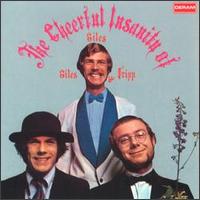
The Cheerful Insanity Of Giles, Giles And Fripp (Giles, Giles and Fripp) - 1968 Deram
A
(Very Good / Good)
All the first three songs not only have amazing hooks, North Meadows has a brilliant
jazzy guitar solo, Newly-Weds is one of the cutest pop tunes I've ever heard and One
In A Million is just delightful beyond all words. Oh that silly little bass line, oh
those flute flourish (or whatever they are). And it hardly gets worse from there.
Nearly every sone offers something interesting, my favourites (beyond the first
three) would have to be Elephant Song, with that ultra-cool jazzy brass riff (cool
in a way only jazzy brass riffs can be) and hilarious lyrics (what do these guys
have against fat people by the way?) and Suite No. 1 where young Fripp just really
shines. And the moody mid-section is no slouch either.

In The Court Of The Crimson King - 1969 EG
D
(Great / Very Good)
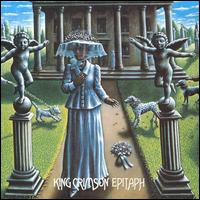
Epitaph - 1997 DGM
A
(Very Good / Good)
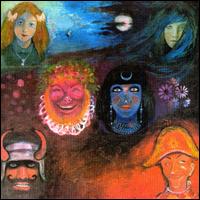
In The Wake Of Poseidon - 1970 EG
C
(Very Good / Great)
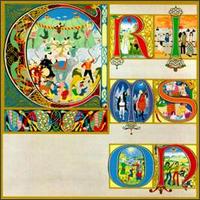
Lizard - 1970 EG
4
(Bad / Mediocre)
After listening to 'Lizard' and 'Islands' back to back (if anyone can),
you get the feeling of a somewhat Beatles influence kind of gone wrong.
But both albums are very creative because I have never really heard
anything like these albums ever again and that might be a good thing who
knows. Still, not bad albums but I wouldn't recommend them.
Cirkus, what about Fripp's acoustic guitar fills in the sung-verses?
And Mel Collins's solo breaks sounding so chilled out he must be in a
different room to the rest of the band?
Indoor Games, is this synth really any dumber than the "musical fart"
synths that crop up all over Selling England By The Pound? FACT:
Haskell's (VCS3-treated) laughter at the end seems to be edited
together from two incidents: Sinfield mooning at the band through a
window, and Haskell becoming disgusted with the closing lyrics.
Happy Family, you guessed it: I love this! Including the VCS£'d
vocals. The mid-song jam bursting with detail: the truly
evil-sounding trombone and flute are first things you notice, but
what about the drumming, Tippett's electric piano or Fripp's
all-over-the-place guitar chording? FACT: the lyrics are about the
Beatles' breakup (in case you didn't know).
The Lizard Suite, even if you don't like it you ought to at least
note the admirable contributions from Robin Miller with his
double-reeds, Tippett with his acoustic and electric pianos and not
forgetting the Evans/Collins/Fripp exchanges in the battle scene
which are even sicker than those in Happy Family.
It's a tough world out there - be prepared
Don't get caught up in the past, but don't worry too much about the
future
It's okay not to be a vegetarian
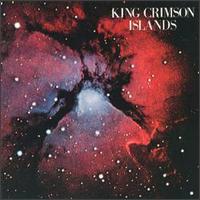
Islands - 1971 EG
7
(Mediocre / Good)
The band returned for an encore, they started to play a very sleazy
typically American Hoochie Coochie Man- type vamp. On top of this Boz sang
a couple of verses of In The Court, and after that it all veered off into a
free jazz jam! This is one of the funniest musical jokes I've ever heard.
This gig was released through the on-line collectors' club of King Crimson.
Oh, I give the album a twelve. Really.

Ladies Of The Road - 2002 DGM
A
(Very Good / Good)
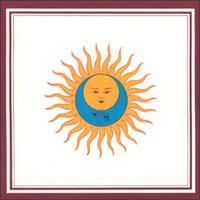
Larks' Tongues In Aspic - 1973 EG
D
(Great / Very Good)
I agree with the above commentator: This is also my favorite KC album.
I like it so much, if fact, that at this point in my life I would
almost certainly give it a perfect score. I know you obviously
disagree, but I think it's both the best album of 1973 (yes, better
than Dark Side of the Moon, Quadrophenia, and Selling England by the
Pound) and the best prog album of all time. I think I prefer it over
Red (which is admittedly a pretty close second in the Crimson catalog)
do to its more diverse sound. Really, I've never heard another album
that sounds remotely like this. The combination of David Cross's
strings and Jamie Muir's weirdass-ness along with the amazing chops of
Wetton, Bruford, and Fripp just could not be duplicated. Also, I think
that instrument which introduces the album is a kalimba (also known as
an mbira or "thumb piano"), though it doesn't credit anyone as playing
one in the CD booklet. Unless I'm mistaken (I've read the tiny
instrument credit page twice), no one is credited with a marimba
either, so who knows. Great review.
Anyway it's a well balanced album, greatly composed and brilliantly played,
I just happen to like best the other 3 (I count even USA). The title track
which opens and ends the album is very very good. Part one has a great
atmosphere, very dark and eerie, combining fast parts with creepy ones, and
part two, my favourite, is fast, captivating and aggressive.
"The Talking Drum" is the only song I'm not that fond of. The ideas are
good, the playing is excellent, but I think it goes on for too long, and if
I'm not in the right mood it might even annoy me!
As for the sung songs: "Book of Saturday" is very cute, with beautiful vocal
harmonies, and good guitar lines (some of it even taped backwards), the
dramatic "Exiles" is better when played live, but the studio version is
great as well because it has that great acoustic guitar that is not on any
live version, and "Easy Money" is an excellent composition, highlited by an
inspired jam in the middle.
Talking about the band:p>
John Wetton is the best singer the band has ever had in my opinion (and
possibly my favourite singer... no not my favourite artist, that one is
Frank Zappa): sometimes it's difficult to fully undestand what he's singing,
but his voice is so powerful and his singing so great that we can forgive
him. And as you say, his bass playing is superb. His bass sounds so rude,
powerful and violent. Levin is probably the best bass player KC had in terms
of musicianship, but he's the one I like the best.
Rating: 8/10
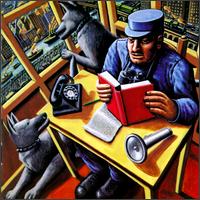
The Night Watch - 1997 DGM
B
(Very Good)
Starless And Bible Black - 1974 EG
A
(Very Good / Good)
The Mincer's main ingredients are extracted from the same lengthy
improvisation which also supplied those (wonderful!) Maximum Distress
tracks on the Great Deceiver album.
"Fracture" is the only instrumental track that was composed, and I think
it's very good and not overlong (maybe only a part approx near the 7:00
mark). The riffs are excellent, Fripp plays like there is no tomorrow (he
said this is the most difficult track he has ever wrote) and the rythm
sections shines as always. I love it!
As for the sung songs, apart from the already mentioned "The Mincer" (btw,
trivial note, I called my bass Mincer thanks to this number ;-) ), there is
the menacing "The Great Deceiver" with Cross' excellent violin in display,
the multipart "Lament" which is one of my favourite songs from the era
(another opinion that doesn't seem to be shared by many people), expecially
the agressive part and the beatiful "The Night Watch", with Wetton's
incredibly great vocals well supported by an inventive and moving guitar by
Fripp.
Rating: 8,5/10
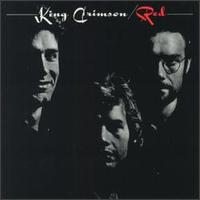
Red - 1974 EG
E
(Great)
Reasons:
Rating: 10/10
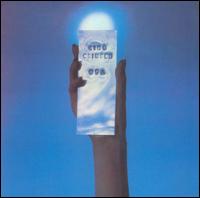
USA - 1975 EG
A
(Very Good / Good)
It does contain overdubs, so it isn't really a 100% live album... but the
overdubs were made by Eddie Jobson! The great Eddie Jobson! Boy, do I love
that guy?! Anyway, if you wish to hear the complete un-overdubbed concert,
it was released by the dynamic Fripp as a 2 CD release together with a
concert in Germany.
As for this live album: "Larks' Tongues in Aspic part II" and "21st Century
Schizoid Man" cook as always, "Exiles" is better than the studio and "Easy
Money" is a good (and quite unusual) version. You may be bothered by the
fade out, as I was. But having listened to the complete concert, I'd say it
was a good idea; the band got pretty uninspired after that and didn't even
reprised the last verse. As for the two bonus tracks: "Fracture" has had
better days and "Starless" is not as good as the studio version, but they
are not a bad addition.
Rating: 7.5/10
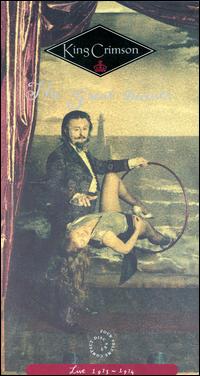
The Great Deceiver - 1992 Caroline
B
(Very Good)
Now - opinions.
Re: improvisations. You have a lower tolerance for this sort of
thing than me, I know, but I really would give Voyage To The Center
another listen. And the genuinely scary Some More Pussyfooting
(definitely no relation to the Fripp & Eno piece: if they wanted to
give it a descriptively self-referential name, how about Another
Sailor's Tale, Concerning A Moonchild Who Survived The Devil's
Triangle). And, finally, there's the incredible Cross-dominated
performance Clueless And Slightly Slack - arguably the
violinist's finest recorded moment with the band.
Re: the rowdy audiences. This is to be expected in Glasgow (goddam
those idiots chanting for Schizoid while Fripp is trying to play
Peace) - but Toronto? Can you believe this - people saying things
like "hey Fripp, where you goin'?" and requesting tunes they know
they'll never hear ("In the Court...", "Cirkus" and even "Hocus
Pocus" ?!) I have a bootleg of that show where you can hear the
idiots shouting all sorts of nonsense in Fripp's direction,
requesting more unlikely tunes ("Tarkus"!)...and one person who
thinks he's being clever tries to show how much of a fan he is by
asking for a song called "driver of the underground train" (he
should've come to the Pittsburgh gig). Oddly (given the
sleevenotes), on the bootleg Fripp never calls anyone an "insensitive
c***t" though I wouldn't have blamed it if he did).
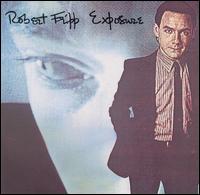
Exposure (Robert Fripp) - 1979 EG
C
(Very Good / Great)
Discipline - 1981 EG
D
(Great / Very Good)
All the exciting parts of Elephant Talk are played by Belew
(including the improvised solo: Fripp plays the written one). Thela
Hun Ginjeet isn't about the arrest but the incident that preceded it:
Belew was trying to record a work-in-progress spoken lyric out in the
street (to get the right atmosphere), but he was surrounded and
intmidated by a street gang, who accused him of being an undercover
cop. After the confrontation with the gang, he then found himself
being held up by the cops, who (probably) thought he was a
terrorist. (He wouldn't get away with making an outdoor tape
recording like that nowadays!)
On a bootleg I have, an audience member points out that Matte Kudasai
sounds like Albatross by Fleetwood Mac, and I wouldn't discount the
possibility that Fripp had that in mind.

Beat - 1982 EG
8
(Good / Mediocre)
Three Of A Perfect Pair - 1984 EG
B
(Very Good)
*Absent Lovers - 1997 EG*
E
(Great)

THRAK - 1995 Virgin
8
(Good / Mediocre)

B'BOOM - 1995 Virgin
9
(Good)
VROOOM VROOOM - 2001 DGM
B
(Very Good)
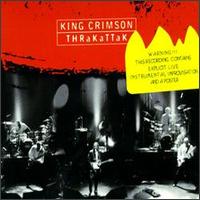
THRaKaTTaK - 1996 DGM
2
(Horrible)

The ConstruKction Of Light - 2000 Virgin
8
(Good / Mediocre)

Heavy ConstruKction - 2000 DGM
B
(Very Good)
Happy With What You Have To Be Happy With - 2002 Sanctuary
8
(Good / Mediocre)
The Power To Believe - 2003 Sanctuary
C
(Very Good / Great)
EleKtriK - 2003 Sanctuary
8
(Good / Mediocre)

A Scarcity Of Miracles (Jakszyk, Fripp And Collins) - 2011 Discipline Global Mobile
8
(Good / Mediocre)
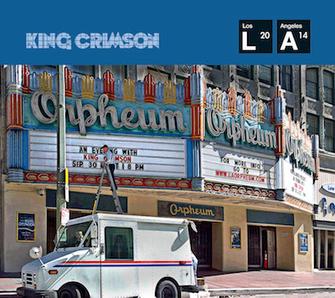
Live At The Orpheum - 2015 Discipline Global Mobile
9
(Good)
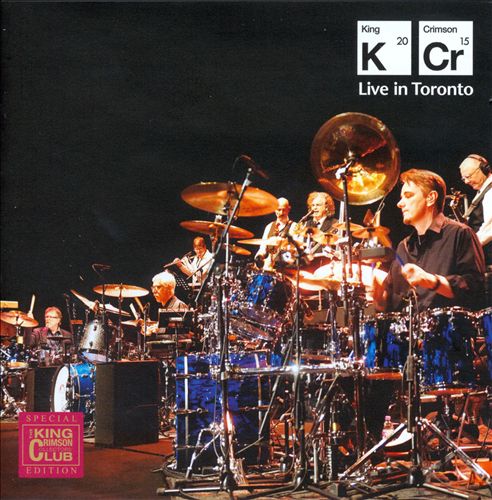
Live In Toronto - 2016 Discipline Global Mobile
B
(Very Good)
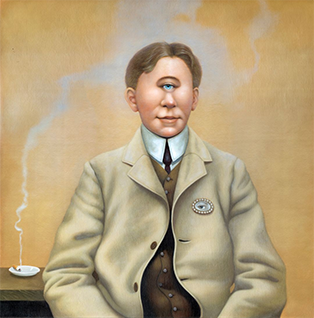
Radical Action To Unseat The Hold Of Monkey Mind - 2016 Discipline Global Mobile
C
(Very Good / Great)
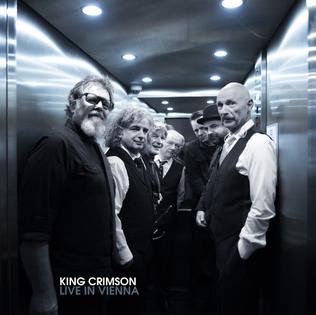
Live In Vienna - 2018 Discipline Global Mobile
B
(Very Good)
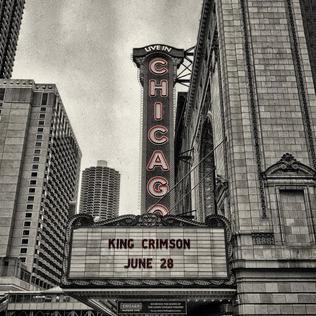
Live In Chicago - 2017 Discipline Global Mobile
D
(Great / Very Good)